
Moresnet: the neutral territory between Belgium and Germany (1816–1920)
Neutral Moresnet was a tiny neutral territory between Belgium and Germany (near the Vaalserberg) created after 1815. It is notable for its zinc industry, multilingual population and unusual joint administration.
Overview
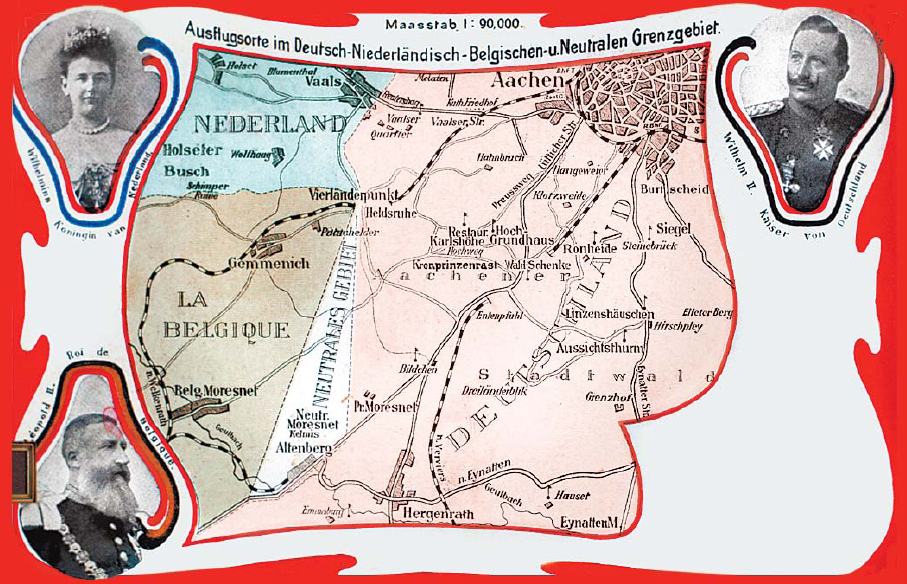
Neutral Moresnet was a compact, internationally neutral enclave created in 1816 after the Napoleonic wars to settle a border dispute. With an area of about 3.5 km², it lay west of Aachen (Aix-la-Chapelle) and close to the tripoint where the borders of present-day Germany, Belgium and the Netherlands meet at the Vaalserberg. Its small size and special status made it a well-known nineteenth‑century curiosity in European border history. For contemporary reference and archival material see relevant documents.
Image gallery
5 Images


Geography and population
Moresnet consisted mainly of the village of Kelmis (also called La Calamine) and surrounding land. The population was linguistically mixed—German dialects, French and Dutch were spoken—reflecting its location between Germanic and Romance regions. The settlement lay roughly 7 km southwest of Aachen and was geographically notable for its mineral-rich ground, which shaped its economy; further regional maps and context are available at regional map.
Governance and daily life
The territory had an unusual form of joint sovereignty. Instead of belonging to a single state, it was administered through a condominium arrangement: representatives of the neighboring powers exercised authority while a local municipal structure handled everyday affairs. Residents paid taxes and followed local ordinances; civil matters were managed by local officials while foreign policy and high-level jurisdiction remained the concern of the two controlling states. A concise administrative summary can be found at administrative account.
Economy and industry
The local economy centered on zinc mining and smelting. Rich zinc deposits attracted investment and industry, which in turn drew workers from different linguistic backgrounds and helped sustain the enclave's population. Mining activities gave the town economic importance beyond its size and are a key reason neighboring states disputed control. For industry-focused references see industry overview.
History and fate
Neutral Moresnet was created at the Congress of Vienna as a compromise to avoid a permanent clash over mineral rights. After Belgian independence in 1830, Belgium took the place of the former Dutch role in the condominium. The unusual arrangement continued until the aftermath of World War I, when the Treaty of Versailles reassigned the territory to Belgium; its formal integration into Belgium was completed shortly after the treaty. For diplomatic and treaty information consult treaty sources and postwar reports.
Legacy and notable facts
Although small, Moresnet is often cited in discussions of microstates and border anomalies. It attracted attention not only for its joint administration and mining economy but also for cultural experiments: linguistic pluralism and local initiatives to define a unique civic identity. Today the history of the enclave appears in local museums and scholarly studies; additional materials and visitor information are listed at visitor resources.
- Size: about 3.5 km².
- Period: created 1816; transferred after World War I (Treaty of Versailles).
- Key settlement: Kelmis / La Calamine.
Questions and answers
Q: What was Moresnet?
A: Moresnet, also known as Neutral Moresnet, was a very small territory that existed from 1816 to 1919. It had a size of 3.5 km².
Q: Why did it exist?
A: It existed because its neighbours could not agree on who should own it, so they decided to make it a neutral territory where both neighbours would both have power.
Q: Where was it located?
A: It was 7 km Southwest of Aix-la-Chapelle (Germany), and south of the points were the borders of Germany, Belgium and the Netherlands come together on the Vaalserberg.
Q: Who were the inhabitants?
A: The Inhabitants were Germans, Flemish, Walloons and Dutchs.
Q: How big was Moresnet?
A: Moresnet had a size of 3.5 km².
Q: When did Moresnet exist?
A: Moresnet existed from 1816 to 1919.
Q: What type of power did each neighbour have in regards to Moresnet?
A: Each neighbour had equal power in regards to Moresnet as it was made into a neutral territory where both neighbours would both have power.
Related articles
Author
AlegsaOnline.com Moresnet: the neutral territory between Belgium and Germany (1816–1920) Leandro Alegsa
URL: https://en.alegsaonline.com/art/66662