
Moons of Haumea
Hiʻiaka and Namaka are two icy moons of the dwarf planet Haumea, discovered in 2005. They formed from a collisional event and offer clues to Haumea's composition, history and orbital dynamics.
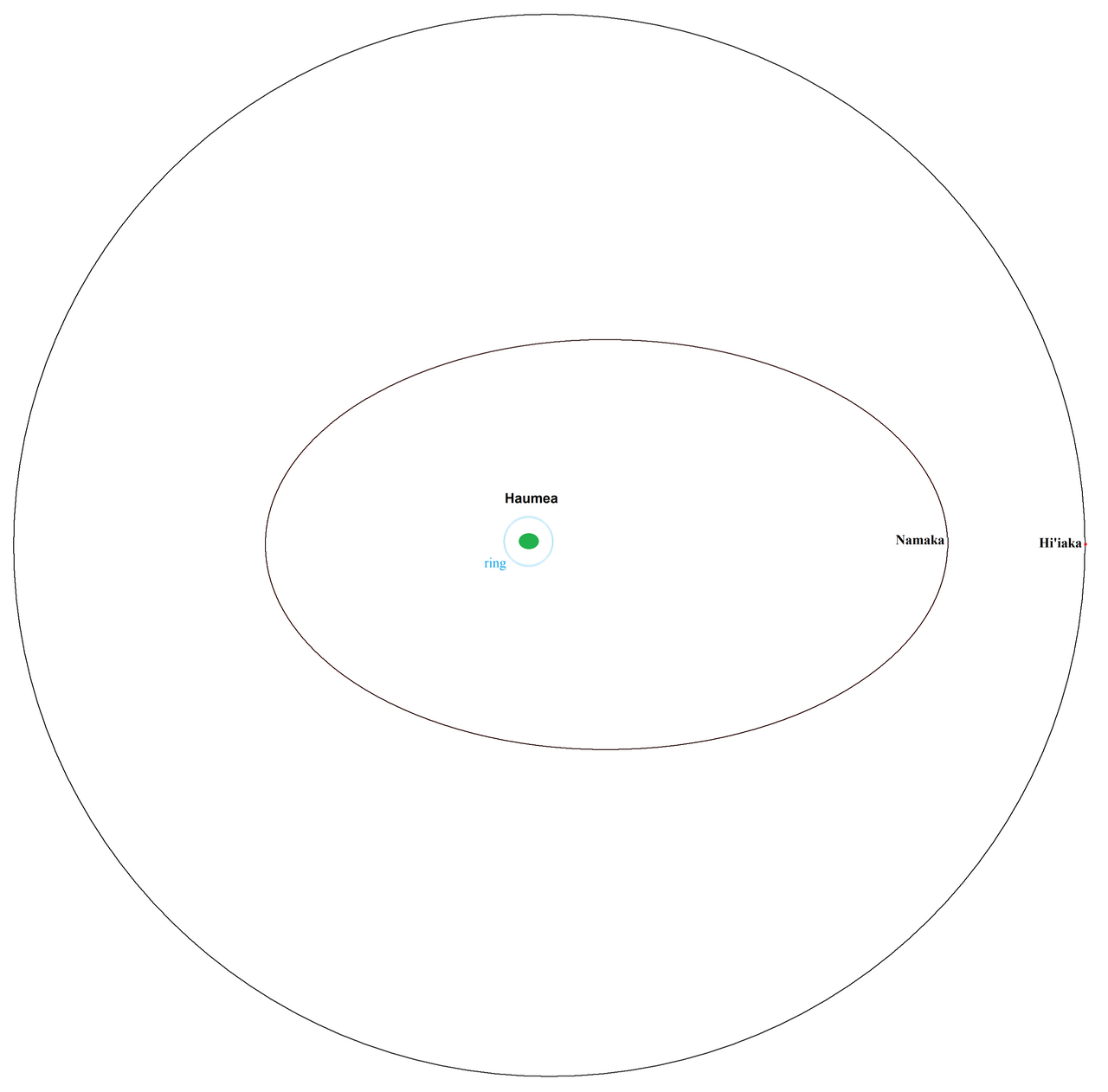
Haumea hosts two confirmed natural satellites that orbit this elongated dwarf planet in the Kuiper belt. Discovered in 2005, the moons Hiʻiaka and Namaka are small, icy bodies whose composition and motions preserve evidence of Haumea's violent past and internal structure. Their bright surfaces and mutual interactions make them important targets for telescopic study. Haumea sits at the center of this miniature system.
Image gallery
9 Images



Discovery and naming
Both moons were first detected in 2005 using large telescopes capable of resolving faint companions around distant objects. The larger satellite, Hiʻiaka, was identified on 26 January 2005, and the smaller companion, Namaka, on 30 June 2005. Early informal nicknames included "Rudolph" and "Blitzen" while follow-up observations confirmed their orbits. The International Astronomical Union approved the official names in 2008, drawing from Hawaiian mythology. Ground-based observatories such as Keck and space telescopes subsequently refined the measurements of their orbits and appearance.
Physical characteristics
Hiʻiaka is the brighter and more massive of the two, with surface spectra dominated by water-ice signatures and evidence of crystalline ice. Namaka is substantially smaller and fainter, and appears less massive despite sometimes showing larger orbital eccentricity and inclination. Both moons are modest in size compared with large planetary satellites: Hiʻiaka spans on the order of a few hundred kilometres, while Namaka is considerably smaller. The high abundance of water ice on both surfaces is consistent with material derived from Haumea's outer icy layers. Hiʻiaka and Namaka therefore contrast with many darker, more carbon-rich Kuiper belt objects.
Origin and orbital dynamics
Evidence suggests the two moons formed from debris produced by a giant impact early in the history of the outer Solar System. That collision is also thought to have produced a family of related Kuiper belt objects that share similar orbital elements and icy surfaces. The moons' orbital behaviour is dynamically interesting: Namaka's orbit is noticeably perturbed by the larger Hiʻiaka, producing changes in eccentricity and inclination that point to past resonant interactions and tidal evolution. Studying these interactions helps reconstruct the collisional and tidal history of the Haumea system.
Scientific significance and observations
- Mass and density estimates for Haumea rely on satellite orbits to determine the system's total mass.
- The composition of the moons supports the hypothesis that Haumea lost an ice-rich outer layer in a major impact.
- The pair provides a natural laboratory for studying satellite formation, orbital resonances and tidal processes in the Kuiper belt.
Ongoing observations from large ground-based telescopes and instruments such as the Hubble Space Telescope refine orbital models, spectroscopic analyses, and size estimates. Beyond their scientific value, the names reflect Hawaiian cultural connections: Haumea is a deity associated with fertility and childbirth in traditional lore, and the moon names derive from that same mythology. Hawaiian mythology and continued study of Haumea help place these small moons in both scientific and cultural context.
Questions and answers
Q: What are the names of the two moons of the dwarf planet Haumea?
A: The two moons of the dwarf planet Haumea are named Hi'iaka and Namaka.
Q: What are Hi'iaka and Namaka named after?
A: Hi'iaka and Namaka are named after the daughters of the Hawaiian goddess of fertility and childbirth, Haumea.
Q: When were Hi'iaka and Namaka discovered?
A: Hi'iaka was discovered on 26 January, 2005, and Namaka was discovered on 30 June, 2005.
Q: What did something crashing into Haumea billions of years ago cause?
A: Something crashing into Haumea billions of years ago caused the planet to break apart its layer of ice, which eventually formed its two moons, Hi'iaka and Namaka.
Q: Which of the two moons is larger and farther away from Haumea?
A: Hi'iaka is larger and farther away from Haumea than Namaka.
Q: What is the size difference between Hi'iaka and Namaka?
A: Hi'iaka is about 350 km (220 mi) in diameter, while Namaka is only one-tenth the size.
Q: What were the nicknames given to Hi'iaka and Namaka before they were given their official names by the International Astronomical Union?
A: Hi'iaka was nicknamed "Rudolph the Red Nosed Reindeer," and Namaka was nicknamed "Blitzen the Reindeer."
Related articles
Author
AlegsaOnline.com Moons of Haumea Leandro Alegsa
URL: https://en.alegsaonline.com/art/66546
Sources
- books.google.com : Handbook of Polynesian Mythology
- web.gps.caltech.edu : "Satellites of the largest Kuiper belt objects"
- arxiv.org : astro-ph/0510029
- ui.adsabs.harvard.edu : 2006ApJ...639L..43B
- doi.org : 10.1086/501524
- abstractsonline.com : "Orbits and Masses of the 2003 EL61 Satellite System"
- journals.uchicago.edu : "Keck Observatory Laser Guide Star Adaptive Optics Discovery and Characterization of a Satellite to the Large Kuiper Belt Object 2003 EL61"
- ui.adsabs.harvard.edu : 2005ApJ...632L..45B
- doi.org : 10.1086/497641
- nytimes.com : "Piecing Together the Clues of an Old Collision, Iceball by Iceball"
- iau.org : "News Release - IAU0807: IAU names fifth dwarf planet Haumea"