
Miranda v. Arizona and the Miranda Warning: history, rules, and significance
Overview of Miranda v. Arizona (1966), the required Miranda warning, its legal effects, limits, and practical importance in U.S. criminal procedure.
Miranda v. Arizona is a foundational United States Supreme Court decision, issued in 1966, that reshaped how custodial interrogations are conducted. The Court held that when a person is taken into police custody and subjected to questioning, the procedural safeguards of the Fifth Amendment require that the suspect be informed of certain rights before interrogation begins. Those protections, commonly known as the Miranda warnings or simply Miranda, were intended to protect against compelled self-incrimination and to ensure that any waiver of rights be knowing and voluntary.
Image gallery
3 Images

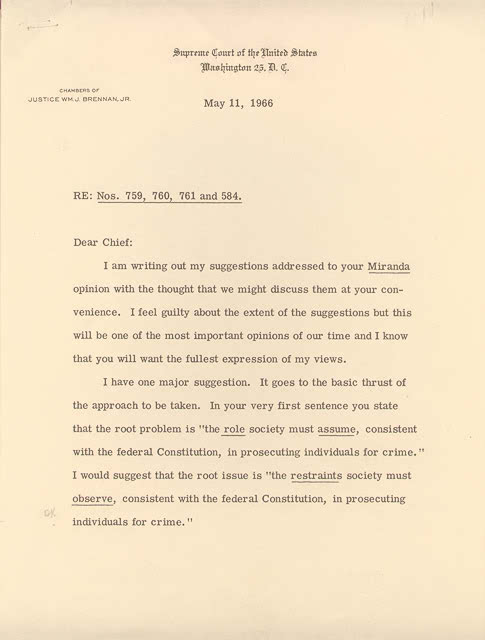
Background and the Supreme Court ruling
The decision arose from consolidated cases involving suspects who had confessed after interrogations without being advised of their constitutional rights. The opinion explained that without clear warnings, the coercive atmosphere of custodial questioning can undermine the voluntariness of statements. The ruling is often cited by its case name and reporter citation; it remains a touchstone in discussions of police procedure and criminal justice reform. For the original opinion and historical context see primary sources and summaries provided by legal scholars at landmark case resources and the Supreme Court archives.
The Miranda warnings
Although the Court did not mandate a single fixed script, it identified the essential information that must be communicated so a suspect can make an informed decision about whether to speak. Typical elements of the warning include:
- The right to remain silent: the suspect is told they need not answer questions.
- Anything said can be used in court: communications made during interrogation may be introduced as evidence.
- The right to an attorney: the suspect may consult with a lawyer before and during questioning.
- Appointment of counsel: if the suspect cannot afford an attorney, one will be provided at no cost.
Police often use a standard warning card or recorded statement to ensure the suspect understands these points. Law enforcement agencies and courts evaluate whether a suspect's waiver of those rights was made voluntarily, knowingly, and intelligently. For guidance on how rights are explained and recorded in practice, see resources on custody and interrogation procedure at resources for suspects and law enforcement manuals at police procedure guides.
The requirement applies only when both custody and interrogation are present. If a person is not in custody or is not being interrogated, Miranda warnings are typically not required. There are recognized exceptions and limits: for instance, certain public-safety concerns or spontaneous volunteered statements may be admissible even without prior warnings. Courts have also refined how waivers and invocations of the right to counsel or the right to remain silent must be handled.
Miranda did not create substantive immunity from prosecution; rather, it created procedural protections designed to safeguard the Fifth Amendment privilege. Over time the decision has generated extensive litigation about its scope, the meaning of a valid waiver, and the consequences of a failure to warn. Practically, Miranda prompts law enforcement to balance effective investigation with constitutional protections and has influenced the use of recorded interviews and clearer documentation of warnings and waivers. For practical information on asserting or invoking rights, see materials addressing counseling and courtroom use at legal assistance.
Today the term "Mirandize" has entered common legal and policing vocabulary as shorthand for giving the required warnings. While the exact language used varies by jurisdiction, the underlying principle remains: suspects in custody must be informed of their rights and any valid waiver must be the product of a free and informed choice.
Questions and answers
Q: What is Miranda v. Arizona?
A: Miranda v. Arizona was a landmark decision of the United States Supreme Court that ruled that a suspect in police custody must be informed of the right to consult with an attorney before and during questioning.
Q: What must a suspect in police custody be informed of?
A: A suspect in police custody must be informed of the right to consult with an attorney before and during questioning, the right against self-incrimination, and they must also make certain that the suspect understands these rights.
Q: What is the Miranda warning?
A: The Miranda warning is the name of the formal warning that is required to be given by police in the United States to criminal suspects.
Q: What is the purpose of the Miranda warning?
A: The purpose of the Miranda warning is to ensure that the accused are aware of their rights under the U.S. Constitution and that they know they can invoke them at any time during the interview.
Q: When must the Miranda warning be given?
A: The Miranda warning must be given before a suspect is interrogated in accordance with the Miranda ruling.
Q: What is the significance of the Miranda ruling?
A: The Miranda ruling is significant because it protects individuals' Fifth Amendment rights against self-incrimination and Sixth Amendment rights to counsel.
Q: What is the meaning of the term "Mirandizing" a suspect?
A: The term "Mirandizing" a suspect refers to the process of reading the Miranda warning to a criminal suspect.
Related articles
Author
AlegsaOnline.com Miranda v. Arizona and the Miranda Warning: history, rules, and significance Leandro Alegsa
URL: https://en.alegsaonline.com/art/65363