
Mir Castle Complex
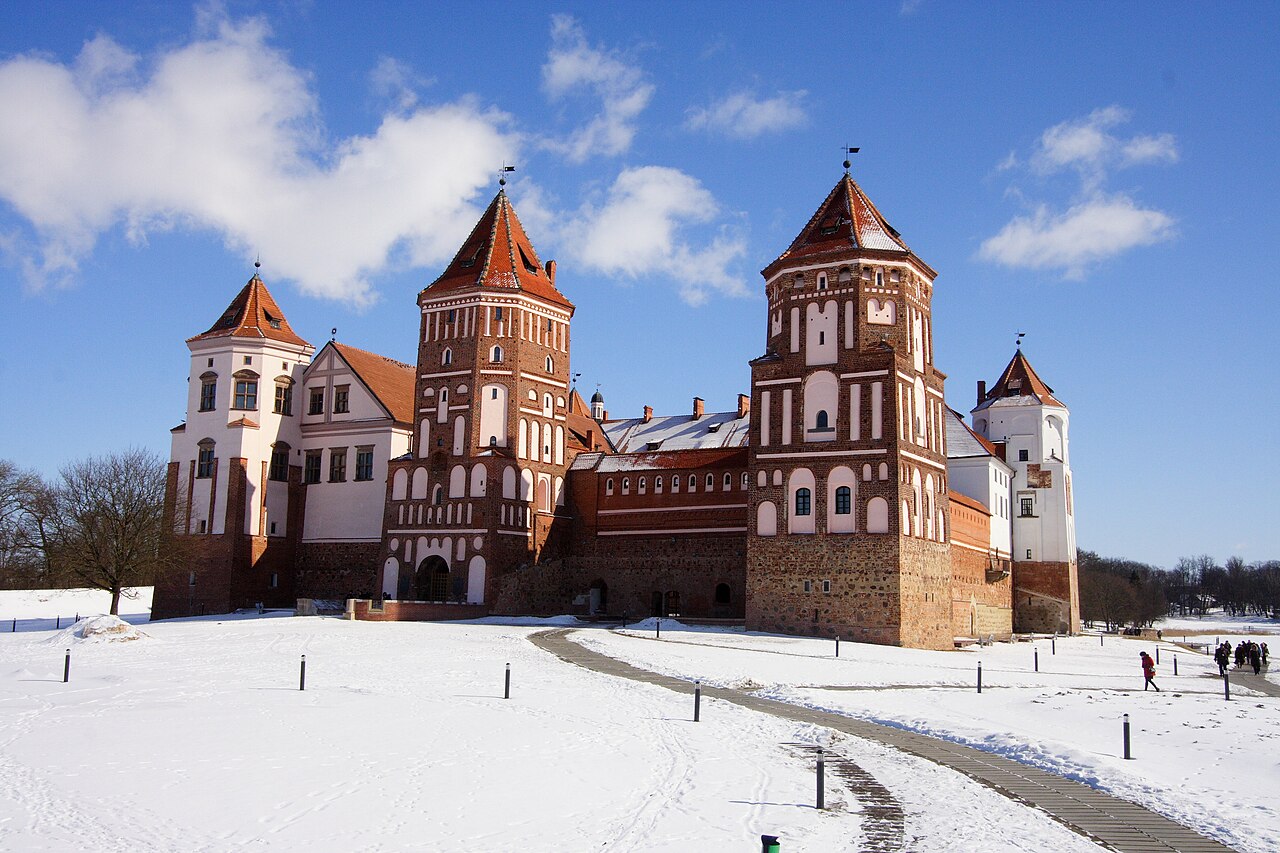
A fortified manor in the town of Mir, Belarus — a late Gothic and Renaissance castle complex notable for its architecture, layered history from the 15th century onward, and UNESCO World Heritage status.
Overview
The Mir Castle Complex stands in the small town of Mir in western Belarus. Built as a defensive residence and later expanded into a stately palace, the ensemble combines late Gothic fortress motifs with later Renaissance additions. The site is known under several local names, including the Belarusian, Lithuanian and Polish forms that reflect the region's multiethnic history. In 2000 it was inscribed on the UNESCO World Heritage List as an outstanding example of a fortified noble residence (UNESCO), which recognised both its architecture and its historic role in the Grand Duchy of Lithuania and later states (inscription).
Image gallery
10 Images




Architecture and layout
The complex surrounds a roughly rectangular courtyard and originally functioned as a fortification as well as a noble household. The main features include massive defensive towers and curtain walls in late Gothic forms. During the 16th century a three-storey residential palace was erected along the eastern and northern inner walls, introducing Renaissance proportions, windows and decorative detail. The building sequence therefore presents a visible transition from a military stronghold to a representative aristocratic estate. Notable elements are the semicircular and polygonal towers, vaulted interiors, and a mixture of brick and stone masonry that illustrates building practices of the period.
History and development
Construction began at the end of the 15th century and the initial fortress was substantially complete by the early 16th century under local feudal lords (early construction). In the mid-16th century the property came into the possession of members of the Radziwiłł family. Mikołaj Krzysztof Radziwiłł, known as "the Orphan," completed major Renaissance-style modifications and added the three-storey palace block (Renaissance phase). Over the following centuries ownership changed through inheritance and sale, including transfer to members of German princely houses and, by the late 19th century, to the Sviatopolk-Mirski family.
- Late 15th–early 16th century: fortress construction and initial completion.
- Mid-16th century: Renaissance alterations and palace addition.
- 19th century: restoration and refurbishment after long periods of neglect and damage.
- 20th century: wartime occupation and postwar adaptation for housing; later conservation.
20th-century events and conservation
The castle experienced neglect and serious damage at various times, including during the Napoleonic campaigns of the early 19th century (Napoleonic period). By the late 19th century new owners carried out restoration that shaped much of the present exterior. In the 20th century the estate suffered again: during World War II it fell under Nazi control and the site was associated with the tragic history of the local Jewish community. After the war parts of the complex were adapted for housing and administrative use, which harmed some interior fabric. From the late Soviet period onward, professional conservation and archaeological study led to more careful restoration and the establishment of a museum on site.
Importance, uses and visiting
Today Mir Castle is both a cultural monument and a public museum that interprets the building's architecture, the lives of its noble owners, and the wider social history of the region. Visitors can see the defensive towers, palace rooms, and exhibition displays documenting restoration work and archaeological finds. The complex is often used for cultural events, temporary exhibitions and guided tours that explain its layered past. Practical information for visitors is available from regional tourism resources and the site's managing institution (local name) and (UNESCO) listings provide further context.
Notable distinctions
Mir Castle is significant for demonstrating the evolution of a late medieval noble residence into a Renaissance palace without losing its fortress character. Its inclusion on the World Heritage List recognises this combination of architectural values and historic continuity dating back to the Grand Duchy period. Ongoing conservation work aims to protect structural fabric and to present the site as both a documentary resource and a visitor attraction for future generations (Lithuanian reference) (Polish reference).
For additional background, archival records and recent research summaries consult institutional surveys and regional studies held by museums and heritage authorities (construction sources) (stylistic studies) (conflict-era reports) (UNESCO dossier).
Questions and answers
Q: What is the Mir Castle Complex?
A: The Mir Castle Complex is a UNESCO World Heritage site located in the town of Mir, Belarus. It was built at the end of the 15th century and completed by Duke Ilinich in the early 16th century.
Q: What style of architecture is used for the castle?
A: The Mir Castle Complex was originally built in Gothic architecture style, but later finished by Mikołaj Krzysztof "the Orphan" Radziwiłł in Renaissance style.
Q: Who owned the castle after Dominik Hieronim Radziwiłł's death?
A: After Dominik Hieronim Radziwiłł's death, his daughter Stefania inherited it. She then married Ludwig zu Sayn-Wittgenstein-Berleburg and their daughter Maria married Prince Chlodwig Hohenlohe-Schillingsfürst.
Q: Who restored the castle at the end of 19th century?
A: Nikolai Sviatopolk-Mirski purchased and restored the castle at the end of 19th century according to plans made by architect Teodor Bursze.
Q: How did WWII affect the castle?
A: During WWII, Nazi forces took control of it and turned it into a ghetto for local Jewish population. This caused damage to its interior structure as well as other parts of it during this period.
A: When was Mir Castle listed as a UNESCO World Heritage Site? Q: In December 2000, Mir Castle was listed by UNESCO as a World Heritage Site
Related articles
Author
AlegsaOnline.com Mir Castle Complex Leandro Alegsa
URL: https://en.alegsaonline.com/art/65335