
Minimalism: art, music, design and lifestyle
Minimalism is an aesthetic and cultural approach that emphasizes reduction, clarity, and essential forms across art, music, design, architecture and everyday life.
Overview
Minimalism is an artistic and cultural approach that seeks to reduce elements to their essentials. In practice this means pared-down forms, limited palettes or restricted musical material presented without excess ornament. Minimalism appears in visual art, music, and built environments such as architecture, and the term is also applied more broadly to design, literature and lifestyles.
Image gallery
10 Images



Characteristics
Common features of minimalist works include restraint, repetition, and focus on fundamental materials or motifs rather than narrative or elaborate surface detail. Minimalist pieces may look simple at first glance but often invite extended attention, revealing variation in proportion, texture, rhythm or placement.
- Reduction: removing nonessential elements to highlight a core idea or shape.
- Repetition and seriality: repeating a single unit or gesture to produce subtle change.
- Economy of materials: limited colors, simple forms, or sparse instrumentation.
- Emphasis on presence: attention to how objects occupy space and time.
History and development
As a named tendency, minimalism became prominent in the mid-20th century. It grew from earlier modernist insistence on clarity and truth to materials, and many influential examples emerged in the 1960s and 1970s. While associated with specific postwar movements and cultural centers, the underlying impulse to simplify and refine has roots in much older practices and in parallel strands across cultures.
Applications and examples
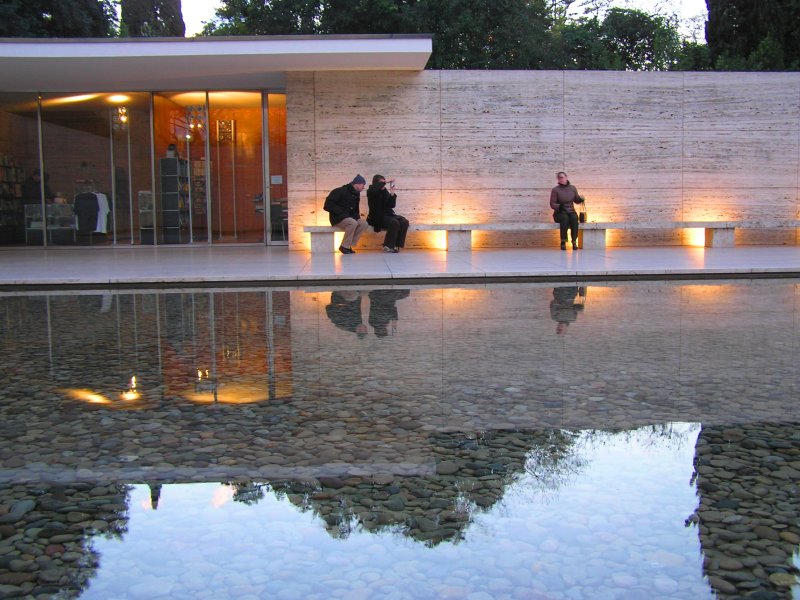
Minimalist ideas inform many fields. In visual art and sculpture, artists use geometric forms and sparse composition; in music, composers work with repeated motifs and gradual change. In design and architecture, minimalism favors open plans, plain surfaces and an economy of detail that emphasizes light, structure and proportion. Outside the arts, the word also describes lifestyle choices that prioritize fewer possessions and clearer priorities.
Distinctions and influence
Minimalism is not simply "plainness" or absence of feeling. Its aim is often to intensify perception by removing distractions. The approach has influenced contemporary graphic design, product design, film language, and digital interfaces, and it continues to be adapted in new contexts where clarity and restraint are valued.
Questions and answers
Q: What is minimalism in art and music?
A: Minimalism in art and music is a way of creating modern forms of expression using simplistic ideas, shapes, and sounds.
Q: When was minimalism most popular in America?
A: Minimalism was most popular in America during the 1960s and 1970s.
Q: What is the technique used in minimalism to make things seem more complex?
A: In minimalism, a simple idea, sound, or shape is repeated many times until it appears to be very complicated.
Q: Apart from art and music, what other areas can minimalism be used to describe?
A: Today, minimalism can also be used to describe design, architecture, poetry, and movies.
Q: What are the different types of minimalism in art and music?
A: There are various types of minimalism in art and music, but they all rely on the use of simple concepts and forms.
Q: Is minimalism still relevant today?
A: Yes, minimalism is still relevant today as it is a powerful means of communicating complex ideas and emotions through simplistic forms.
Q: What makes minimalism an effective tool for expression?
A: Minimalism's effectiveness as a tool for expression lies in its ability to simplify complex ideas, making them easier to understand and appreciate.
Related articles
Author
AlegsaOnline.com Minimalism: art, music, design and lifestyle Leandro Alegsa
URL: https://en.alegsaonline.com/art/65212
Sources
- britannica.com : "Minimalism - art movement"