
Mimosa pudica — the sensitive plant: description, behavior, and uses
Mimosa pudica, the sensitive or touch‑me‑not plant, is a creeping legume known for rapid leaf folding when disturbed; native to the Americas and now pantropical, it is grown ornamentally and studied for plant movement.
Overview
Mimosa pudica is a small creeping herb in the pea family (Fabaceae) commonly called the sensitive plant or touch‑me‑not. It is noted for rapid leaf movement: compound leaves fold and droop in response to touch, vibration or sudden light changes, then reopen after minutes. It belongs to the genus Mimosa (Mimosa) and is treated in many taxonomic and horticultural resources (taxonomic overview).
Image gallery
9 Images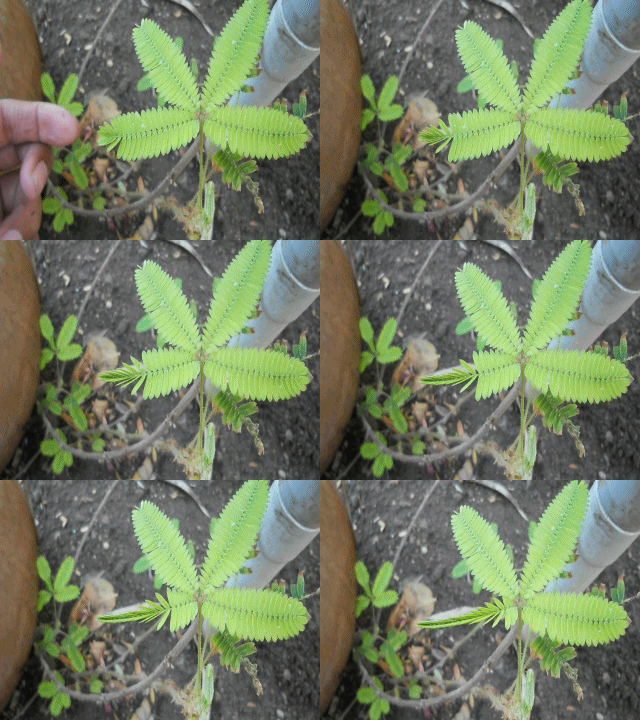



Description and identifying features
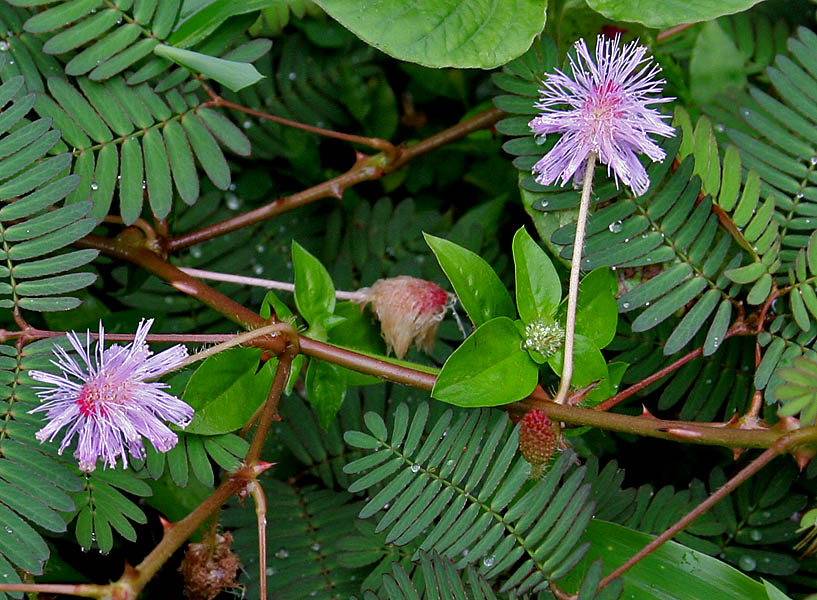
M. pudica typically forms mats or low clumps. Leaves are pinnate with many small leaflets that close together when stimulated. Flowers are small, globular clusters of pink to pale purple threads, followed by narrow, segmented seed pods. It grows as a creeping annual or perennial depending on climate and cultivation (horticulture notes).
Movement and physiology
The folding response is a rapid plant movement (seismonasty/thigmonasty) produced by short‑term loss of turgor pressure in specialized hinge tissues called pulvini. The signal involves ion fluxes and electrical changes that propagate through the plant; researchers study M. pudica to understand plant electrophysiology and rapid movement mechanisms.
Distribution and habitat
Native to tropical regions of South America and Central America, M. pudica has spread widely and now occurs in many warm regions worldwide. It is recorded in floras and databases for South America and Central America, and is often listed among widespread pantropical weeds (weed information).
Uses, cultural notes and management
The plant is popular as an ornamental and educational specimen because of its responsive leaves. In traditional medicine it has been used locally for a range of purposes, though clinical evidence is limited and such uses should be regarded cautiously. Where it becomes abundant, it can interfere with pasture, crop seedlings and native vegetation; management relies on cultivation practices, physical removal and standard weed control methods.
Notable distinctions
- M. pudica is one of several "sensitive" species—other plants also show touch responses, so common names may overlap.
- Its rapid movement makes it a model organism for studies of plant behavior, signaling and rapid nastic movements.
Because it is widespread and easily grown, Mimosa pudica is familiar to gardeners, educators and scientists alike as a striking example of plant responsiveness to the environment.
Questions and answers
Q: What is Mimosa pudica?
A: Mimosa pudica is a species of Mimosa, a creeping herb that is categorized as either an annual or a perennial plant.
Q: What is the curiosity value of Mimosa pudica?
A: Mimosa pudica is often grown for its curiosity value because the compound leaves fold inward and droop when touched or shaken, re-opening minutes later.
Q: Where is Mimosa pudica native to?
A: Mimosa pudica is native to South America and Central America.
Q: Is Mimosa pudica a common weed?
A: Yes, despite being native to South and Central America, Mimosa pudica is now considered a widespread weed.
Q: Does Mimosa pudica have any special properties or uses?
A: While it doesn't have any significant medicinal or commercial uses, Mimosa pudica is often grown for its novelty value, particularly for its unique leaf movements when touched or shaken.
Q: What is the growth habit of Mimosa pudica like?
A: Mimosa pudica is a creeping herb, which means that it grows close to the ground and forms runners that spread outward in all directions.
Q: Can Mimosa pudica be grown as both an annual and a perennial plant?
A: Yes, depending on the growing conditions and climate, Mimosa pudica can be grown as either an annual or a perennial plant.
Related articles
Author
AlegsaOnline.com Mimosa pudica — the sensitive plant: description, behavior, and uses Leandro Alegsa
URL: https://en.alegsaonline.com/art/65126
Sources
- ars-grin.gov : "Mimosa pudica information from NPGS/GRIN"
- fs.fed.us : "Mimosa pudica L."
- doi.org : 10.1111/j.1445-6664.2008.00316.x
- books.google.com : Biology of plants
- lccn.loc.gov : 2004053303
- worldcat.org : 56051064