
MIMO (Multiple Input Multiple Output) — multi‑antenna wireless communications
MIMO uses multiple transmit and receive antennas to boost data rates, reliability and spectral efficiency in Wi‑Fi, cellular and other radio systems by exploiting spatial pathways.
Overview
MIMO, short for Multiple Input Multiple Output, is a family of antenna and signal‑processing techniques used in modern wireless systems. By using multiple transmit and/or receive antennas, MIMO exploits the spatial dimension of radio channels to carry more information, reduce errors, or focus energy. The approach underpins many contemporary standards and devices, improving throughput and link robustness without expanding occupied bandwidth.
Image gallery
5 Images


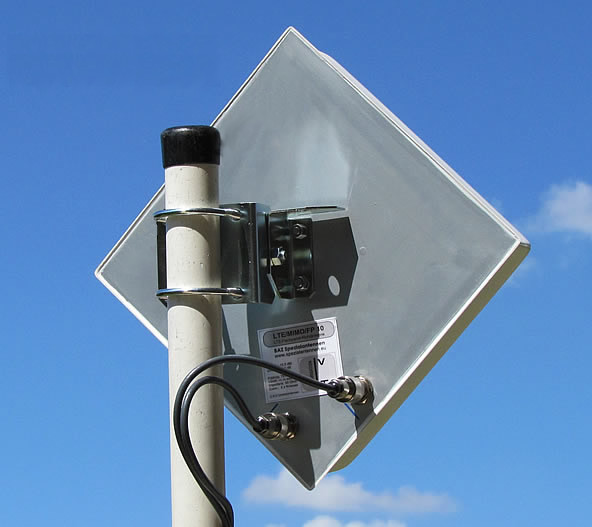
How MIMO works
At its heart MIMO turns what used to be treated as interference or multipath into a resource. With distinct antenna elements and appropriate signal processing, the system can form several parallel data streams or create diversity to protect a single stream. Key concepts include:
- Spatial multiplexing — sending independent data streams on different antennas so a receiver can separate them and thereby increase data rate.
- Diversity — transmitting redundant copies over different antennas or paths to reduce the probability of deep fades and dropouts.
- Beamforming and precoding — shaping the transmitted waveform to direct power toward a receiver or to null interference, often using knowledge of the channel.
- Channel state information (CSI) — estimates of how signals propagate, used to decode streams and to optimize transmission strategies; CSI can be measured at the receiver and fed back, or estimated at the transmitter in certain duplexing modes.
Variants and notable distinctions
MIMO is not a single technique but a set of related methods. Single‑user MIMO (SU‑MIMO) dedicates the antenna array to one device, while multi‑user MIMO (MU‑MIMO) serves several devices simultaneously, akin to multiple teachers helping many students at once. Massive MIMO refers to systems with very large numbers of antennas—typically at base stations—to greatly increase capacity and spectral efficiency. Practical implementations balance complexity, power, and the amount of channel information available.
History and development
The idea of exploiting multiple antennas for spatial multiplexing and diversity emerged in the early 1990s, with influential theoretical work and early patents proposing the use of multiple transmit and receive elements to improve wireless capacity. Since then, advances in digital signal processing, silicon integration, and standards development have moved MIMO from theory to widespread practical use in consumer and infrastructure equipment.
Applications and examples
MIMO is widely deployed across wireless technologies. Consumer products such as routers and smartphones use MIMO to support faster and more reliable connections. Wi‑Fi standards rely on MIMO variants to multiply throughput and serve multiple clients, and cellular systems (LTE, 5G) incorporate MU‑MIMO and massive MIMO to improve network capacity. Beyond communications, MIMO principles appear in radar, sonar, and other multi‑sensor systems where spatial processing can separate signals and suppress interference.
Limitations and practical considerations
MIMO's benefits depend on the propagation environment and system design. Rich scattering helps separate parallel streams, while pure line‑of‑sight conditions may limit spatial multiplexing unless large antenna apertures or special arrangements are used. More antennas mean more hardware and processing overhead, and accurate CSI is often needed for best performance. Regulatory, cost, and power constraints shape how many antennas and what processing are practical for a given product.
Why MIMO matters
MIMO transformed wireless design by adding spatial degrees of freedom: networks can serve more users, deliver higher peak speeds, and maintain links in challenging conditions without consuming extra spectrum. As demand for wireless capacity grows, especially for video, cloud services and IoT, MIMO and its large‑antenna descendants remain central tools for scaling performance.
For further technical introductions and specifications consult resources on wireless standards and RF system design; manufacturers and standards bodies publish implementation details and profiles for different deployment scenarios. See also discussions of antenna arrays, channel estimation, and beamforming algorithms.
Questions and answers
Q: What is MIMO technology?
A: MIMO (Multiple Input, Multiple Output) is a technology that allows an antenna or multiple antennas to communicate with multiple devices, minimizing errors and maximizing efficiency.
Q: What is the commonly used MIMO variant?
A: The most commonly used MIMO variant is MU-MIMO, which stands for Multiple User-Multiple Input, Multiple Output.
Q: How can MU-MIMO technology be compared to a classroom with many students and a single teacher?
A: Imagine a classroom with one teacher and many students who need help. Since there is only one teacher, it will take the teacher a while to fully help all the students. But if there are multiple teachers, students will get help much faster and better. The same way, a router with MU-MIMO technology will be able to communicate with multiple devices with increased speed and minimal errors.
Q: Where are MIMO technologies commonly found?
A: MIMO technologies are commonly found in routers, smartphones, laptops, TVs, etc.
Q: What other technologies besides Wi-Fi use MIMO wireless technology?
A: Besides Wi-Fi, LTE (Long Term Evolution) and many other radio, wireless and RF technologies are using the new MIMO wireless technology to provide increased link capacity and spectral efficiency combined with improved link reliability using what were previously seen as interference paths.
Q: Who was the first to propose the use of spatial multiplexing using MIMO?
A: Two researchers, Arogyaswami Paulraj and Thomas Kailath, were the first to propose the use of spatial multiplexing using MIMO in 1993 and in the following year their US patent was granted.
Q: What is the advantage of MIMO compared to other technologies?
A: MIMO has the advantage of being able to communicate with multiple devices simultaneously with minimal errors and increased speed.
Related articles
Author
AlegsaOnline.com MIMO (Multiple Input Multiple Output) — multi‑antenna wireless communications Leandro Alegsa
URL: https://en.alegsaonline.com/art/65125