
Middle Low German
Medieval West Germanic vernacular spoken in northern Germany and around the Baltic; lingua franca of Hanseatic commerce, influential on Scandinavian languages and preserved in legal and literary texts.
Overview
Middle Low German was the principal West Germanic vernacular of northern Germany and adjacent coastal regions in the High and Late Middle Ages. It developed from Old Saxon and became widely used from roughly the 12th to the 16th centuries in both spoken and written forms. As a regional literary and administrative language it served towns, merchants and courts, and functioned as a practical lingua franca across the Baltic and North Sea littoral.
Image gallery
5 Images


Characteristics
Linguistically, Middle Low German belongs to the Low German branch and therefore did not participate in the High German consonant shift that distinguishes High German varieties. Its grammar retained many conservative West Germanic features while showing innovations typical of medieval vernaculars: simplification of inflectional endings, a developing vocabulary for trade and maritime life, and a written tradition using a regional orthography. Dialectal variation existed across coastal, urban and rural areas.
History and spread
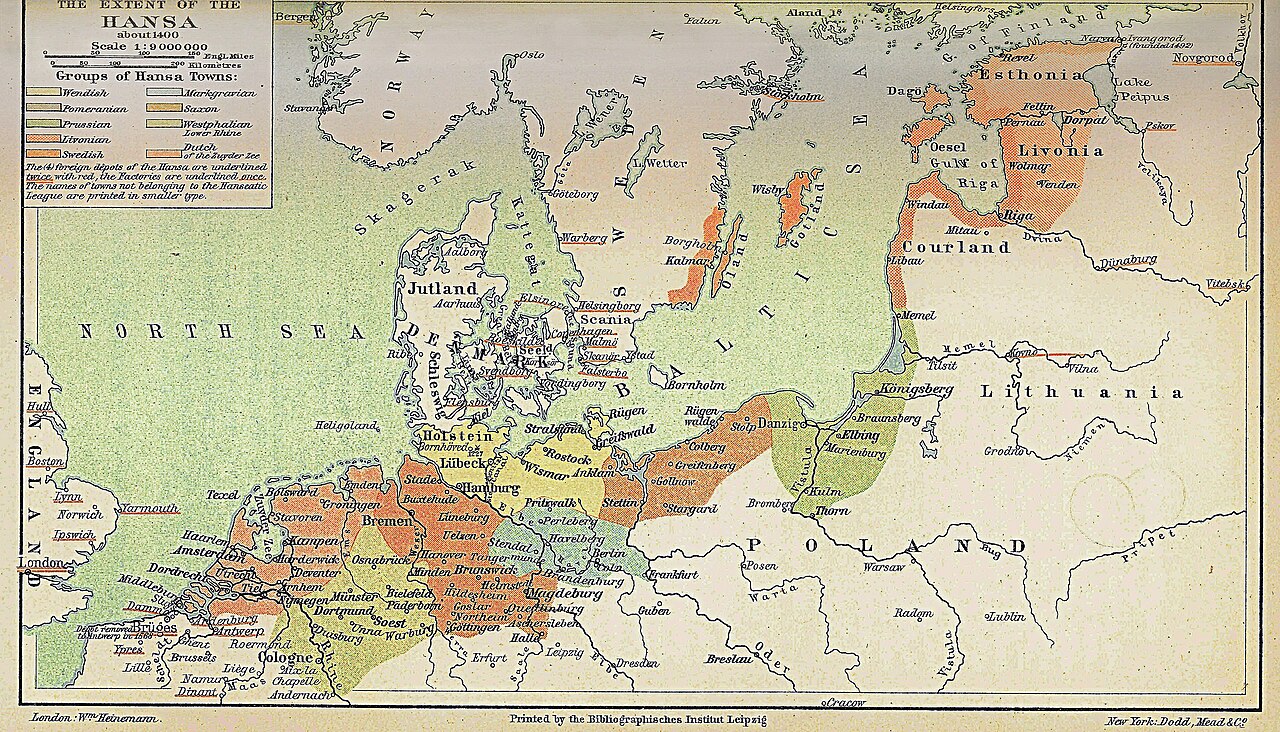
The language evolved from Old Saxon and is first securely attested in texts from the 13th century. Its geographic reach was amplified by the expansion of Hanseatic trade, when Middle Low German functioned as a common language among merchants and port cities. The Hanseatic League's commercial and legal networks helped spread the language along routes in present-day northern Germany, the Netherlands, Poland and the Baltic states; the League itself is often associated with Middle Low German usage (Hanseatic League).
Uses and legacy
Middle Low German was used for everyday correspondence, commercial account books, legal texts, treaties and diplomatic exchanges. It provided vocabulary to neighboring languages, notably contributing loanwords to the Scandinavian languages, including Swedish (Swedish), and influenced administrative and maritime terminology. Documents and agreements from the period attest to its role in formal affairs: it appears in commercial contracts, municipal records and diplomatic correspondence (treaties, diplomacy).
Notable texts and distinctions
A well-known surviving work in this language is the Sachsenspiegel, a medieval legal codex which illustrates how Middle Low German could be used for complex legal and prose compositions. Middle Low German is distinct from contemporary Middle High German varieties and later Early New High German standards; its influence survives in modern Low German dialects and in a range of loanwords across Northern Europe.
- Typical uses: trade documents, law books, town chronicles
- Geographic core: northern Germany and Baltic littoral
- Legacy: lexical influence on Scandinavian and regional languages
Questions and answers
Q: What is Middle Low German?
A: Middle Low German is a development step of the Low German language, in use in the northern part of Germany, which developed from Old Saxon in the Middle Ages.
Q: When were the first records of Middle Low German made?
A: The first records of Middle Low German date from the 13th century.
Q: Which league used Middle Low German as one of its languages?
A: The Hanseatic League used Middle Low German as one of its languages.
Q: How did Middle Low German influence Nordic languages?
A: Middle Low German influenced Nordic languages, such as Swedish, by contributing loanwords.
Q: In what areas besides trade and diplomacy was Middle Low German used?
A: Middle Low German was also used for treaties and diplomacy.
Q: What is an example of Middle Low German surviving testimony?
A: The Sachsenspiegel is an example of surviving testimony of Middle Low German.
Q: How did Middle Low German contribute to the development of Nordic languages?
A: Middle Low German contributed to the development of Nordic languages by providing them with loanwords.
Related articles
Author
AlegsaOnline.com Middle Low German Leandro Alegsa
URL: https://en.alegsaonline.com/art/64683