
Middle-earth: Tolkien’s Mythic Continent and Legendarium
Middle-earth is the mythic continent created by J. R. R. Tolkien as the setting for his epic tales. It has its own peoples, languages, history and geography within the wider world of Arda.
Middle-earth is the principal setting for J. R. R. Tolkien’s imaginative mythology. Often used to refer to the entire body of his imagined prehistory, the term more precisely denotes the central continent of Arda, the fictional world in which his best-known narratives unfold. Tolkien conceived Middle-earth as a legendary, prehistoric phase of our own Earth: a richly detailed landscape of kingdoms, wild regions, and ancient ruins that provides the stage for adventure, tragedy and moral struggle. See Middle-earth and its creator J. R. R. Tolkien.
Image gallery
4 Images
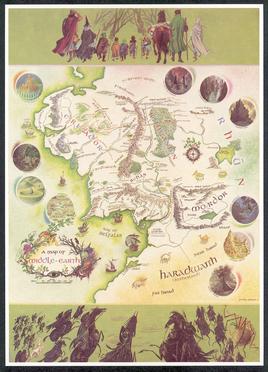


Overview and main works
Tolkien’s stories set in Middle-earth include and interconnect across several books and posthumous collections. The most widely read are The Hobbit and The Lord of the Rings, but the deeper background is explored in The Silmarillion and in editorial collections such as Unfinished Tales and The History of Middle-earth. These works together form what is often called Tolkien’s "Legendarium": a coherent mythic history that spans many ages and explains how peoples, places and objects—most famously the Rings of Power—came into being.
Geography and cosmology
Within Tolkien’s internal geography, Middle-earth lies on the continent of the same name in the world called Arda. The world originally had a flat cosmology in earlier texts and later becomes round; this evolution is part of the mythology itself. Significant locations include the Shire, Rivendell, Lothl�rien, Gondor, Rohan, Mordor and the drowned lands of Beleriand from the First Age. Tolkien drew maps to anchor his stories and to support consistent travel, genealogy and historical depth.
Peoples, creatures and languages
Middle-earth is populated by a variety of sentient peoples and creatures. Major groups are listed below; each has distinct cultures, languages and roles in the unfolding history:
- Elves — immortal beings with deep ties to art, language and the world’s earliest history.
- Men — mortal humans whose fates and kingdoms (like Númenor and Gondor) shape later ages; see humans.
- Dwarves — skilled craftsmen and miners with their own lore and strongholds.
- Hobbits — a small, rural people noted for resilience and love of hearth and home; more at hobbits.
- Other beings — Ents, Orcs, Dragons, Maiar (including wizards) and the dark Valar such as Morgoth and Sauron.
Tolkien was a philologist; he constructed multiple languages for different peoples (notably Quenya and Sindarin for the Elves) and often used language development as the origin for place names and histories. The Elvish names for Middle-earth—Endor, Endóre and Ennor—reflect this linguistic backdrop.
History, themes and influence
Middle-earth’s fictional chronology is organized into Ages. The First Age centers on the wars against Morgoth; the Second Age includes the rise and fall of Númenor and the forging of the Rings; the Third Age culminates in the War of the Ring. These long-term events let Tolkien explore themes such as mortality versus immortality, power and corruption, friendship and sacrifice, and the tension between nature and industrialization. The scope and detail of the Legendarium profoundly influenced modern fantasy literature, gaming, scholarship and numerous adaptations.
Distinctions and notable facts
Although ‘‘Middle-earth’’ is frequently used to mean all of Tolkien’s fictional output, specialists use Arda or the Legendarium when discussing the entire created world or corpus. Tolkien’s background in medieval literature and languages shaped his method: he sought to create a mythology with internal coherence, linguistic depth and a sense of antiquity. For further context on Tolkien’s life, works and later editorial compilations, consult reference entries and editions that collect his posthumous writings and notes: peoples and creatures, historical accounts, and comprehensive guides to his fiction and scholarship.
Questions and answers
Q: What is Middle-earth?
A: Middle-earth is a fictional fantasy world invented by J. R. R. Tolkien that is the setting for several of his books, including The Hobbit and The Lord of the Rings.
Q: What is the history of Middle-earth?
A: Middle-earth has its own geography, several different species and peoples, their languages, and a history that spans thousands of years.
Q: What are the different species and peoples in Middle-earth?
A: The different species and peoples in Middle-earth include elves, dwarves, humans, and hobbits.
Q: How did Tolkien create Middle-earth?
A: Tolkien created and worked on Middle-earth through most of his life, and it is this creation for which he is most famous.
Q: What is meant by the term 'artificial myth' in relation to the stories of Middle-earth?
A: The stories of Middle-earth are also a kind of 'artificial myth'.
Q: What are some of the names for Middle-earth in the fictional Elvish languages Quenya and Sindarin?
A: 'Middle-earth' is called Endor (or Endóre) and Ennor in the fictional Elvish languages Quenya and Sindarin.
Q: Is Middle-earth a real place?
A: No, Middle-earth is a fictional fantasy world invented by J. R. R. Tolkien.
Related articles
Author
AlegsaOnline.com Middle-earth: Tolkien’s Mythic Continent and Legendarium Leandro Alegsa
URL: https://en.alegsaonline.com/art/64670
Sources
- commons.wikimedia.org : Middle-earth