
Ascension (Christian feast): origins, observance, and significance
Ascension Day commemorates Jesus Christ's ascent to heaven forty days after Easter. This article covers its scriptural basis, historical development, liturgical observances, customs and where it is a public holiday.
Overview
The Feast of the Christian holiday called the Ascension commemorates the account in the Bible in which Jesus is described as having ascended into heaven in the presence of his apostles. Observed forty days after the resurrection, the feast marks a transition during the Easter season and is regarded as one of the major or ecumenical Christian celebrations alongside Easter and Pentecost.
Image gallery
4 Images


Scriptural basis and early tradition
The primary biblical references to the Ascension are found in the Gospel accounts and in the opening chapters of Acts. These texts recount final appearances of Jesus to his followers and describe him being taken up and seated at the right hand of God, a phrase that has been incorporated into creeds and common prayer. Early Christian writers and liturgical calendars began to mark the event as a distinct celebration in the centuries after the apostolic era.
Date, calculation and adaptations
Ascension Day is traditionally celebrated on a Thursday, forty days after Easter Sunday, which means that its calendar date changes each year with the date of Easter. To accommodate modern pastoral needs, some churches transfer the observance to the following Sunday so that more people can participate in communal worship. The timing also underlines the link between the Ascension and the coming of the Holy Spirit at Pentecost, which occurs ten days later.
Liturgical observance and common customs
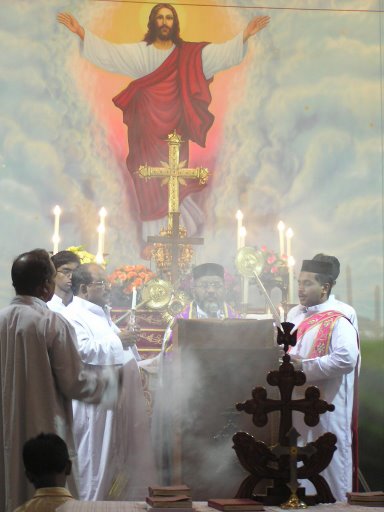
Liturgy for the day typically includes readings recounting Christ's final appearances, prayers that reflect his exaltation, and hymns celebrating his enthronement. Common practices include a solemn Mass or Divine Liturgy, sermons on Christ's continuing presence with the Church, and liturgical emphasis on his role as mediator and king. In many places clergy and congregations hold processions or outdoor services to symbolize the journey to heaven; in others, local customs add civic or family elements to the observance.
Variations among Christian traditions
Different branches of Christianity highlight complementary aspects of the feast. Western churches often emphasize Christ's exaltation, intercession, and the theological completion of the Incarnation. Eastern churches frequently present a cosmic interpretation, showing the Ascension as the restoration of creation and Christ's entry into the heavenly realm on behalf of all. Anglican, Lutheran, Methodist and Roman Catholic calendars consistently mark the day, while some Protestant communities may observe a transferred Sunday or give it less liturgical prominence.
Iconography and cultural expression
Art and music have long been associated with Ascension themes. Visual depictions traditionally show Christ rising above the earth, often with angels and the apostles below. Liturgical drama, hymns and choral works have developed to express both the narrative and theological dimensions of the event. In some cultures the feast has inspired local processions, civic observances, or communal meals connected to the church calendar.
Public holiday status and geographic notes
Ascension Day is a public holiday in a number of countries. Examples include Austria, Belgium, Colombia, Denmark, Finland, France and Germany. It is also observed as a civil holiday in Haiti, Iceland, Indonesia, Liechtenstein, Luxembourg, Madagascar, Namibia, The Netherlands, Norway, Sweden, Switzerland and Vanuatu. In some of these countries the civil and religious calendars have intertwined traditions; for example, in parts of Germany the day has in modern times coincided with secular events such as Father's Day.
Theological significance
The Ascension is often interpreted as the completion of the earthly ministry of Jesus and his return to divine authority. Theologically it is connected to Christ's kingship, his role as intercessor for humanity, and the promise of the Holy Spirit who empowers the apostles for mission. Many churches link the feast with practical themes: mission, witness, and the presence of Christ with his people through the Spirit rather than by physical presence.
Modern observance and pastoral practice
Contemporary observance ranges from solemn liturgical celebration to modest local customs. Where it is not a public holiday, churches maintain special services and educational programs about its meaning. In places where the feast is moved to Sunday, parish life often incorporates the themes of ascent, mission and sending into congregational activity for the following week.
Further reading and resources
- Liturgical texts and denominational guidance on the Ascension can be found in official church calendars and worship books; see representative resources for historical context at biblical studies and ecumenical literature.
- Regional descriptions of customs are available from national church bodies in countries such as Austria and France, and from local parish histories in places like The Netherlands and Germany.
- For comparative theological perspectives, consult surveys in patristic studies and modern theological commentaries on the Easter season and the role of the Ascension in Christian doctrine.
Because practices and emphases vary by tradition and locality, readers interested in specific liturgies or civic customs should consult local church resources, national calendars, and reputable introductions to Christian festivals for more detailed guidance.
Questions and answers
Q: What is Ascension?
A: Ascension is a Christian holiday that celebrates Jesus ascending (going up) to heaven.
Q: When is Ascension Day celebrated?
A: Ascension Day is officially celebrated on a Thursday, although not all countries hold the feast on this day. It is one of the ecumenical feasts and all Christians celebrate it.
Q: What does the story in the Bible say about Jesus' ascension?
A: According to the story told in the Bible, Jesus ascended (went up) to heaven and was seen by his apostles. His body went to heaven and he sits at the right-hand side of God the Father.
Q: Is Ascension Day a public holiday in some countries?
A: Yes, in some countries such as Austria, Belgium, Colombia, Denmark, Finland, France, Germany (since the 1930s), Haiti, Iceland, Indonesia, Liechtenstein, Luxembourg Madagascar Namibia The Netherlands Norway Sweden Switzerland and Vanuatu it is a public holiday; Germany also holds its Father's day on the same date.
Q: How many days after Easter is Ascension Day celebrated?
A: Ascension Day is celebrated forty days after Easter or Jesus' resurrection.
Q: Are there other important Christian holidays besides Easter and Pentecost?
A: Yes, Ascension Day is another very important feast in the calendar of Christian Church that all Christians celebrate much like Easter and Pentecost.
Related articles
Author
AlegsaOnline.com Ascension (Christian feast): origins, observance, and significance Leandro Alegsa
URL: https://en.alegsaonline.com/art/6467
Sources
- sor.cua.edu : Calendars of the Syriac Orthodox Church
- tools.wmflabs.org : Romans 10:5-7
- tools.wmflabs.org : 24:51
- tools.wmflabs.org : John 20:17
- tools.wmflabs.org : 1 Peter 3:21-22
- tools.wmflabs.org : Ephesians 4:7-13
- tools.wmflabs.org : 1 Timothy 3:16
- tools.wmflabs.org : 16:19
- gnosis.org : Against Heresies