
AS-90: British 155 mm self-propelled gun
The AS-90 is a British tracked self-propelled 155 mm artillery system introduced in the early 1990s, designed for mobile indirect fire support and used by Royal Artillery formations.
Overview
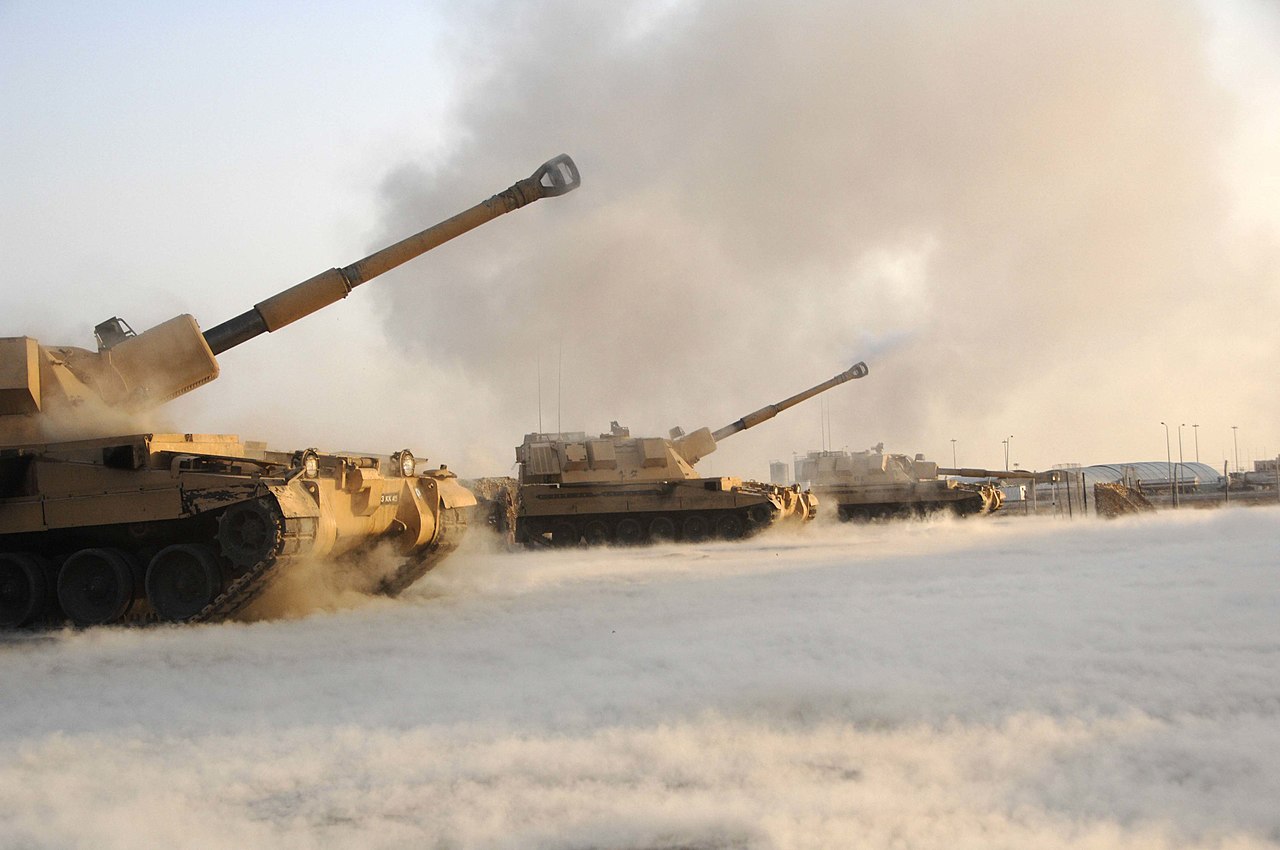
The AS-90 (Artillery System for the 1990s) is a tracked, turreted self-propelled artillery piece built to provide mobile indirect fire for British forces. Officially designated Gun Equipment 155 mm L131 in British service, the AS-90 entered operational use in the early 1990s and was adopted by formations of the British Army. It combines a 155 mm artillery gun with armour protection and a fully traversing turret to allow shoot-and-scoot operations on the modern battlefield.
Image gallery
7 Images


Design and main characteristics
The AS-90 is mounted on a tracked chassis and carries a 155 mm gun in a rotating turret. The design emphasises mobility, protection for the crew, and the ability to deliver sustained, accurate indirect fire. Key attributes include:
- Calibre and armament: a 155 mm gun (British designation L131) intended to fire standard NATO 155 mm ammunition.
- Protection and mobility: light armour protects the fighting compartment and essential systems while the tracked suspension gives cross-country mobility similar to other armoured formations.
- Ammunition handling: onboard stowage for a complement of rounds and arrangements for rapid supply to the gun, allowing timely fire missions and displacement.
- Fire control: systems and optics to support indirect fire, target engagement, and integration with higher-level artillery command networks.
Development, production and upgrades
The AS-90 was developed and manufactured by Vickers Shipbuilding and Engineering (VSEL), a company later incorporated into BAE Systems. Production took place in the early 1990s: around 179 chassis were produced between approximately 1992 and 1995 at a programme cost commonly reported in public sources. In the 2000s the vehicle was the subject of upgrade studies intended to extend range and performance. One notable proposal sought to fit a longer 52‑calibre barrel to increase maximum range to about 30 km with standard rounds and considerably further with specialised munitions; that particular project did not reach widespread implementation within the British fleet.
Service history and users
Within UK service the AS-90 has been allocated to regiments of the Royal Artillery and the Royal Horse Artillery; sources commonly note use by five regiments. It has provided brigade-level and divisional fire support, taking advantage of mobility to accompany armoured formations and to relocate after firing. The platform has been integrated into modern artillery doctrines that emphasise rapid target acquisition, coordination with forward observers and command systems, and the use of precision and extended-range ammunition when available.
Role, significance and distinctions
The AS-90 occupies the role between lighter towed guns and heavier, longer-range artillery systems: it trades some strategic range for tactical mobility, armoured protection and faster deployment. Compared with towed 155 mm pieces, self-propelled systems like the AS-90 can shoot from prepared or unprepared positions with greater survivability and tempo. Although several modernisation concepts were studied, the AS-90 remains principally a 155 mm turreted self-propelled gun designed for flexible, protected fire support.
For further manufacturer and service information see manufacturer pages and unit histories: manufacturer details, the principal user British Army, and summaries of regimental allocations unit listings.
Questions and answers
Q: What is the AS-90?
A: The AS-90 is a lightly armoured self-propelled artillery gun used by the British Army.
Q: When was the AS-90 first used?
A: The AS-90 was first used in 1993.
Q: What is the AS-90's official name?
A: The AS-90's official name is Gun Equipment 155 mm L131.
Q: How many regiments of the Royal Horse Artillery and Royal Artillery use the AS-90?
A: Five regiments of the Royal Horse Artillery and Royal Artillery use the AS-90.
Q: Who designed and built the AS-90?
A: The AS-90 was designed and built by Vickers Shipbuilding and Engineering (VSEL), which has been owned by BAE Systems since 1999.
Q: How many AS-90s were made from 1992 to 1995, and what was the cost?
A: 179 AS-90s were made from 1992 to 1995, and the cost was £300 million.
Q: What project involving the AS-90 was requested in 2002, and what was the goal?
A: In 2002, it was requested that 96 British Army AS-90s be given a 52 calibre gun to increase their range to 30 km, with the possibility of reaching 60 to 80 km with special shells. However, this project was eventually ended.
Related articles
Author
AlegsaOnline.com AS-90: British 155 mm self-propelled gun Leandro Alegsa
URL: https://en.alegsaonline.com/art/6430
Sources
- deagel.com : Additional deployment information
- armedforces.co.uk : Armed Forces - a6a4 - British Army - Artillery - AS 90
- army-technology.com : Army Technology - AS90 BRaveheart 155mm - Self Propelled Howitzer
- baesystems.com : 155MM Study Looks To Pack More Punch Into The Royal Navy's Fleet
- mod.uk : Army to get new precision "search and destroy" anti-armour weapon
- army.mod.uk : "British Army equipment"