
Metropolitan Life Insurance Company Tower
Early 20th-century New York City skyscraper at Madison Square known as the Met Life Tower; notable for its clock tower, campanile-inspired design and status as the world’s tallest building from 1909–1913.
Overview
The Metropolitan Life Insurance Company Tower, commonly called the Met Life Tower, is an early skyscraper on the edge of Madison Square Park in Manhattan, New York City. Completed in 1909, the building rises to about 700 feet and contains roughly fifty floors. It originally served as the headquarters of the Metropolitan Life Insurance Company and remains one of the city’s most recognizable historic towers.
Image gallery
10 Images




Design and architectural features
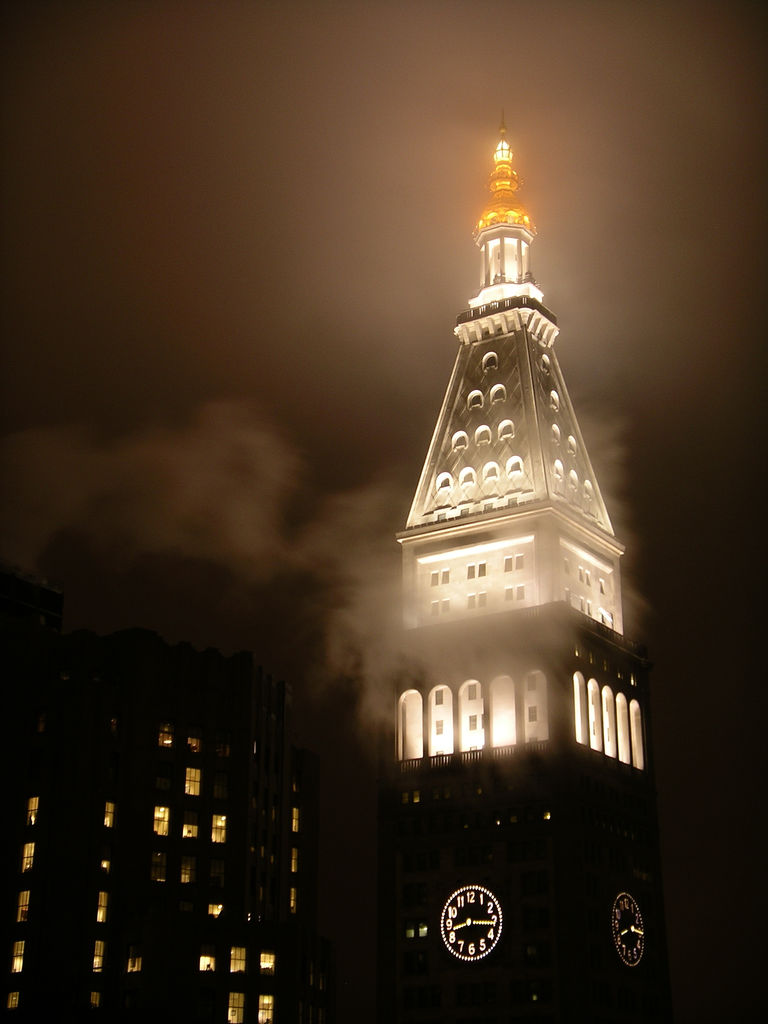
The tower was conceived as a tall, narrow clock tower with a pyramidal roof, a silhouette that evokes historic European campaniles. Its massing includes a broad base that steps up into a slender shaft capped by the tower and spire. Near the top are large clock faces on multiple elevations and ornamental detailing that reflected the Beaux-Arts and classical tastes common for institutional architecture of the period.
History and development
Built in the first decade of the 20th century, the Met Life Tower briefly held the title of the world’s tallest building from 1909 until 1913, when it was eclipsed by taller commercial skyscrapers. It was part of a wave of ambitious construction that transformed Lower and Midtown Manhattan in that era. The tower stood alongside other period landmarks and helped define the skyline around Madison Square.
Use, importance and legacy
Beyond its function as office space for an insurance company, the tower became a civic landmark and a symbol of corporate prestige. Its clock faces and illuminated top made it a night-time focal point. Over time the building has been the subject of preservation efforts and adaptive reuse, reflecting broader patterns in the conservation of early skyscrapers.
Notable distinctions and context
Key distinctions include its short tenure as the world’s tallest building and its clear inspiration from Venetian campaniles. Located at a prominent city intersection, it forms part of a cluster of historic structures that chart the evolution of skyscraper design from masonry bases to steel-frame towers.
Further reading and references
Questions and answers
Q: What is the Metropolitan Life Insurance Company Tower?
A: The Metropolitan Life Insurance Company Tower is a skyscraper in New York City, United States.
Q: How tall is the Metropolitan Life Insurance Company Tower?
A: The Metropolitan Life Insurance Company Tower is 213 meters (700 feet) tall.
Q: How many floors does the Metropolitan Life Insurance Company Tower have?
A: The Metropolitan Life Insurance Company Tower has 50 floors.
Q: When was the Metropolitan Life Insurance Company Tower built?
A: The Metropolitan Life Insurance Company Tower was built in 1909.
Q: How long was the Metropolitan Life Insurance Company Tower the tallest building in the world?
A: The Metropolitan Life Insurance Company Tower was the tallest building in the world from 1909 to 1913.
Q: What was the tallest building in the world before the Metropolitan Life Insurance Company Tower was built?
A: The tallest building in the world before the Metropolitan Life Insurance Company Tower was built was the Singer Building.
Q: What became the tallest building in the world four years after the Metropolitan Life Insurance Company Tower was built?
A: The Woolworth Building became the tallest building in the world four years after the Metropolitan Life Insurance Company Tower was built.
Related articles
Author
AlegsaOnline.com Metropolitan Life Insurance Company Tower Leandro Alegsa
URL: https://en.alegsaonline.com/art/64263