
Meteor shower: causes, observation, and notable displays
An overview of meteor showers: how streams of cometary or asteroidal debris produce meteors, how showers are named and measured, notable examples, and practical observing guidance.
Overview
A meteor shower is a celestial event in which numerous meteors appear to radiate from a single region of the sky during a limited interval of time. The bright streaks seen from the ground are the visible traces of tiny solid particles — meteoroids — that enter Earth’s atmosphere at high speed and heat up, producing brief glowing paths called meteors. Most of these particles are extremely small, typically no larger than grains of sand, and they vaporize before reaching the surface; larger survivors that strike the ground are classified as meteorites.
Image gallery
10 Images
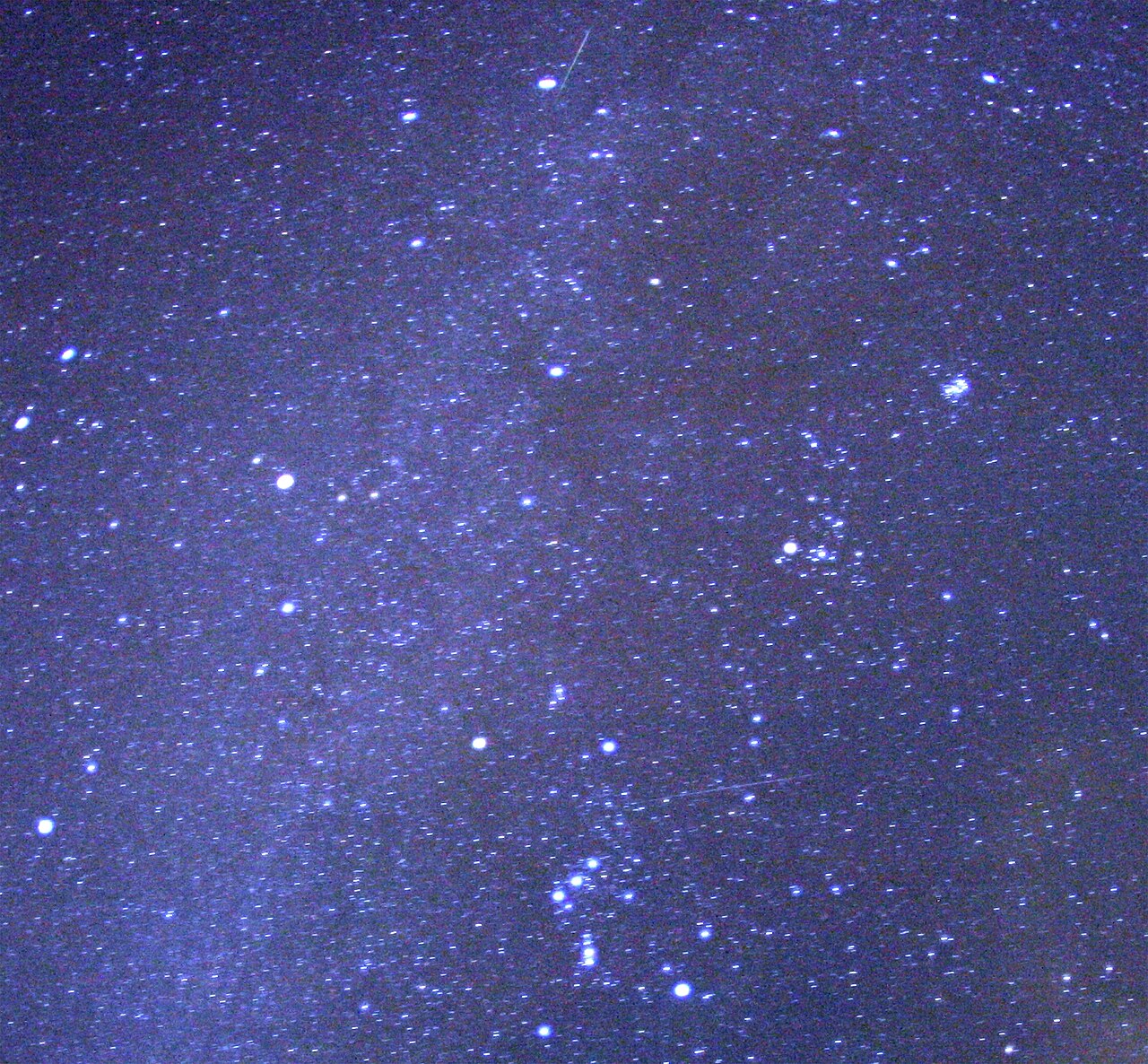




Causes and structure of a shower
Meteor showers arise when Earth crosses a stream of debris left along the orbit of a comet or, in some cases, an asteroid. Comets shed dust and small fragments as their ices sublimate when warmed by the Sun, spreading material into a roughly toroidal band around the parent object’s path. When those particles encounter Earth, they enter the atmosphere on nearly parallel tracks; from a given observing location this produces the illusion that meteors originate from a single point on the celestial sphere called the radiant. The particles themselves are more accurately described as meteoroids while in space.
Some streams are ancient and dispersed, producing modest rates of meteors over several weeks; others are dense dust trails recently released by a parent body and can yield concentrated outbursts. Parent bodies may be classical comets — often referred to simply as a comet — or occasionally asteroid-like objects that have behaved like comets in the past. The stream occupies roughly the same orbit the parent follows, so the timing of a shower is predictable from year to year.
Notable showers and historical context
Well-known annual displays include the Perseids, Geminids, Quadrantids and Leonids. The Perseids, associated with comet Swift–Tuttle, are among the most reliably active and peak in mid-August; they are often favored by observers for bright, frequent meteors and warm summer nights. The Geminids, originating from the unusual parent object 3200 Phaethon (Phaethon), tend to be strong in December. The Leonid stream can produce dramatic meteor storms roughly every three decades when Earth encounters a particularly dense filament; historically the great Leonid storm of 1833 helped establish the concept of meteor showers when observers recognised a common radiant near the constellation Leo (Leonids).
The Perseid shower (Perseids) typically peaks on or about 12 August and is famous for steady, high hourly rates under dark skies. Quadrantids and Geminids are other prominent examples, each with distinct peak dates and activity profiles driven by the geometry and particle density of their parent streams.
Observation, measurement, and importance
Astronomers describe shower intensity in terms such as the zenithal hourly rate (ZHR), an estimate of how many meteors an ideal observer would see under perfect conditions with the radiant at the zenith. Actual counts are lower when the radiant is low on the horizon, when the Moon is bright, or in regions affected by light pollution or clouds. Observers often use simple naked-eye counts, wide-field photography, or radar to study showers; scientists monitor showers to learn about the composition and evolution of small bodies in the Solar System and to assess impact hazards from larger fragments.
Practical tips and distinctions
- Best viewing: lie back with an unobstructed view, allow eyes to adapt to the dark, and look at a broad area of sky rather than aiming directly at the radiant.
- Timing: showers have an interval of activity and a sharper peak night; check current predictions and local conditions before planning observation.
- Photography: use a wide-angle lens, a stable mount, and long exposures to capture multiple meteors and star fields; avoid pointing directly toward the Moon.
- Terminology: meteoroid = particle in space, meteor = luminous trail in the atmosphere, meteorite = surviving fragment on the ground.
Understanding meteor showers connects amateur skywatching with professional research into the Solar System’s small bodies. Records of past storms and continuous monitoring of annual displays provide insights into how dust streams evolve over decades and centuries, and they help identify the parent comets or asteroids responsible for the spectacle.
Further reading and observing resources are available from many astronomy groups and institutions; for basic background see the links provided by major space agencies and amateur organisations (meteoroid definitions, cometary origins, orbital mechanics, solar influence, Phaethon studies, Perseid predictions, Leonid history).
Questions and answers
Q: What is a meteor shower?
A: A meteor shower is an event when many meteors seem to come from one point in the night sky. These meteors are caused by meteoroids entering Earth's atmosphere at extremely high speeds on parallel paths, and most of them burn up before reaching the Earth's surface.
Q: What causes a meteor shower?
A: Meteor showers are the result of an interaction between a planet, such as Earth, and streams of debris from a comet. When a comet swings by the Sun in its orbit, some of its ice vaporizes and releases meteoroids which spread out along the entire orbit of the comet to form a dense meteoroid stream.
Q: What is the most visible meteor shower in most years?
A: The Perseids are typically the most visible meteor shower in most years, peaking on 12 August each year at over one meteor per minute.
Q: What is special about the Leonid Meteor Shower?
A: The Leonid Meteor Shower peaks around 17 November each year and about every 33 years it produces a big storm with thousands of meteors per hour. This was first realized during an 1833 storm when it was noticed that all meteors seemed to radiate from near Gamma Leonis star.
Q: How can I find out how many meteors will be visible from my location?
A: NASA has created a tool that allows you to calculate how many meteors per hour will be visible from your observing location.
Related articles
Author
AlegsaOnline.com Meteor shower: causes, observation, and notable displays Leandro Alegsa
URL: https://en.alegsaonline.com/art/64186