
Metatarsal bones
Five long bones in the foot that connect the tarsal bones to the toe phalanges; important for weightbearing, gait, and common sites of fracture and injury.
Overview
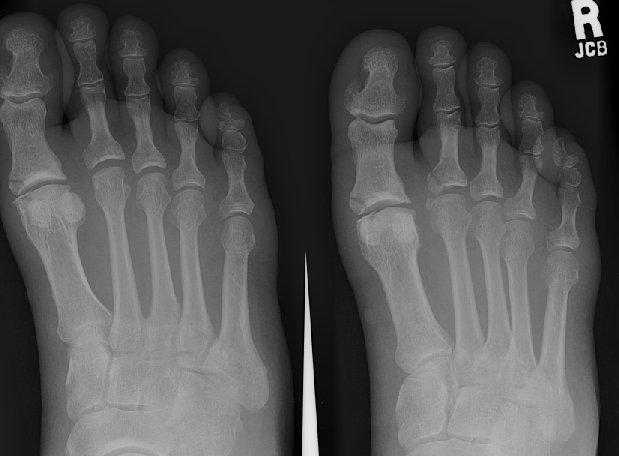
The metatarsal bones form the central skeleton of the fore‑part of the foot. There are five metatarsals, arranged side by side between the tarsal bones of the hind- and mid-foot and the phalanges of the toes. They are long tubular bones that provide support for the plantar arch, transmit forces during walking and running, and serve as attachment points for tendons and ligaments. General descriptions of the foot and its components are often grouped under the term metatarsus.
Image gallery
10 Images



Anatomy and distinguishing features
Metatarsals are numbered from the medial side (the side of the big toe) as first through fifth. Each metatarsal has a base (proximal end, articulating with the tarsal bones), a shaft, and a head (distal end, articulating with the phalanges of the toes). Clinicians and anatomists sometimes use Roman numerals for numbering (I–V). The first metatarsal is shorter and thicker to bear greater loads; the second is often the longest. The fifth metatarsal has a prominent lateral tuberosity that is a frequent site of injury.
Development and variation
During growth each metatarsal develops from primary and secondary ossification centers in cartilage templates; timing and pattern follow the general plan of long bone development. Variations are common: some people have accessory ossicles near metatarsal heads or bases, and differences in relative length can influence foot mechanics (for example, a relatively long second metatarsal may contribute to metatarsalgia). Metatarsals are analogous in position and function to the metacarpal bones of the hand (metacarpals), though shaped to withstand weightbearing rather than fine manipulation.
Function and clinical importance
Metatarsals support the transverse and longitudinal arches and act as levers during the push‑off phase of gait. They transmit large ground reaction forces and are therefore susceptible to overuse and acute injuries. Common clinical issues include stress fractures from repetitive loading, traumatic fractures from direct impact, and degenerative changes at the metatarsophalangeal joints. In many sports, particularly soccer, these bones are frequently injured; reports and equipment discussions have linked some injuries to footwear designs used by players (sports injuries, modern boot designs).
Fractures, diagnosis and treatment
Metatarsal fractures have several typical patterns: avulsion fractures (often at the fifth metatarsal base), diaphyseal (shaft) fractures, Jones fractures (a fracture in the proximal diaphyseal region of the fifth metatarsal that may heal poorly), and stress fractures of the shafts or heads. Diagnosis combines clinical exam with imaging. Initial management depends on location, displacement and stability: many non‑displaced fractures are treated conservatively with immobilization, activity modification and protected weightbearing. Displaced fractures, certain Jones fractures, and injuries failing to heal may require surgical fixation.
Rehabilitation and prevention
Recovery focuses on restoring strength, range of motion and normal gait mechanics. Rehabilitation typically progresses from immobilization to graduated weightbearing, muscle conditioning and footwear or orthotic adjustments to reduce recurrence. Preventive measures emphasize appropriate conditioning, gradual training increases, and protective equipment when indicated; specific protective socks or padding have been trialed to reduce dorsal foot impact in contact sports.
Notable distinctions and additional resources
- The first metatarsal is adapted for loadbearing and has different biomechanics than the lesser metatarsals.
- The fifth metatarsal is prone to both avulsion and Jones fractures because of its anatomy and tendon attachments.
- For comparative context, see resources on tarsal anatomy, toe phalanges, and numbering conventions (Roman numerals).
For further reading and clinical guidance consult authoritative anatomy texts and current orthopedic sources: introductory materials can be found via general anatomy references (metatarsus overview, hand‑foot comparisons), and sports medicine summaries discuss injury patterns in athletes (sports injuries overview, equipment and prevention).
Questions and answers
Q: What are metatarsal bones?
A: Metatarsal bones are a group of five long bones in the foot that are between the tarsal bones of the hind and mid-foot and the phalanges of the toes.
Q: How are the metatarsal bones numbered?
A: The metatarsal bones are numbered from the side of the large toe: the first, second, third, fourth, and fifth metatarsal.
Q: What is the similarity between metatarsal bones and metacarpal bones?
A: The metatarsal bones are like the metacarpal bones of the hand.
Q: Why are metatarsal bones often broken by soccer players?
A: Metatarsal bones are often broken by soccer players due to the lightweight design of modern football boots, which give less protection to the foot.
Q: What is the solution tested by soccer players to protect the top of their foot?
A: In 2010, some soccer players began testing a new sock that had a rubber silicon pad over the foot to protect the top of the foot.
Q: Are the metatarsal bones important?
A: Yes, the metatarsal bones are important as they form the skeletal structure of the foot and support the weight of the body during physical activities like walking, running, and jumping.
Q: What is the function of metatarsal bones?
A: The function of metatarsal bones is to transmit the weight of the body from the ankle to the toes and provide stability, balance, and flexibility to the foot during locomotion.
Related articles
Author
AlegsaOnline.com Metatarsal bones Leandro Alegsa
URL: https://en.alegsaonline.com/art/64181
Sources
- mirrorfootball.co.uk : "Sock boffs may have cured metatarsal woes for Rooney and Co"