
Messier 87 (M87): Giant Elliptical Galaxy in the Virgo Cluster
Messier 87 is a nearby supergiant elliptical galaxy in the Virgo Cluster, notable for its powerful relativistic jet and a supermassive black hole imaged by the Event Horizon Telescope.
Overview
Messier 87 (M87, NGC 4486, also called Virgo A) is one of the nearest and most intensively studied giant elliptical galaxies. It lies near the center of the northern Virgo Cluster at a distance of roughly 16.4 megaparsecs (about 53.5 million light-years). M87 exhibits a nearly featureless ellipsoidal stellar distribution rather than the spiral arms and dust lanes typical of disk galaxies. Despite its apparently smooth appearance in visible light, the galaxy hosts energetic phenomena at its core that make it an important subject in extragalactic astronomy.
Image gallery
10 Images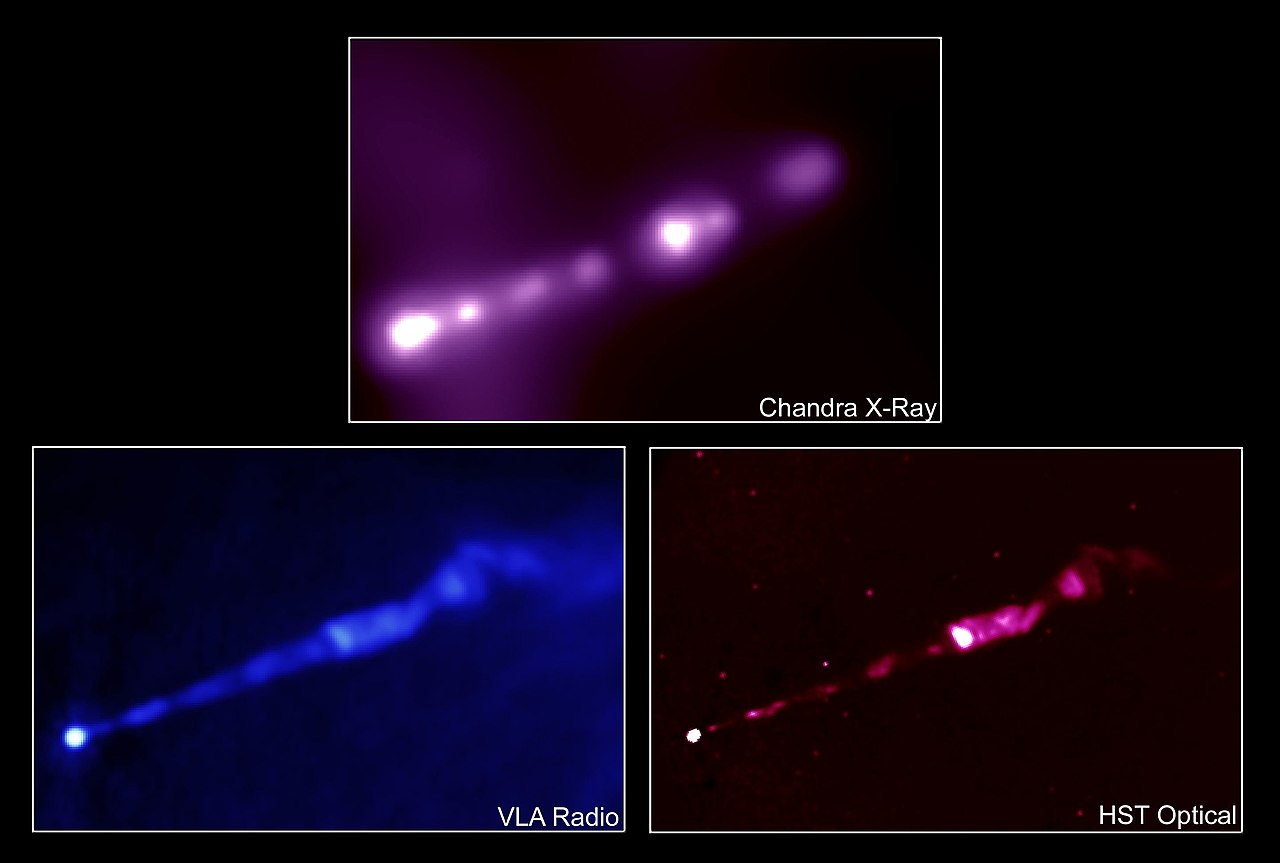


Structure, stars and clusters
M87 is classified as a supergiant elliptical galaxy and contains a predominantly old stellar population. It also supports an exceptionally rich system of globular clusters, one of the largest known around any galaxy. These clusters and the galaxy's stellar kinematics are used to trace its mass distribution and assembly history. The surface brightness of M87 falls off smoothly with radius, reflecting the extended, pressure-supported stellar system typical of massive ellipticals.
Hot gas and environment
The galaxy is embedded in a substantial halo of hot ionized gas that emits strongly in X-rays. This intracluster and interstellar medium interacts with outflows from the nucleus and with the surrounding Virgo Cluster environment. X-ray observations reveal cavities, shocks and complex structures produced when energy from the central region inflates bubbles in the hot gas, a process that influences cooling and star formation in the galaxy and its surroundings.
Central black hole and direct imaging
At the heart of M87 lies a supermassive black hole with a mass of several billion times that of the Sun; a common estimate is about 6.5 × 10^9 solar masses. This black hole powers a bright, compact nucleus that emits across the electromagnetic spectrum. In April 2019 the Event Horizon Telescope (EHT), a global millimeter-wavelength interferometer, released the first direct image of the black hole's immediate environment. The EHT image shows a bright emission ring surrounding a darker central region, interpreted as the black hole's shadow, on scales of a few thousandths of a parsec. The EHT result provided a new test of strong gravity and models of accretion and emission near an event horizon.
Relativistic jet and high-energy phenomena
M87 produces a well-known relativistic jet of plasma launched from the vicinity of the central black hole. The jet is visible at radio, optical, ultraviolet and X-ray wavelengths and extends at least several thousand light-years into intergalactic space. High-resolution imaging, including observations with the Hubble Space Telescope, has shown apparent motions in jet features that can exceed the speed of light when projected on the sky; this apparent superluminal motion is an optical effect caused by material moving close to the speed of light at a small angle to our line of sight. The jet contains bright knots and shocks where particles are accelerated to high energies, and it is a major source of nonthermal emission detected from radio to gamma-ray energies.
Mass measurements and techniques
Mass estimates for the central black hole and for the galaxy as a whole come from multiple methods. Stellar dynamics, gas kinematics, and very long baseline interferometry (VLBI) each provide complementary constraints. The black hole mass derived from stellar and gas motions in the inner region agrees broadly with the mass inferred from the angular size of the shadow seen by the EHT, within the uncertainties of each technique. Studies of globular clusters and planetary nebulae help map the dark matter halo and probe the assembly history of this massive system.
Historical observations and scientific importance
Charles Messier cataloged M87 in 1781 as a nebulous object. Over two centuries of observations have revealed its importance as a nearby example of an active galaxy and as a laboratory for studying the interaction of a supermassive black hole with its host galaxy. M87 is a prototype radio galaxy (often associated with Fanaroff–Riley type I morphology) and has been the focus of multiwavelength campaigns combining optical telescopes, radio interferometers, X-ray observatories and, most recently, the EHT.
Key facts
- Type: Supergiant elliptical galaxy (giant E)
- Distance: ≈16.4 Mpc (≈53.5 million light-years)
- Central black hole: several billion solar masses; imaged by the EHT
- Jet: relativistic plasma jet visible in radio through X-rays and beyond
- Environment: located near the center of the northern Virgo Cluster
Observational highlights and resources
M87 continues to be monitored across the electromagnetic spectrum. Major observational facilities that have contributed to our understanding include the Hubble Space Telescope, the Chandra X-ray Observatory, radio arrays such as the Very Large Array and VLBI networks, and the Event Horizon Telescope. These programs have helped track jet dynamics, measure the properties of the nucleus, and study how energy from the central region affects the surrounding gas.
Further reading
- Catalog and general overview
- Historical notes on Messier's discovery
- Virgo Cluster context
- Distance measurements and methods
- Observational summaries and images
- Comparison with spiral galaxies
- Morphological classification
- Photometry and luminosity profiles
- Studies of the central black hole
- Multiwavelength radiation from the nucleus
- Spectral studies across wavebands
- Radio observations and interferometry
- Jet physics and plasma studies
- High-energy phenomena and blazar-like behavior
- Relativistic motion and apparent superluminal effects
- Hubble Space Telescope imaging and analyses
Questions and answers
Q: What is Messier 87?
A: Messier 87 (also known as M87, Virgo A or NGC 4486) is a supergiant elliptical galaxy.
Q: When was it discovered?
A: It was discovered in 1781 by the French astronomer Charles Messier.
Q: How far away from Earth is it located?
A: It is about 16.4 million parsecs (53.5 million light-years) from Earth.
Q: What does it look like?
A: Unlike a disk-shaped spiral galaxy, Messier 87 has no distinctive dust lanes and has an almost featureless, ellipsoidal shape with luminosity diminishing with distance from the centre.
Q: What can be found at its core?
A: At the core of this unusually large galaxy is an unusually large supermassive black hole which is a strong source of radiation at many wavelengths, particularly radio waves.
Q: What image was taken by the Event Horizon Telescope in 2017?
A: The image taken by the Event Horizon Telescope in 2017 showed the shadow of the black hole surrounded by an emission ring with a diameter of 3.36×10⁻³ parsecs (0.0110 light-years).
Q: How fast does its jet travel?
A: In pictures taken by the Hubble Space Telescope in 1999, the motion of Messier 87's jet was measured at four to six times the speed of light although this may be an optical illusion caused by relativistic velocity of the jet.
Related articles
Author
AlegsaOnline.com Messier 87 (M87): Giant Elliptical Galaxy in the Virgo Cluster Leandro Alegsa
URL: https://en.alegsaonline.com/art/64128
Sources
- ui.adsabs.harvard.edu : 2010A&A...524A..71B
- doi.org : 10.1051/0004-6361/201014876
- ui.adsabs.harvard.edu : 1987AJ.....94..251B
- doi.org : 10.1086/114467
- time.com : "These Are the First Pictures of a Black Hole — And That's a Big, Even Supermassive, Deal"
- nytimes.com : "Black Hole Picture Revealed for the First Time - Astronomers at last have captured an image of the darkest entities in the cosmos - Comments"
- jpl.nasa.gov : "Black Hole Image Makes History"
- ui.adsabs.harvard.edu : 1954ApJ...119..215B
- doi.org : 10.1086/145813
- stsci.edu : stsci.edu/ftp/science/m87/press.txt
- ui.adsabs.harvard.edu : 2011ApJ...729..129M
- doi.org : 10.1088/0004-637X/729/2/129