
Messier 82 (M82) — the Cigar Galaxy
Messier 82 (M82) is a nearby starburst galaxy in Ursa Major. Noted for an intense central starburst, a bipolar superwind, ultraluminous X-ray sources, many young massive clusters and interactions within the M81 group.
Overview
Messier 82, commonly called M82 or the "Cigar Galaxy," is a nearby starburst galaxy located in the northern constellation Ursa Major. At a distance of roughly 12 million light‑years (≈3.6 Mpc), it is one of the closest and best‑studied examples of a galaxy undergoing an intense episode of star formation. Seen nearly edge‑on, its elongated shape gives rise to the informal name "Cigar Galaxy." For general compilations, images and data collections see dedicated resources such as M82 resources.
Image gallery
10 Images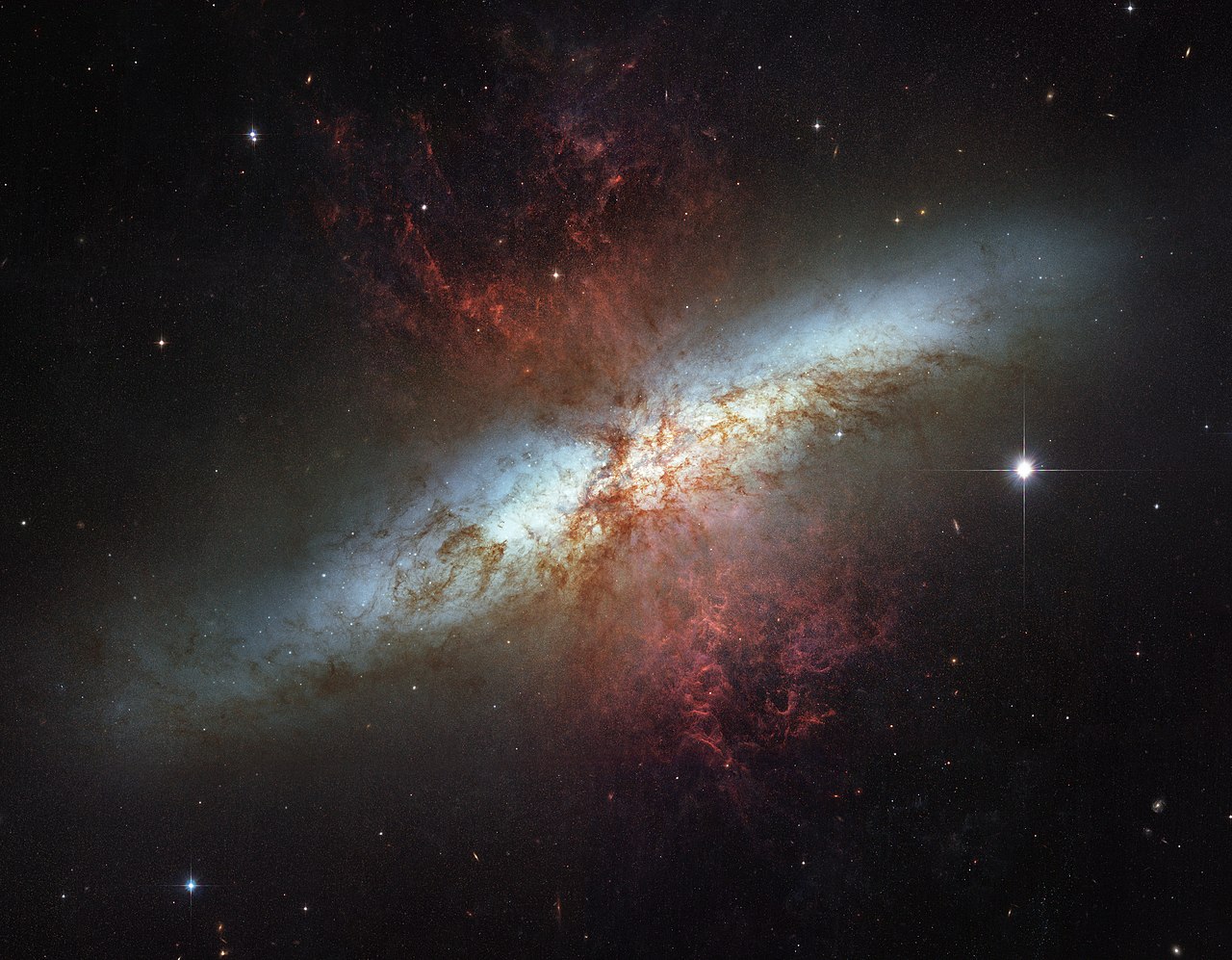


Structure and classification
M82 is usually described as an irregular or peculiar galaxy whose luminosity is dominated by a compact, energetic central starburst. Much of its emission is strong in the infrared because dust heated by massive young stars absorbs ultraviolet radiation and reradiates in the thermal infrared. The central kiloparsec contains a high surface density of star formation, making the nucleus conspicuously bright at radio, infrared, optical emission lines and X‑ray wavelengths. Summary data and comparative measurements are available in various astronomical catalogs and overview pages such as comparative sources.
Starburst core and star clusters
High‑resolution imaging with space telescopes revealed nearly two hundred compact, young massive clusters concentrated in the starburst core. Many of these clusters have masses of order a few 10^5 solar masses and host large populations of hot, short‑lived stars. The combined effect of many massive stars and frequent supernovae produces strong mechanical energy input and drives much of the galaxy's energetic appearance. Detailed observational programs and data sets are summarized by observatory pages including space telescope observations.
Outflows and energetic phenomena
One of M82's most striking features is a bipolar superwind: a large‑scale outflow of hot gas, dust and filaments that extends perpendicular to the galaxy's disk. The wind is visible in optical emission lines, infrared emission from dust, radio structures and soft X‑rays; it is powered by the collective action of stellar winds and supernova explosions in the central starburst. The galaxy also hosts very bright X‑ray sources, including the notable ultraluminous X‑ray source M82 X‑1, studied as a potential intermediate‑mass black hole or an unusually bright accreting binary. Multiwavelength surveys and catalogs describing these sources can be consulted via institutional survey pages such as survey links.
Environment and interactions
M82 is a member of the nearby M81 group of galaxies. Its present starburst is widely attributed to tidal interactions with neighboring galaxies, especially the large spiral M81 and the dwarf irregular NGC 3077, which funneled gas inward and triggered concentrated star formation. The group environment and tidal streams linking the galaxies have been mapped in neutral hydrogen and in deep optical imaging; related studies and group summaries are available through data portals and reviews such as distance and environment and group studies.
Observational history and notable events
M82 has long been a target of both professional and amateur observers because of its brightness and proximity. It has produced several well‑observed transient events; a recent widely followed example was a bright supernova discovered in 2014 that received extensive multiwavelength follow‑up. Because of its accessibility and rich phenomenology, M82 continues to be used as a nearby laboratory for studying feedback, starburst evolution and the role of interactions in shaping galaxy properties. Selected data archives and mission pages provide deeper catalogs and images for research and public interest, for example through aggregated portals like space mission resources and summary pages at data summaries.
Importance to astronomy
- M82 serves as a nearby example of intense star formation and feedback processes that affect galaxy evolution.
- Its infrared luminosity and compact central star formation make it a prototype luminous infrared galaxy useful for comparison with more distant starbursts.
- The visible superwind demonstrates how star formation can expel material into a galaxy's halo and beyond, enriching the surrounding medium.
Because of its proximity and brightness across the electromagnetic spectrum, M82 remains a focus of observations from radio interferometers to space‑based X‑ray and infrared telescopes. For further images, spectra and catalog entries consult observatory archives and survey pages such as survey links and institutional overviews like constellation resources.
Questions and answers
Q: What is Messier 82?
A: Messier 82 is a nearby starburst galaxy in the constellation Ursa Major, located about 12 million light years away.
Q: What is Messier 82 also known as?
A: Messier 82 is also known as NGC 3034, Cigar galaxy or M82.
Q: How bright is Messier 82 compared to the Milky Way?
A: Messier 82 is five times brighter than the whole Milky Way.
Q: How much brighter is the starburst core of Messier 82 compared to our galaxy's center?
A: The starburst core of Messier 82 is one hundred times brighter than our galaxy's center.
Q: What did the Hubble Space Telescope reveal in 2005 about Messier 82?
A: The Hubble Space Telescope revealed 197 young massive clusters in the starburst core of Messier 82.
Q: What is the average mass of the young massive clusters in the starburst core of Messier 82?
A: The average mass of the young massive clusters in the starburst core of Messier 82 is around 2×10⁵ M⊙.
Q: How much faster are young stars being born in the center of Messier 82 compared to our entire Milky Way Galaxy?
A: Young stars are being born 10 times faster in the center of Messier 82 than they are inside our entire Milky Way Galaxy.
Related articles
Author
AlegsaOnline.com Messier 82 (M82) — the Cigar Galaxy Leandro Alegsa
URL: https://en.alegsaonline.com/art/64126
Sources
- arxiv.org : 0804.1913
- ui.adsabs.harvard.edu : 2008A&A...484..711B
- doi.org : 10.1051/0004-6361:200809653
- newswise.com : Happy sweet sixteen, Hubble Telescope!
- newscientist.com : "Mysterious radio waves emitted from nearby galaxy"
- jb.man.ac.uk : "Mystery object in Starburst Galaxy M82 - Jodrell Bank Centre for Astrophysics"
- wikidata.org : wikidata.org/wiki/Q14026
- d-nb.info : 4382340-3