
Mesolithic — the Middle Stone Age transition between Paleolithic and Neolithic
Mesolithic: the postglacial, hunter‑gatherer phase between Paleolithic and Neolithic, marked by microlithic tools, changing environments, regional variation and steps toward sedentism and farming.
Overview
The Mesolithic is the archaeological term for a transitional phase of the Stone Age that sits between the end of the Paleolithic and the establishment of Neolithic farming societies. It is most often associated with changes that followed the end of the last Ice Age: people adapted to new environments, developed small refined stone tools, and in some regions began long‑term experiments with food production and settlement. The timing and character of the Mesolithic vary widely by region; where conditions and cultures differed, archaeologists sometimes use alternative labels such as Epipalaeolithic or Later Stone Age. See general discussions of stone‑age technology and archaeological practice for context.
Image gallery
10 Images


Environment and chronology
The Mesolithic broadly corresponds to the period after the Last Glacial Maximum when rising temperatures, retreating ice sheets, and sea‑level rise transformed landscapes across Europe, Asia and other temperate regions. In many parts of Europe the Mesolithic spans roughly from about 10,000 to 5,000 BCE, though the start and end dates are earlier or later elsewhere. The shift from tundra to forested ecosystems altered available resources and encouraged more fishing, foraging in woodland environments, and flexible seasonal mobility rather than the large‑game hunting of colder climates.
Technology and material culture
Mesolithic toolkits are often dominated by small, sharply worked flint or chert pieces known as microliths. These were commonly hafted into composite implements, producing lightweight arrows, barbs and sickle inserts. Bone, antler and wood were also used to make points, harpoons and digging tools. Unlike many Neolithic assemblages, Mesolithic sites usually lack extensive ground‑stone tool repertoires and pottery, though regional exceptions occur where pottery or early farming practices appeared contemporaneously. For contrast with other Stone Age phases, compare Paleolithic hunting traditions of large, communal drives and later Neolithic innovations in domestication and pottery production: Paleolithic and Neolithic descriptions are helpful, as are accounts of hunter‑gatherer lifeways versus emerging hunter‑gatherer to farmer transitions.
Economy, settlement and social life
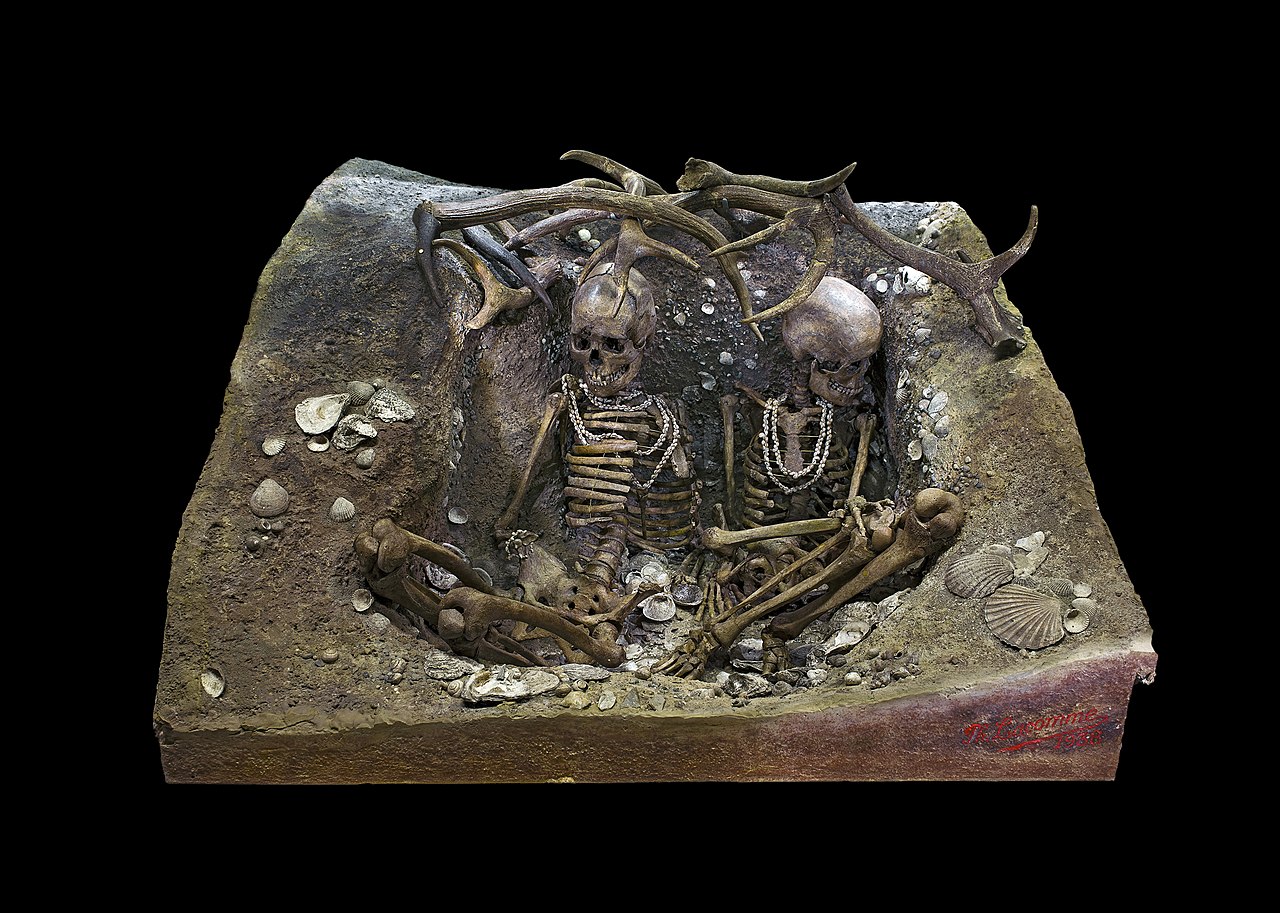
Mesolithic communities typically relied on a broad spectrum of wild foods: fish, shellfish, small mammals, birds, nuts and wild cereals. In some areas this led to increased sedentism — seasonal or year‑round occupation of rich coastal, riverine or lacustrine sites — and to the creation of shell middens and other long‑term deposits. Burials and symbolic artifacts from Mesolithic graves suggest complex social identities and ritual behaviors. In parts of the Near East, the Natufian culture is often cited as a Mesolithic‑like horizon in which intensive foraging, proto‑sedentism and early cultivation blurred the boundary with later Neolithic farming traditions.
Regional variations and terminology
The label "Mesolithic" is most commonly applied in Europe; in the Levant and Near East archaeologists frequently use "Epipalaeolithic" for comparable horizons, and in Africa the term "Later Stone Age" is preferred. In North America the broad equivalent is often called the "Archaic" period. These differences reflect real variations in how and when people adopted practices such as pottery, domesticated plants and animals, and permanent villages. The word "Mesolithic" itself was introduced in the 19th century and later popularized in twentieth‑century surveys by scholars such as V. Gordon Childe.
Archaeological evidence and notable sites
Mesolithic archaeology draws on a wide range of site types: open camps, lakeside settlements, shell middens, rock shelters and burial grounds. Well‑known European sites include Star Carr in England, which preserves wooden platforms and rich faunal remains, and various coastal middens that document intensive marine exploitation. In the Levant, sites such as Ain Mallaha illustrate late hunter‑gatherer sedentism. Specialists study lithic typologies, faunal assemblages and stratigraphy to reconstruct seasonal movements, diet and technological change; further reading on early agriculture and pottery can be found through summaries on wheat domestication and the later adoption of pottery.
- Typical Mesolithic tools: microliths, arrowheads, bone harpoons and ground bone points.
- Key processes: postglacial environmental change, broader diet breadth, increased site reuse and early steps toward cultivation.
- Related terms: farmers (Neolithic contrast), hunter‑gatherers (continuity), and archaeological frameworks for periodization.
The Mesolithic represents a diverse and regionally variable chapter in human prehistory: neither simply a brief technical stage nor a single cultural package, it captures multiple experiments in subsistence, mobility and social organization that set the stage for the agricultural lifeways of the Neolithic.
Questions and answers
Q: What is the Mesolithic period?
A: The Mesolithic period is a period in the development of human technology between the Paleolithic and Neolithic periods of the Stone Age.
Q: How did people live during the Palaeolithic period?
A: During the Palaeolithic period, people were pure hunter-gatherers.
Q: How did people live during the Neolithic period?
A: During the Neolithic period, they were farmers in settlements with domesticated animals and wheat, with over 100 kinds of tools and with pottery.
Q: What are Mesolithic tools?
A: Mesolithic tools are small tools produced by chipping, and are hunter-gatherer tools, often arrowheads and points.
Q: What are Neolithic tools?
A: Neolithic tools are often polished and far more varied. They are tools of more settled societies with some agriculture.
Q: Who introduced the term 'Mesolithic' and when?
A: The term 'Mesolithic' was introduced by Hodder Westrop in 1877, though the idea had been used earlier.
Q: What other term is sometimes used instead of 'Mesolithic'?
A: Another term, 'Epipalaeolithic', is sometimes used instead.
Related articles
Author
AlegsaOnline.com Mesolithic — the Middle Stone Age transition between Paleolithic and Neolithic Leandro Alegsa
URL: https://en.alegsaonline.com/art/64089
Sources
- dienekes.blogspot.com : Dienekes' Anthropology Blog : Dog domestication in the Aurignacian (c. 32kyBP
- msnbc.msn.com : MSNBC : World's first dog lived 31,700 years ago, ate big
- bbc.co.uk : bbc.co.uk/news/science-environment-25885519
- biorxiv.org : biorxiv.org/content/early/2013/12/23/001552