
Mendelian inheritance: principles, history, and applications
Overview of Mendelian inheritance: the classical laws of segregation, independent assortment and dominance, Mendel's pea experiments, common examples, and known limitations in modern genetics.
Overview
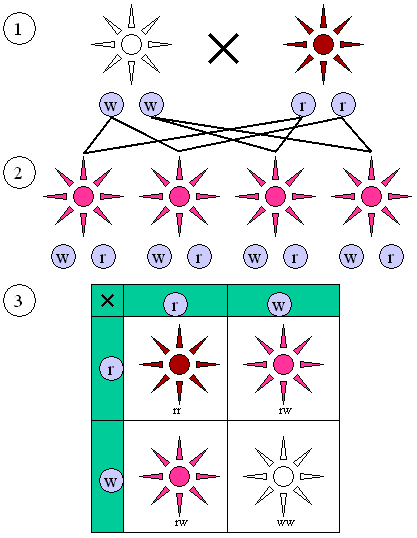
Mendelian inheritance refers to the basic patterns by which traits are transmitted from parents to offspring according to the principles first articulated by Gregor Mendel in the 19th century. These rules provide a conceptual foundation for classical genetics and explain how discrete heritable units—now called genes or alleles—affect observable characteristics (phenotypes) in predictable ways.
Image gallery
10 Images





Core principles
The classical scheme is commonly summarized by three interrelated ideas:
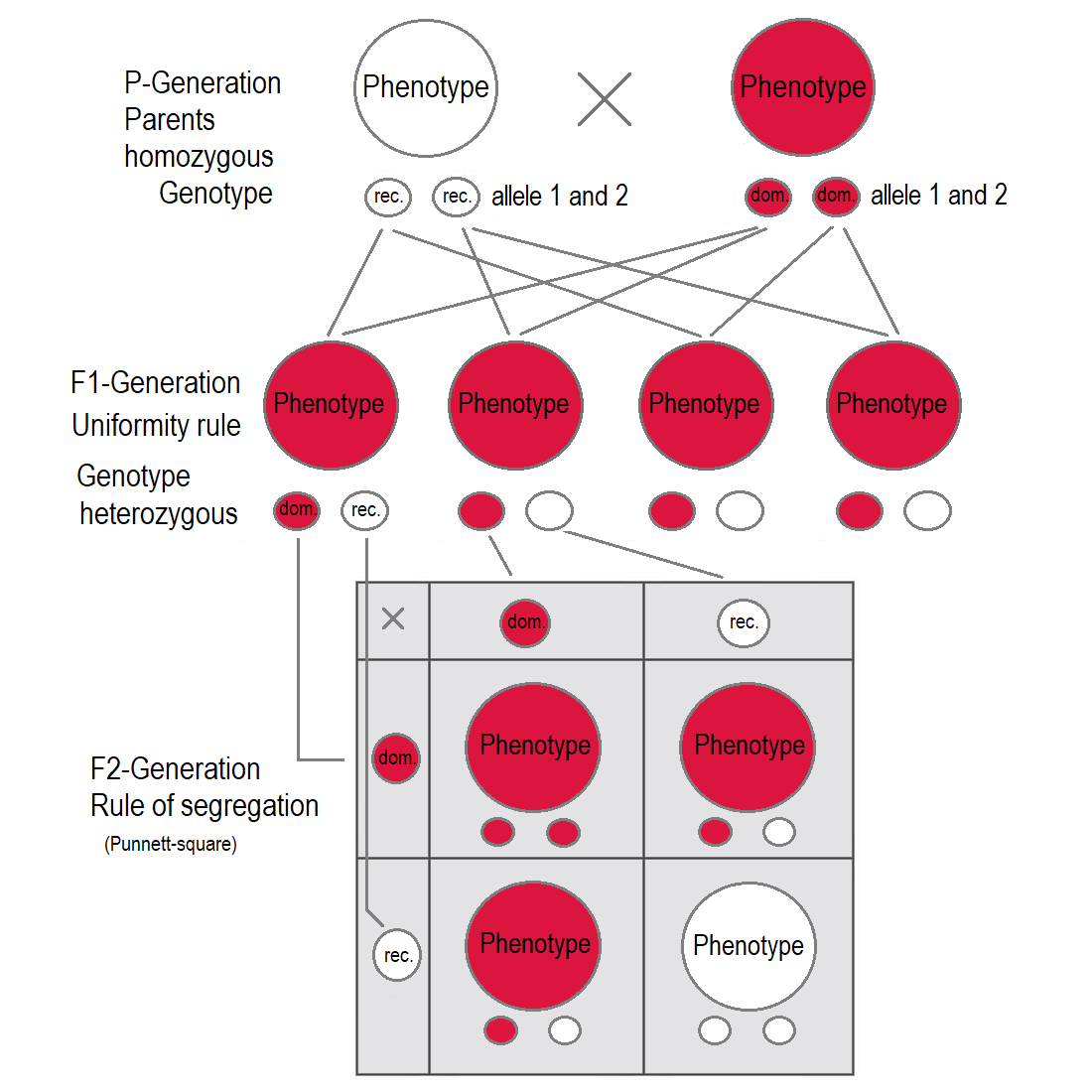
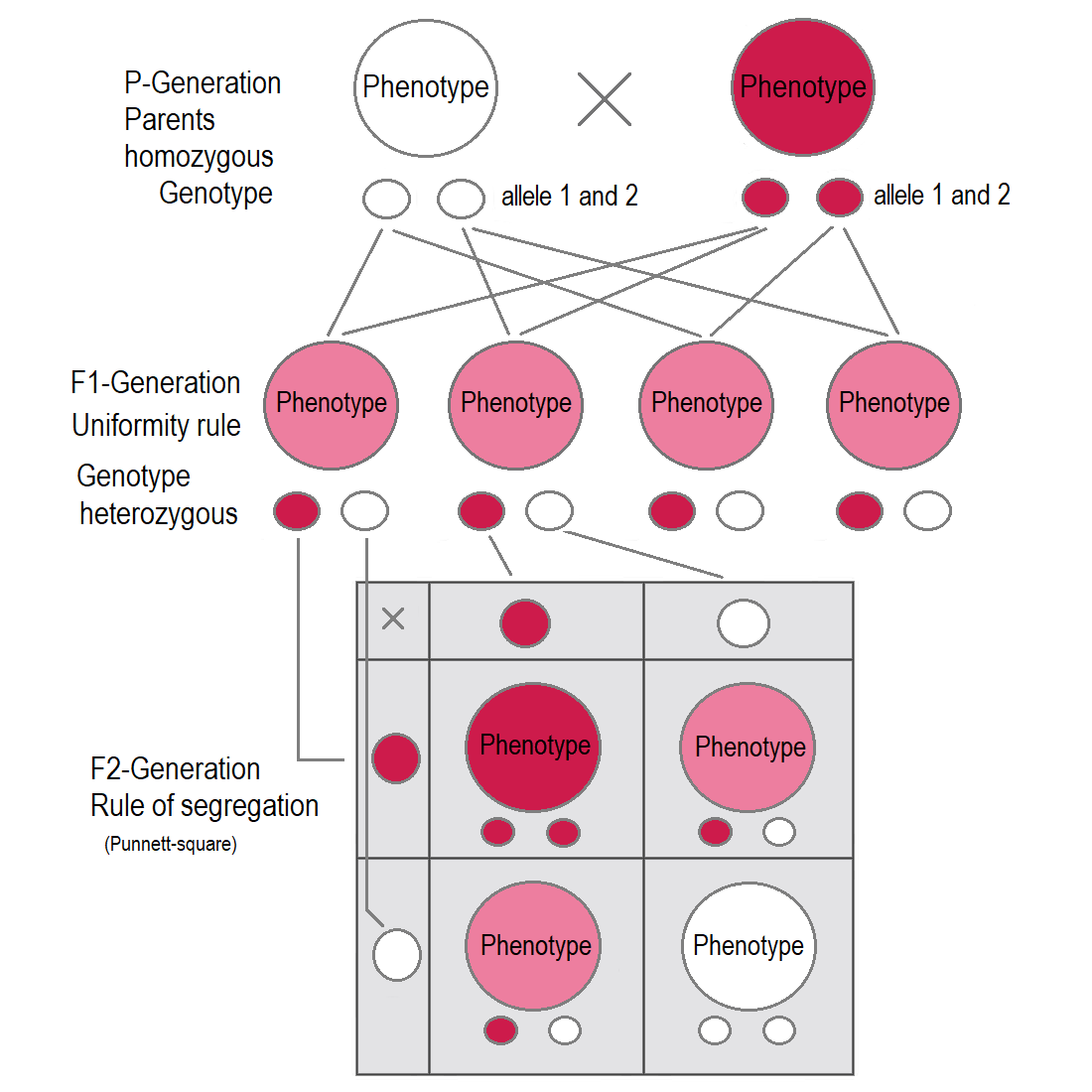
- Law of segregation: each individual carries two copies of a gene (alleles) and these separate so that a gamete receives one copy.
- Law of independent assortment: alleles of different genes are distributed to gametes independently when the genes are on different chromosomes or far apart.
- Dominance and recessiveness: when two different alleles are present, one may mask the effect of the other in the phenotype.
These rules explain why certain simple crosses yield characteristic numerical ratios and why predictable outcomes occur in monohybrid and dihybrid crosses.
Mendel's experiments and historical context
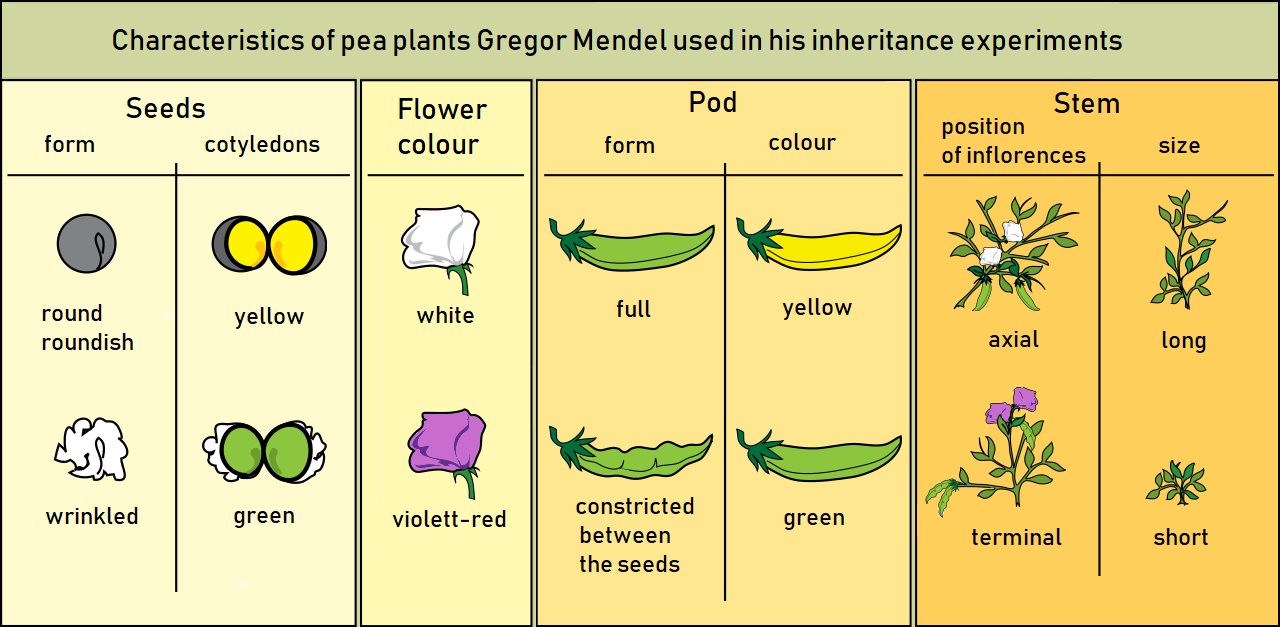
Gregor Mendel, an Augustinian monk, carried out controlled breeding experiments on garden peas in the 1850s and published his results in 1866. He chose pea varieties that bred true for specific, contrasting traits (for example, tall vs. short, yellow vs. green seeds) and counted large numbers of offspring while using systematic crosses and test crosses to infer underlying patterns. His quantitative approach and use of discrete traits distinguished his work from earlier observations of heredity. Mendel's contributions were largely unrecognized until around 1900, when several biologists independently rediscovered his laws and linked them to chromosome behavior during meiosis.
Uses, examples and practical importance
Mendelian principles are used to predict outcomes in simple genetic crosses such as monohybrid and dihybrid crosses and to design breeding programs in plants and animals. Classic examples include the pea character crossings that produced the familiar 3:1 ratio in dominant-recessive monohybrid offspring and the 9:3:3:1 pattern in dihybrid crosses. In medicine, Mendelian inheritance helps classify single-gene disorders as autosomal dominant, autosomal recessive, X-linked, or mitochondrial and guides genetic counseling and testing. For teaching and introductory analysis, Mendelian models remain indispensable.
Limitations and extensions
While powerful, Mendelian rules describe idealized, single-gene situations. Real biological inheritance often departs from these patterns because of linked genes (genes close together on the same chromosome), incomplete dominance, codominance, multiple alleles, polygenic traits, pleiotropy, epistasis, and environmental influences. Mitochondrial and other non-Mendelian inheritances follow different rules. Discoveries in molecular biology and chromosome theory expanded Mendel's ideas, explaining why segregation and independent assortment occur at the level of chromosomes and DNA.
Notable facts and further reading
Key experimental techniques Mendel used include starting with true-breeding lines, counting many offspring, and performing reciprocal and test crosses. For a concise biography of the scientist and the later interpretation of his work see Gregor Mendel and related summaries at biographical sources. For experimental methods and historical documents see collections of his papers and modern commentaries at plant genetics resources and practical guides to crosses at pea genetics. For general genetic background and modern extensions consult introductory texts and reviews at genetics references or methodological overviews at experimental genetics.
Questions and answers
Q: Who discovered the basic rules of genetics?
A: The basic rules of genetics were first discovered by a monk named Gregor Mendel in the 1850s.
Q: When was Mendel's work published?
A: Mendel's work was published in 1866.
Q: What plants did Mendel use for his experiments?
A: For his experiments, Mendel studied how traits were passed on in pea plants.
Q: How did Mendel design his experiments?
A: Mendel designed his experiments very carefully. He started his crosses with plants that bred true, and counted characters that were either/or in nature (either tall or short). He bred large numbers of plants, and expressed his results numerically. He used test crosses to reveal the presence and proportion of recessive characters.
Q: How long had people been noticing how traits are inherited from parents to their children before Mendel's work?
A: People had been noticing how traits are inherited from parents to their children for thousands of years before Mendel's work.
Related articles
Author
AlegsaOnline.com Mendelian inheritance: principles, history, and applications Leandro Alegsa
URL: https://en.alegsaonline.com/art/63785