
Memnon (mythology)
Memnon, a heroic Ethiopian king in Greek epic tradition, was a son of Eos who fought for Troy; famed for his prowess, his death at Achilles' hand and later cultural legacy including the Colossi of Memnon.
Overview
Memnon is a figure of Greek myth and epic tradition presented as an Aethiopian king and a mighty ally of the Trojans in the events surrounding the Trojan War. Described in post-Homeric epic and later classical sources, he is famed for his close match to Achilles in skill and for the episode in which he kills Antilochus and is in turn slain by Achilles.
Image gallery
10 Images


Parentage and nature
According to the tradition preserved outside the Iliad, Memnon was the son of the dawn goddess Eos and the mortal Tithonus. His mixed divine descent marks him as a near-demigod: strong and imposing, yet subject to death. Ancient authors called him by the Greek name Μέμνων and associated him with distant southern peoples called "Aethiopians" in classical parlance, a term that denoted peoples at the edges of the Greek world rather than a single modern identity.
Role in the Trojan War
In later epic accounts Memnon arrives with a contingent of warriors to aid Troy against the Achaeans. He quickly proves himself a formidable combatant, celebrated for bravery and martial skill. During the fighting he fatally wounds Antilochus, an event that provokes Achilles to seek him out. The duel between Memnon and Achilles echoes other climactic pairings in the cycle, notably the confrontation between Achilles and Hector, both of which explore themes of heroism and fate.
Death, funeral and legacy
Memnon's death at the hands of Achilles is depicted as a grave and moving episode: some accounts stress Achilles' remorse or the mourning rites performed for the fallen king. Classical writers report that the gods showed special attention to his burial and that his story inspired cultic commemoration in the Greek imagination. The famous Egyptian monuments later called the Colossi of Memnon were linked by the Greeks to his name and to a legend that one of the statues "sang" at dawn.
Sources, significance and artistic representation
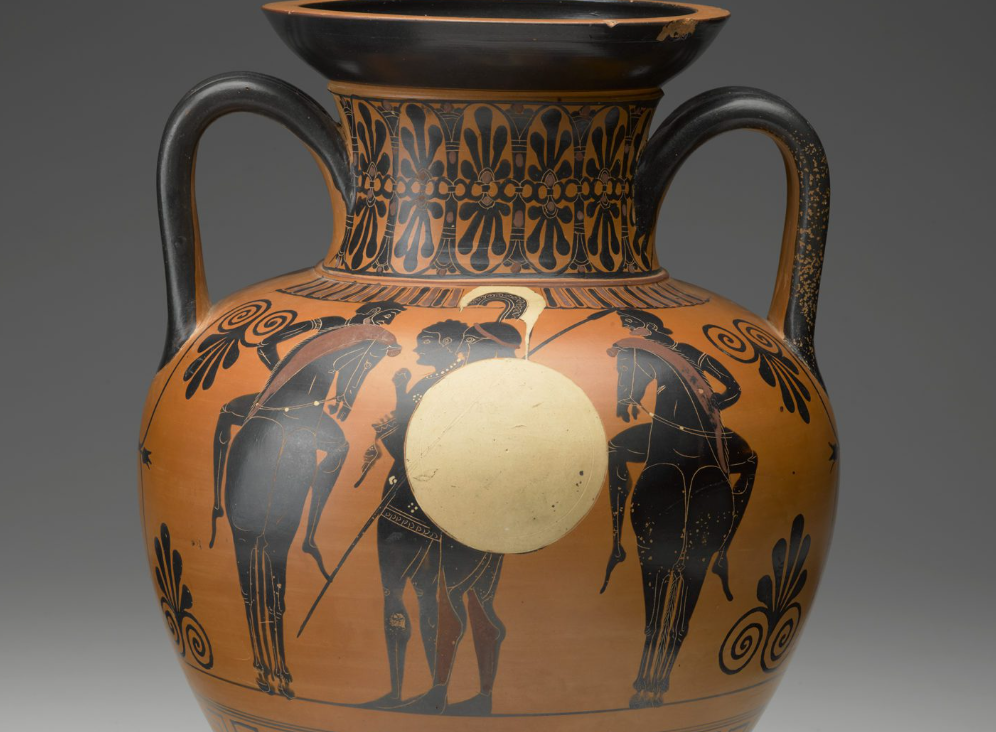
Memnon appears chiefly in the Epic Cycle material summarized by later authors and in works by poets and tragedians who drew on that tradition. He functions in myth as a foil to Achilles and as a representative of the wider, multiethnic cast of forces involved in the Trojan narratives. Artists and sculptors in antiquity and beyond depicted his combat with Achilles, and classical reception preserved his memory through literature, art, and place-names.
Key points
Questions and answers
Q: Who was Memnon in Greek mythology?
A: Memnon was an Aethiopian king and ally of the Trojans during the Trojan War.
Q: What was Memnon's status in Greek mythology?
A: Memnon was considered a demigod and was the son of Tithonus and Eos, the goddess of the dawn.
Q: How was Memnon's skill as a warrior regarded?
A: Memnon was considered to be almost equal in prowess and skill to Achilles.
Q: Whom did Memnon kill during the Trojan War?
A: Memnon himself slew Antilochus in the middle of a fierce battle.
Q: Who killed Memnon during the Trojan War?
A: Achilles later killed Memnon.
Q: How does the death of Memnon echo that of Hector?
A: The death of Memnon appears to echo that of Hector, as both were defenders of Troy and slain by Achilles.
Q: How would you describe Memnon's importance in Greek mythology?
A: Memnon is an important character in Greek mythology as a powerful warrior who was an ally of the Trojans during the Trojan War.
Related articles
Author
AlegsaOnline.com Memnon (mythology) Leandro Alegsa
URL: https://en.alegsaonline.com/art/63728