
Artificial neural network (ANN)
An artificial neural network is a computational model inspired by biological neurons that learns from data; it underpins modern machine learning and deep learning across many applications.
Overview
An artificial neural network (ANN) is a class of computational models designed to recognize patterns and make predictions by learning from examples. ANNs are implemented in software and sometimes specialized hardware, and they take inspiration from the way collections of biological neurons communicate in animal brains — though the resemblance is conceptual rather than literal. By adjusting internal parameters during a training process, an ANN can approximate complicated functions and solve tasks such as classification, regression, sequence prediction, and control.
Image gallery
6 Images



Structure and key components
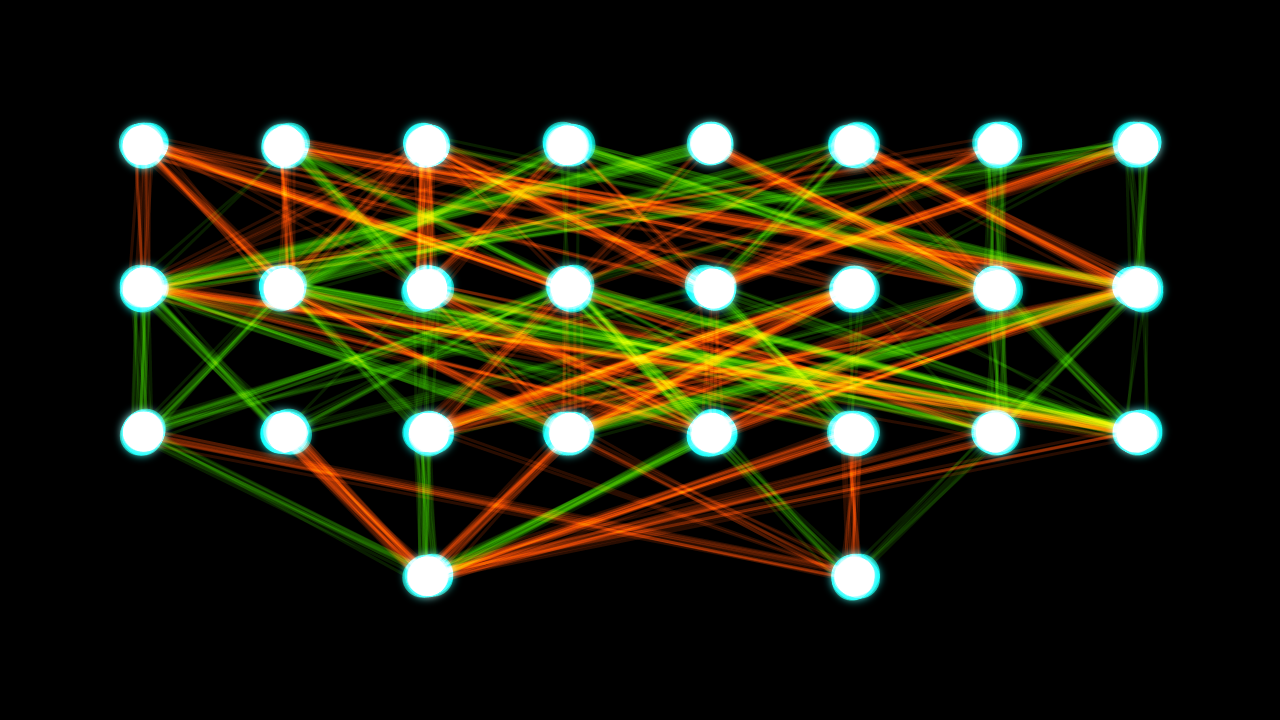
At a basic level, an ANN is built from interconnected units often called neurons, nodes, or units, organized into layers. Typical components include:
- Input layer: receives raw data features.
- Hidden layers: one or more layers where computation and feature extraction occur; deep networks have many hidden layers.
- Output layer: produces predictions or decisions.
- Weights and biases: scalar parameters that scale and shift signals between units and are adjusted during training.
- Activation functions: nonlinear functions (for example, sigmoid, ReLU, or softmax) that enable networks to model complex relationships.
Information flows through the network (in feedforward architectures) and learning commonly proceeds by computing a loss that measures error and then reducing that loss using optimization algorithms such as gradient descent together with the backpropagation method for computing gradients.
Major types and variants
There are many architectures suited to different data and tasks. Common varieties include:
- Feedforward networks (multilayer perceptrons) for general-purpose prediction.
- Convolutional neural networks (CNNs) for image and spatial data.
- Recurrent neural networks (RNNs) and their gated variants for sequential data.
- Transformer architectures, which rely on attention mechanisms and are widely used in language models and other domains.
These approaches are part of the broader field of machine learning and, when organized into very large or deep models trained on huge datasets, are often described as deep learning.
History and development
The concept of artificial neurons dates back to the mid-20th century, beginning with early models such as the perceptron. Progress has come in waves: initial enthusiasm, periods of limited success and theoretical critique, and later revival driven by algorithmic advances, larger datasets, and increased computational power. The modern resurgence of deep networks in the 2000s and 2010s led to rapid advances in tasks like image recognition, speech recognition, and natural language processing.
Applications and importance
ANNs are widely applied across science, industry, and everyday technology. Typical applications include computer vision (object detection, medical imaging), speech and audio processing, natural language understanding and generation, recommendation systems, autonomous vehicles, robotics, and financial forecasting. Their capacity to learn flexible representations from raw data makes them a central tool for building systems that would be difficult to engineer by hand.
Limitations, risks, and distinctions
Despite practical success, neural networks have limitations. They can require large labeled datasets and significant compute resources to train, and they may be sensitive to design choices and hyperparameters. Models can overfit training data and may fail to generalize robustly. Interpretability is an ongoing challenge, and ethical issues such as bias in training data and misuse of capabilities are active areas of concern. It is also important to note that, while inspired by biological neurons, ANNs are highly simplified mathematical abstractions and do not replicate the full complexity of biological brains.
For readers seeking a broader technological or conceptual context, general resources on artificial intelligence and related software can provide further background: artificial intelligence overview, introductory material on software implementations, and practical tutorials in machine learning and deep learning.
Questions and answers
Q: What is a neural network?
A: A neural network (also called an ANN or an artificial neural network) is a sort of computer software, inspired by biological neurons. It is made up of cells that work together to produce a desired result, although each individual cell is only responsible for solving a small part of the problem.
Q: How does a neural network compare to biological brains?
A: Biological brains are capable of solving difficult problems, but each neuron is only responsible for solving a very small part of the problem. Similarly, a neural network is made up of cells that work together to produce a desired result, although each individual cell is only responsible for solving a small part of the problem.
Q: What type of program can create artificially intelligent programs?
A: Neural networks are an example of machine learning, where a program can change as it learns to solve a problem.
Q: How can you train and improve with each example in order to use deep learning?
A: A neural network can be trained and improved with each example, but the larger the neural network, the more examples it needs to perform well—often needing millions or billions of examples in the case of deep learning.
Q: What do you need in order for deep learning to be successful?
A: In order for deep learning to be successful you need millions or billions of examples depending on how large your neural network is.
Q: How does machine learning relate to creating artificially intelligent programs?
A: Machine learning relates to creating artificially intelligent programs because it allows programs to change as they learn how to solve problems.
Related articles
Author
AlegsaOnline.com Artificial neural network (ANN) Leandro Alegsa
URL: https://en.alegsaonline.com/art/6353
Sources
- newscientist.com : "Baby robot learns first words from human teacher"