
Mechanical energy: definition, components, conservation, and applications
Mechanical energy is the sum of kinetic and potential energy in a mechanical system. This article explains its forms, conservation under ideal conditions, common examples, and distinctions from other energy types.
Overview
In physics, mechanical energy refers to the energy associated with the motion and relative positions of objects in a mechanical system. It is a macroscopic form of energy that appears as two primary contributions: kinetic energy of moving parts and potential energy stored because of configuration or position. Mechanical energy is measured in the same units as other forms of energy (joules) and is a useful bookkeeping quantity when analyzing machines, collisions, or the motion of bodies under forces.
Image gallery
3 Images

Components and simple formulas
The total mechanical energy E_mech of a system is commonly written as the sum of kinetic and potential parts: E_mech = K + U. Typical expressions used in elementary mechanics include:
- Kinetic energy (translational): K = 1/2 m v^2, where m is mass and v is speed.
- Gravitational potential energy near Earth's surface: U_grav = m g h, with g the acceleration of gravity and h height above a reference.
- Elastic (spring) potential energy: U_spring = 1/2 k x^2, for spring constant k and extension x.
Conservation and energy transfer
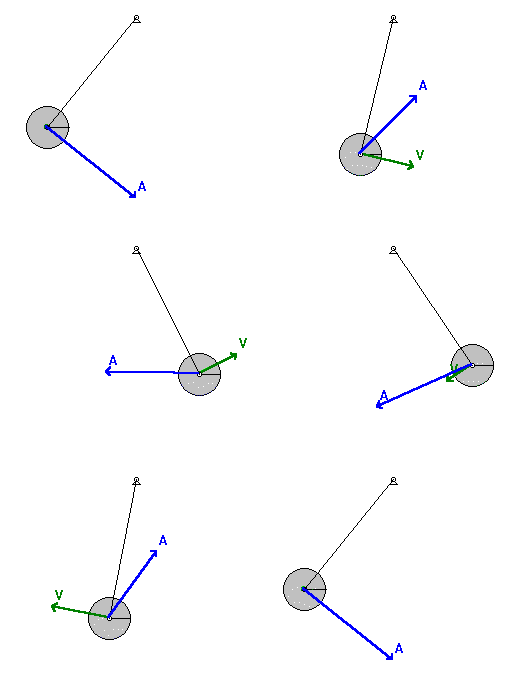
The conservation of mechanical energy states that, for an isolated system acted on only by conservative forces (like gravity or ideal springs), the total mechanical energy remains constant. When non-conservative forces such as friction, air resistance, or inelastic deformation act, mechanical energy can be converted into other forms (thermal energy, sound, internal energy), so E_mech is not conserved. Mechanical work describes the transfer of mechanical energy into or out of a part of a system and depends on the path taken by the forces; energy, however, follows the broader law of conservation of energy which includes all forms.
Uses, examples, and problem types
Mechanical energy concepts appear across science and engineering. Common examples include:
- A thrown ball: kinetic energy increases as it speeds up, while gravitational potential energy changes with height.
- Roller coasters: conversion between U_grav and K determines speeds along the track (neglecting losses).
- Machines and engines: designers track mechanical energy to estimate useful output and losses to friction or heat.
Distinctions and notable facts
Mechanical energy differs from microscopic internal energy (thermal energy, chemical energy) although they can interconvert. Mechanical energy is a state function when referring to the energy content of a system at a given configuration; in contrast, work is process-dependent and quantifies energy transfer. When analyzing real systems, account for non-conservative effects: some lost mechanical energy appears as heat, sound, or permanent deformation. For practical engineering, tracking mechanical energy alongside power and efficiency clarifies performance and conservation limits.
Further reading and resources
For introductory treatments and worked examples consult general physics texts and online resources on energy and work. Foundational topics to explore next include rotational kinetic energy, energy methods in dynamics, and the relationship between force fields and potential energy. See resources in basic physics collections for step-by-step problem solving and visual demonstrations: physics overview, potential energy details, kinetic energy properties, and units and measurement guides at energy units.
Questions and answers
Q: What is mechanical energy?
A: Mechanical energy describes the potential and kinetic energy present in the components of a mechanical system.
Q: What is mechanical work?
A: Mechanical work is the transfer of a given amount of mechanical energy, such as when throwing a ball, lifting a box, crushing a soda can, or stirring a beverage.
Q: How are mechanical energy and mechanical work measured?
A: Both mechanical energy and mechanical work are measured in the same units as energy in general.
Q: What is a state function?
A: A state function is when a component of a system has a certain amount of mechanical energy.
Q: What does "mechanical work" describe?
A: "Mechanical work" describes the amount of mechanical energy a component has gained or lost.
Q: What is the principle of conservation of mechanical energy?
A: The principle of conservation of mechanical energy states that under certain conditions, the total mechanical energy of a system is constant.
Q: Does the conservation of mechanical energy hold when mechanical energy is converted to other forms?
A: No, the rule does not hold when mechanical energy is converted to other forms, such as chemical, nuclear, or electromagnetic. However, the principle of general conservation of energy is an unbroken rule of physics.
Related articles
Author
AlegsaOnline.com Mechanical energy: definition, components, conservation, and applications Leandro Alegsa
URL: https://en.alegsaonline.com/art/63350