
Matrix mechanics: the operator formulation of quantum theory
Matrix mechanics is the original operator-based formulation of quantum theory, using matrices to represent observables and their noncommuting algebra; it remains central to modern quantum physics and computation.
Matrix mechanics was the first complete algebraic formulation of quantum theory. Developed in the mid-1920s as a direct attempt to predict observed atomic spectra, it represents physical quantities—such as energy and position—as arrays of numbers that act on state vectors. Its origin is closely associated with Werner Heisenberg, who sought a calculational scheme for spectral intensities; his ideas were recognized and recast into the language of linear algebra by colleagues such as Max Born. The abstract objects that appear in the theory are now called operators, and many of these operators can be represented concretely by matrices (matrix representations) acting on vectors in a complex vector space.
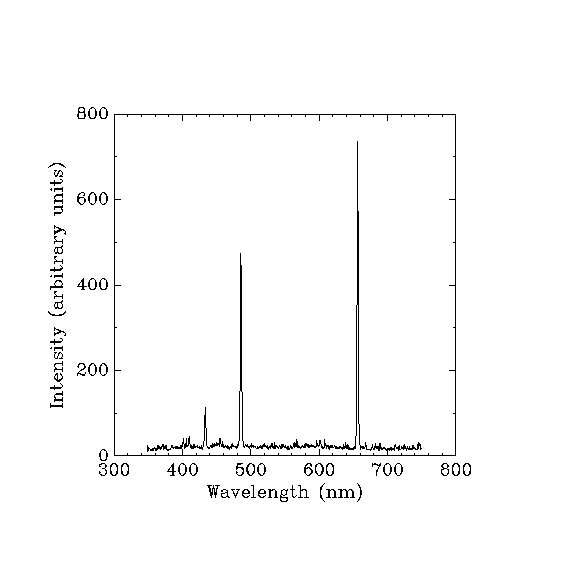
Image gallery
1 Image
Core concepts and structure
At its heart, matrix mechanics replaces classical numbers for observables with operators that generally do not commute. Physical states are described by vectors (or rays) in a Hilbert space, and measurable outcomes correspond to eigenvalues of operators. Key ideas include:
- Operators and matrices: Observables correspond to linear operators. In a chosen basis these operators become matrices whose entries encode transition amplitudes between basis states.
- Eigenvalues and measurement: Measurement yields an eigenvalue of the corresponding operator; the associated eigenvector describes a state with a definite value for that observable.
- Non-commutativity: The order of multiplication matters. Commutation relations such as [A,B] = AB − BA underlie quantum phenomena and constraints on simultaneous measurements.
- Probability interpretation: Probabilities derive from squared magnitudes of projection amplitudes, a probabilistic link clarified by Born and others.

Historical development
The matrix formulation emerged rapidly when physicists realized that Heisenberg's algebraic rules could be interpreted as multiplication rules for arrays. Max Born and his student Pascual Jordan formalized this insight into a systematic matrix theory, and Paul Dirac contributed a unifying, abstract notation. Around the same time Erwin Schrödinger developed wave mechanics; it was soon shown that the two approaches are mathematically equivalent representations of the same underlying quantum framework. One of the most famous consequences of the noncommutative structure is the relation now known as the Heisenberg uncertainty principle, which places fundamental limits on the precision with which pairs of observables can be simultaneously specified.
Uses, examples, and importance
Matrix mechanics is particularly natural and effective when dealing with systems that have discrete states or finite-dimensional state spaces. Typical applications and examples include:
- The analysis of atomic spectra and transition probabilities, which motivated the theory's creation.
- Spin systems and angular momentum, where small matrices (e.g., Pauli matrices) capture essential physics.
- Quantum information and computation, where qubits and gates are described by finite matrices and unitary operations.
- Numerical and computational methods, such as diagonalization and spectral decomposition, which are matrix-based and widely used in practical problems.
Distinctions and notable facts
Matrix mechanics differs in presentation from wave mechanics but not in physical predictions: the distinct formulations are related by changes of representation and are mathematically equivalent. The choice between a matrix or wave description is often guided by convenience: matrices are compact for discrete spectra and operator algebra, whereas wavefunctions are more intuitive for continuous spatial problems. The operator viewpoint also makes clear the algebraic roots of quantum behavior and provides the modern language for quantum field theory and many-body physics. Today, matrix methods remain indispensable across theoretical and experimental quantum science.
Questions and answers
Q: What is Matrix Mechanics?
A: Matrix mechanics is a form of expression of the laws of physics developed by Werner Heisenberg which uses matrices to predict the intensities of photons in various bands of the hydrogen spectrum.
Q: Who developed Matrix Mechanics?
A: Werner Heisenberg initially developed matrix mechanics as an equation to predict the intensities of photons in various bands of the hydrogen spectrum.
Q: How was it discovered?
A: Max Born saw that Heisenberg's equation was essentially a plan for creating and multiplying matrices, thus leading to the discovery of matrix mechanics.
Q: Is it still used today?
A: Yes, matrix mechanics is still used today since it is useful and convenient for some purposes.
Q: Are there other mathematical ways to express quantum physics?
A: Yes, Erwin Schrödinger's equation using a wave function is mathematically equivalent but easier to use for other purposes.
Q: What was one early success associated with this theory?
A: One early success associated with this theory was what is now known as Heisenberg's Uncertainty Principle.
Q: Who announced this success shortly after its development?
A: The announcement of this success shortly after its development was made by Werner Heisenberg himself.
Related articles
Author
AlegsaOnline.com Matrix mechanics: the operator formulation of quantum theory Leandro Alegsa
URL: https://en.alegsaonline.com/art/62850