
Matanuska–Susitna Valley (Mat‑Su Valley): geography, history, and uses
A concise overview of Alaska’s Matanuska–Susitna Valley — its landscape, rivers and mountains, settlement history, economy, government and recreational importance.
Overview
The Matanuska–Susitna Valley, commonly called the Mat‑Su or simply the Valley, is a broad river and mountain corridor in Southcentral Alaska roughly 25 miles north of Anchorage. It contains the drainage basins and lowlands formed by the Matanuska, Knik and Susitna rivers and has grown into a populous exurban and rural region within the state. Many residents commute to jobs in Anchorage, creating a strong suburban and commuter connection that has shaped land use and transportation patterns in the area (commuter community).
Image gallery
2 Images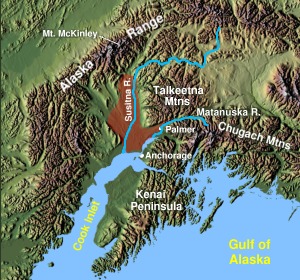

Geography and hydrology
The Valley occupies a broad glacial trough carved by repeated ice advances during the Pleistocene. Large rivers—including the Matanuska and Susitna—drain glaciers and headwater basins, feeding numerous lakes and braided channels. The legacy of glaciation is visible in moraines, outwash plains and the fine mineral sediments carried downstream. Those fine sediments, often called glacial silt, help create unusually fertile floodplain soils for Alaska and support limited large‑scale agriculture in the region (glaciers, glacial silt).
Mountains, minerals and natural resources
The Valley is framed by several mountain ranges. Important local ranges include:
- Alaska Range to the north and northwest
- The Talkeetna Mountains, rising along the eastern side of the valley
- Chugach Mountains to the south and southeast
These uplands contain both historic and active extraction sites. Prospectors and miners sought gold and other minerals in the early 20th century, and traces of that period remain in old workings and small operational mines (gold, mines). Streams and river corridors support significant salmon runs, an ecological and cultural resource for people and wildlife (salmon).
Settlement, communities and land use
The Valley includes a mix of small towns, suburban neighborhoods and rural homesteads. Principal population centers and communities include:
Settlement patterns reflect waves of migration: indigenous Alaska Native communities long preceded Euro‑American arrivals, and the federal relocation and colonization efforts of the early 1930s brought new farming families to the region. Later 20th‑century growth was driven by Anchorage’s expansion and by newcomers seeking recreational and rural lifestyles in Alaska.
Government, administration and distinctions
The area is administered as the Matanuska‑Susitna Borough, the local municipal authority responsible for planning, schools and services in the region (borough). Alaska’s use of boroughs differs from much of the rest of the United States, where counties are the common subdivision; some Alaskan territory remains unorganized and outside boroughs (counties). The Mat‑Su borough deals with development pressures as population increases while also managing resources and subsistence access for Alaska Native and long‑resident communities (Alaska Natives).
Economy, recreation and significance
The Valley’s economy blends agriculture, resource extraction, tourism and commuter employment. Its farms, helped by the rich river sediments, are among the few in Alaska suitable for larger‑scale production of vegetables and forage crops. Outdoor recreation—hiking, fishing, hunting, winter sports and river activities—draws residents and visitors year‑round. The interplay of productive river systems, mountain backcountry and proximity to Anchorage gives the Mat‑Su Valley a distinctive role in Alaska’s landscape as both a working rural region and a gateway to wilderness.
For readers seeking additional maps, community information and resource management details, regional planning documents and local government pages provide regularly updated material (regional context, Southcentral overview). Historical accounts and natural history summaries are useful for understanding how glaciers, rivers and human settlement combined to form today’s Mat‑Su Valley.
Further reading and resources: local borough publications, fisheries reports and geological surveys summarize current information on salmon returns, mineral prospects and agricultural production (fisheries, soil and silt studies, mining reports).
Additional context on transportation links, suburban growth patterns and conservation efforts can be found through planning and regional outreach portals (Anchorage connections, commuting patterns, town information).
Historical migrations and demographic notes are available in local histories that cover early colonist settlements of the 1930s and subsequent decades of population change (community history, gold rush era).
For visitor planning and recreational guidelines, consult regional trail and wildlife resources that describe public access points, safety advisories and seasonal considerations (recreation, mountain access).
Questions and answers
Q: What is the Matanuska-Susitna Valley?
A: The Matanuska-Susitna Valley is an area in Southcentral Alaska located south of the Alaska Range about 25 miles from Anchorage. It includes the valleys of the Matanuska River, Knik River, and Susitna River.
Q: What towns are located in the valley?
A: The towns located in the valley include Palmer, Wasilla, Big Lake, Houston, Willow and Talkeetna.
Q: What mountain ranges are found in this area?
A: The mountain ranges found in this area are the Alaska Range, Talkeetna Mountains and Chugach Mountains.
Q: Are there any gold mines in these mountains?
A: Yes, there are both working and old gold mines found in these mountains.
Q: How was this region formed?
A: This region was formed by glaciers which left many lakes throughout the area.
Q: Who governs this region?
A: This region is governed by a local government called the Matanuska-Susitna Borough.
Q: How did people come to settle here originally?
A: People first came to settle here between 1900 and 1930 when hundreds of "colonists" were moved here by the United States Federal Government during early 1930s. In 1970's more newcomers arrived to Anchorage before moving to live an "Alaskan country" lifestyle in Matanuska Valley.
Related articles
Author
AlegsaOnline.com Matanuska–Susitna Valley (Mat‑Su Valley): geography, history, and uses Leandro Alegsa
URL: https://en.alegsaonline.com/art/62768