
Mass versus weight: understanding the difference
Clear, concise explanation of mass and weight — definitions, units, measurement methods, examples (Earth, Moon, poles), and common confusions between the two.
Overview
In the physical sciences the terms mass and weight refer to distinct concepts. Mass is a measure of the amount of matter in an object and is an intrinsic property that does not change when the object moves between locations. Weight is the force exerted on that mass by a local gravitational field (or by acceleration), so weight depends on both mass and the strength of gravity at a given place.
Image gallery
6 Images


Core relationship and formula
The numerical connection is commonly written as W = m · g, where W is weight (a force), m is mass, and g is the acceleration due to gravity at the location. On Earth, g is about 9.8 m/s², so a mass of one kilogram experiences a downward force close to 9.8 newtons. Because weight depends on g, the same object has a different weight on the Moon, a different weight at the equator than at the North Pole, and effectively zero apparent weight when in free fall (for example, orbiting spacecraft).
Units and common usage
Mass is measured in units such as kilograms or grams. Everyday language sometimes uses pounds, which can mean pound-mass or pound-force depending on context; this causes confusion because pounds may refer to mass in commerce but to force in engineering. A simple reference is that a one‑liter container of water has a mass near one kilogram because of its volume and density. Weight is measured in units of force such as newtons in the International System (SI) or pound-force in some customary systems.
How mass and weight are measured
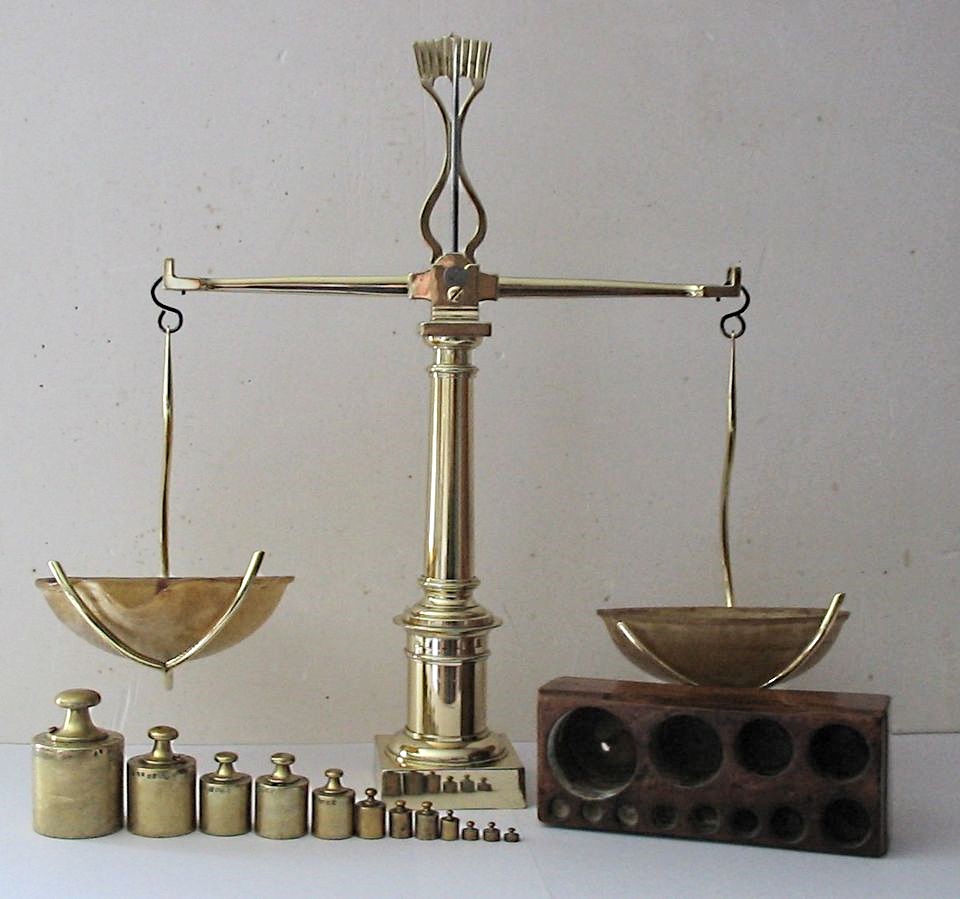
- Balance scales compare masses directly and give the same reading regardless of local gravity, because they compare two masses rather than measuring force.
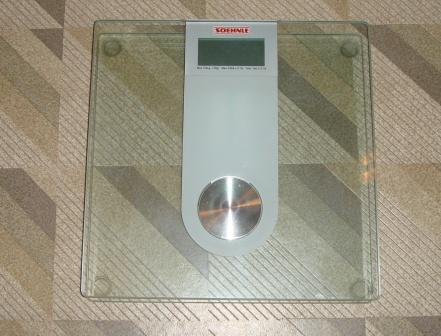
- Spring scales and many electronic scales measure the force the object exerts on the device and therefore measure weight or apparent weight; their reading changes if gravity or acceleration changes.
- Apparent weight can also change because of buoyancy in a fluid or acceleration in an elevator or vehicle; these effects alter the net force a scale senses.
Examples, importance and applications
Distinguishing mass from weight matters across science and daily life. Engineers must use mass when computing inertia and dynamics, while structural designers must consider weight as a force that loads supports and foundations. Astronauts in orbit experience near‑weightlessness even though their mass is unchanged. Commercial weighing for shipping and retail typically treats ‘‘weight’’ as a measure of mass, which works because instruments and regulations standardize the meaning for the context.
History and conceptual notes
Historical figures such as Galileo and Newton framed the ideas of inertial motion and universal gravitation that underpin mass and weight. Modern physics emphasizes the equivalence of inertial and gravitational mass, a principle central to Einstein’s theories of gravity. In everyday speech the terms are often used interchangeably, but in technical contexts the distinction is important for correct calculations, measurements, and safety.
For further reading on the basic definitions, measurement techniques, and historical development, see resources linked to the scientific terms above.
Questions and answers
Q: What is the difference between mass and weight?
A: Mass is a measure of the amount of matter in an object, while weight is a measure of the force on an object caused by gravity.
Q: What is weight?
A: Weight is how hard gravity pulls on an object.
Q: Will the mass of an object change if it is moved from the equator to the North Pole?
A: No, the mass of an object will remain the same.
Q: Will the weight of an object change if it is moved from the equator to the North Pole?
A: Yes, the weight of an object will grow by 0.5% due to the increase in the earth's gravitational field.
Q: What units are used to measure mass?
A: Mass is measured in kilograms or pounds.
Q: What is the mass of a one-liter volume of water?
A: The mass of a one-liter volume of water is one kilogram.
Q: What units are used to measure weight?
A: Weight is measured in newtons, which is the standard unit for force.
Related articles
Author
AlegsaOnline.com Mass versus weight: understanding the difference Leandro Alegsa
URL: https://en.alegsaonline.com/art/62682