
Marzahn: history, development and landmarks of a Berlin locality
Marzahn is an eastern Berlin locality known for its large postwar housing estate, the Gärten der Welt park, wartime memorials, and its administrative history within Marzahn‑Hellersdorf.
Overview
Marzahn is a locality in the eastern part of the German capital, administered within the borough Marzahn‑Hellersdorf. It forms part of metropolitan Berlin and is commonly identified by a combination of high‑density residential blocks, broad green spaces and a number of memorial sites that reflect difficult episodes of twentieth‑century history. Local services and cultural programmes are coordinated at borough level (local borough offices).
Image gallery
10 Images




Geography and subdivisions
The locality covers a varied landscape that includes surviving village cores, large prefabricated housing complexes and parkland. To the north an elongated strip of land that once belonged to the Brandenburg municipality of Ahrensfelde is now integrated with Marzahn. Within the locality small neighbourhoods and residential clusters, such as Bürknersfelde, form part of the everyday urban fabric.
Origins and medieval history
The settlement now called Marzahn appears in medieval records: a deed around 1300 names the village as Morczane when Margrave Albert III of Brandenburg granted local estates to the Cistercian abbey at Friedland. Over the centuries the village remained within the evolving territory of Brandenburg and passed into the domain of successive regional rulers; its rural character persisted until the modern era.
Twentieth century: incorporation and housing development
Marzahn was incorporated into Greater Berlin in 1920 as part of the Lichtenberg district (Lichtenberg). In the late twentieth century, particularly during the era of the German Democratic Republic, the area was dramatically reshaped by large‑scale housing construction. Prefabricated concrete apartment blocks (Plattenbau) produced one of the largest contiguous council‑era estates in Berlin. Administratively, the estate became the centre of a separate borough in 1979; later boundary changes created Hellersdorf and related localities in 1986, and a 2001 municipal reform reunited the two boroughs in the present configuration.
Nazi era and memorials
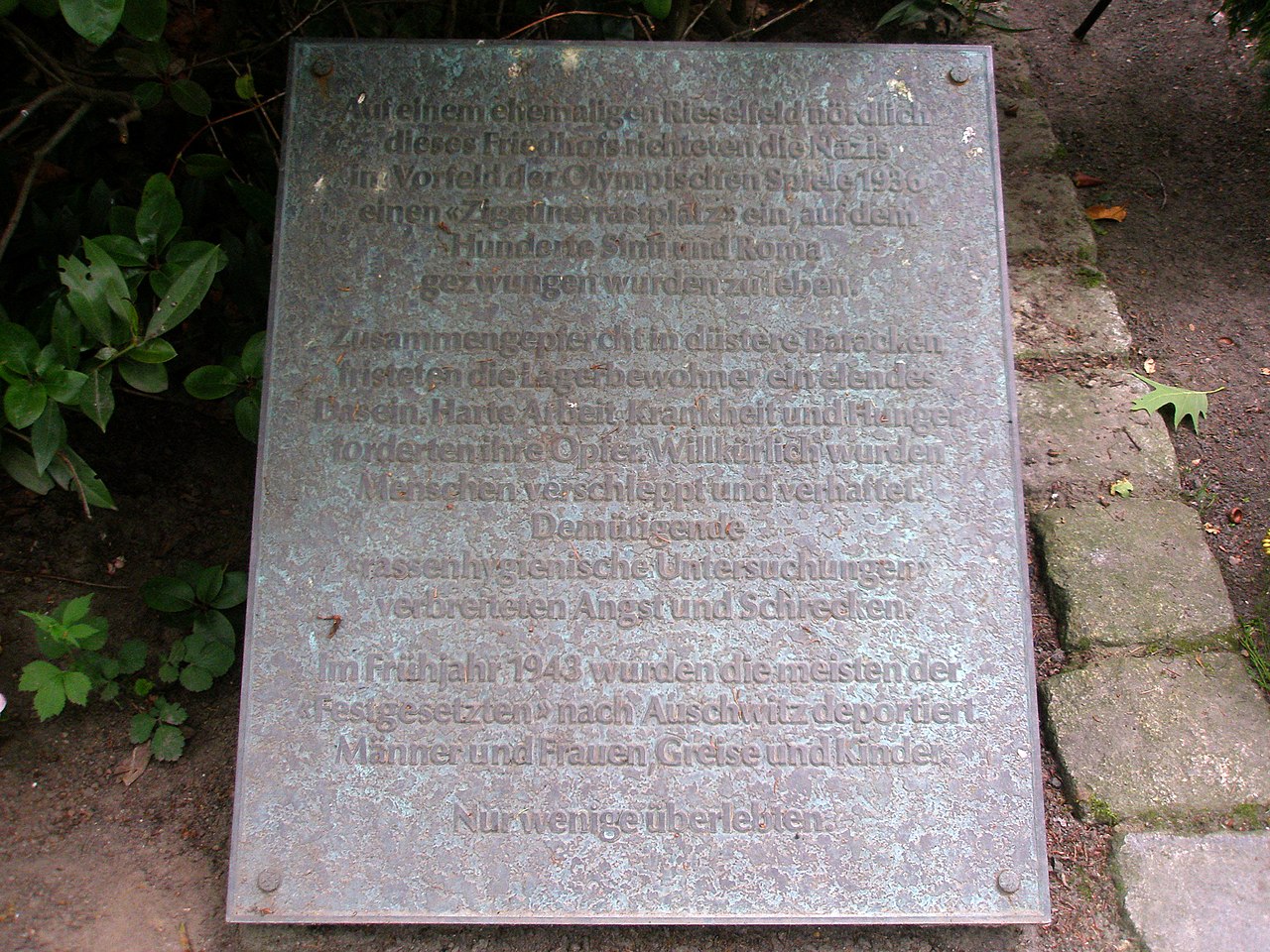
Marzahn carries a painful legacy from the Nazi period. In July 1936, shortly before the Olympic Games in Berlin, Roma people were interned in a camp on the outskirts of the locality, a move intended to remove them from public view during the event (1936 Olympics). This internment was part of wider persecution that eventually led many Roma and Sinti to be deported to extermination camps such as Auschwitz‑Birkenau. The camp site later became the location of a water treatment facility (site today), and local cemeteries and memorials commemorate both Roma victims and forced labourers who died during the Second World War. Accounts note that several hundred to up to around 2,000 people were affected by the Marzahn internment and subsequent deportations; memorials and information panels preserve this memory (Roma history).
Post‑1989 changes and urban renewal
After German reunification, Marzahn underwent social and physical change. Some industrial sites were repurposed and small commercial enterprises emerged alongside public‑sector investment in transport and services. Urban renewal projects have focused on improving energy efficiency in older panel housing, diversifying housing types and enhancing public spaces. Local planning balances the preservation of green areas with the need for modern amenities.
Parks, culture and the Gärten der Welt
One of Marzahn’s best‑known visitor attractions is the complex created from the 1987 Berliner Gartenschau (Gartenschau), held to mark Berlin’s 750th anniversary. The Erholungspark Marzahn contains the Gärten der Welt (Gardens of the World), a landscaped ensemble that presents a range of international garden designs. Visitors encounter a Chinese garden, a Japanese garden (Japanese), Balinese and Korean sections, and a recreated Italian Renaissance garden. The park also includes labyrinth elements inspired by places such as Hampton Court and Chartres (labyrinth inspirations), and hosts seasonal festivals, guided tours and horticultural displays.
Economy, transport and contemporary life
Today Marzahn combines residential neighbourhoods with light industry, retail and local services. Former factory sites have been adapted for modern uses, while some industrial employers remain important to the local economy. Public transport and road connections link Marzahn to central Berlin and nearby districts; these links support commuting, shopping and cultural exchange. For historical context on municipal changes see references to East Berlin administrative history and the region’s earlier governance within Brandenburg (Thirty Years' War background).
Notable sites and visitor information
- Gärten der Welt — a major landscaped attraction with international theme gardens and events.
- Erholungspark Marzahn — public parkland developed from the 1987 horticultural exhibition.
- Memorial sites and cemeteries — places of remembrance for Roma internment and wartime forced labour victims.
- Prefabricated housing estate — the large Plattenbau development that defines much of the locality’s architectural character.
Visitors seeking official information, guided tours or archival material may consult borough resources and cultural services provided by Marzahn‑Hellersdorf and related municipal pages. Local museums, memorials and the park authority also supply educational materials for those wishing to explore Marzahn’s layered history and contemporary life.
Questions and answers
Q: What is Marzahn?
A: Marzahn is a locality within the borough Marzahn-Hellersdorf of Berlin.
Q: When did Marzahn become part of Greater Berlin?
A: Marzahn became part of Greater Berlin in 1920, as a part of the Lichtenberg district.
Q: What happened to Marzahn and Hellersdorf in 2001?
A: In 2001, the former boroughs of Marzahn and Hellersdorf were fused into a single new borough.
Q: Who owned the land that now includes Bürknersfelde and Ahrensfelde?
A: The land that now includes Bürknersfelde and Ahrensfelde once belonged to the Brandenburg municipality of Ahrensfelde and was incorporated into Berlin in 1990.
Q: When was Marzahn first mentioned in history?
A: The historic village of Marzahn was first mentioned as Morczane in a 1300 deed by Margrave Albert III of Brandenburg-Salzwedel.
Q: What happened at the labour camp located in Marzhan during WWII?
A: During WWII, a labour camp located in Marzan interned Roma from July 16, 1936 on until 1943 when they were deported to Auschwitz-Birkenau where most were gassed as part of Nazi Porajmos extermination policy.
Q: What event took place at Erholungspark (Recreation Park)Marazhn 1987? A:In 1987, Erholungspark (Recreation Park)Marazhn hosted the Berliner Gartenschau which was a horticulture show on the occasion of Berlin's 750th anniversary.
Related articles
Author
AlegsaOnline.com Marzahn: history, development and landmarks of a Berlin locality Leandro Alegsa
URL: https://en.alegsaonline.com/art/62522