
Artemision Zeus (Early Classical Greek Bronze, c. 460 BCE)
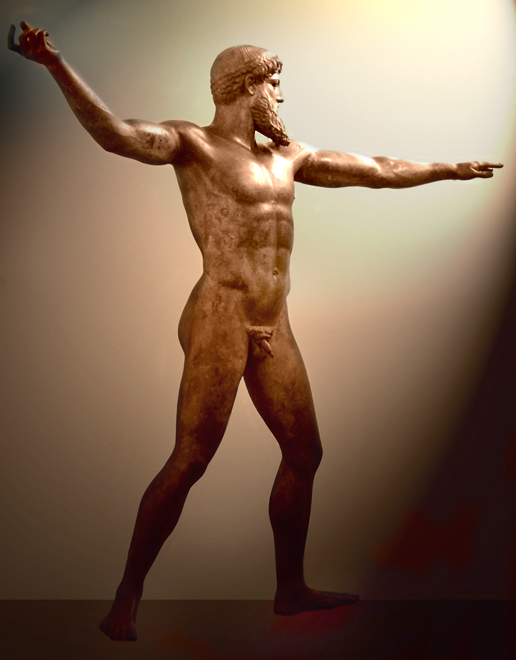
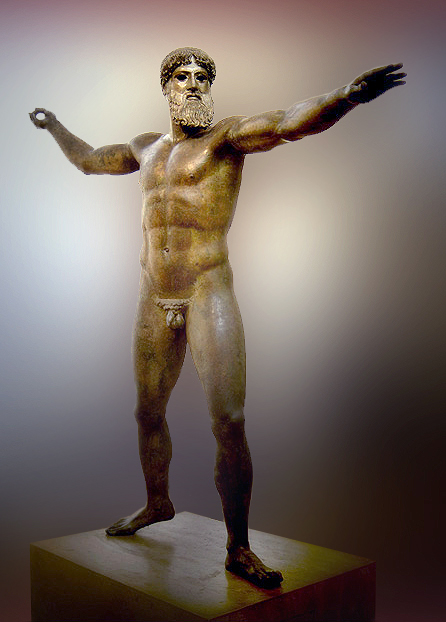
A 2.09 m hollow-bronze statue from c. 460 BCE recovered off Cape Artemision. Traditionally called Zeus, but its missing attribute leaves room for debate; now exhibited in the National Archaeological Museum, Athens.
Overview
The Artemision Zeus is a full-size Greek bronze statue dating to the Early Classical period (around 460 BCE). Recovered from the wreckage of a ship off Cape Artemision in northern Euboea during excavations in 1926–1928, the sculpture stands approximately 2.09 metres tall and is one of the few substantial bronzes from classical Greece to survive to the present day. It is conserved and displayed in the National Archaeological Museum in Athens.
Image gallery
10 Images



Description and identity
The figure is shown in a vigorous, forward-stepping stance with one arm raised. Many of its extremities and the object once held in the raised hand are missing, leaving the identity open to interpretation. Traditionally the statue has been identified as Zeus, the sky god, but alternative readings suggest it could represent Poseidon, the sea god. The ambiguity arises because the same pose could suit either a thunderbolt or a trident; some scholars, notably Caroline Houser, have argued that a long trident would have obscured the face and therefore favour identification as Zeus. The well-proportioned anatomy, the turned head and the sense of imminent action are characteristic of the transitional "Severe" style of the early fifth century BCE.
Artistic features and technique
The sculpture reflects developments in naturalism that followed the Archaic period: muscles and weight shift are rendered with observation of the living body rather than formulaic patterns. Like other monumental bronzes of the era, it was made by joining separately cast elements, probably using techniques derived from the lost-wax method to produce a hollow, life-sized form. Surviving surface detail suggests careful modelling of hair and beard, and the overall dynamism is typical of the mid-fifth-century repertoire that also produced works such as the Riace bronzes.
Context, recovery and conservation
The statue was recovered from a shipwreck that contained other wooden and bronze fragments, a find that illustrates the movement of artworks and trade in the classical Mediterranean. Its survival is due to the shipboard context and the durability of bronze, although seawater and corrosion have removed or damaged many original parts. Conservation and reconstruction have focused on stabilising the metal and mounting the figure for public display while preserving evidence of its archaeological find-spot.
Significance and notable facts
- Material: bronze; technique: hollow casting and assembly of multiple pieces.
- Date: c. 460 BCE, Early Classical (Severe) style.
- Height: about 2.09 m.
- Discovery: shipwreck off Cape Artemision, excavated 1926–1928.
- Current location: National Archaeological Museum, Athens.
- Attribute uncertainty: whether the raised hand held a thunderbolt or a trident remains debated, which affects the identification as Zeus or Poseidon.
Because large bronzes were often melted down in antiquity, the Artemision figure is a rare and invaluable witness to fifth-century Greek monumental sculpture and to techniques of casting and display. Its precise identity may never be fully resolved, but its artistic quality and archaeological context continue to inform understanding of classical art and maritime trade.
Questions and answers
Q: What is the Artemision Zeus?
A: The Artemision Zeus is a Greek bronze statue.
Q: When was the Artemision Zeus created?
A: The Artemision Zeus dates back to the Early Classical period, around 460 BC.
Q: What is the height of the Artemision Zeus?
A: The Artemision Zeus stands 2.09 meters tall.
Q: Where was the Artemision Zeus found?
A: The Artemision Zeus was found in the debris of a shipwreck near Cape Artemision in 1926-1928.
Q: Where is the Artemision Zeus located today?
A: The Artemision Zeus is currently on display at the National Museum in Athens.
Q: Which mythological figure is the Artemision Zeus believed to represent?
A: The identity of the figure depicted in the Artemision Zeus is a subject of some debate, with some experts believing it is Zeus, while others suggest it may be Poseidon.
Q: Why do some scholars believe the figure in the Artemision Zeus is not Poseidon?
A: Caroline Houser believes it is unlikely the statue is Poseidon because his trident would obscure the statue's face.
Tags
Related articles
Author
AlegsaOnline.com Artemision Zeus (Early Classical Greek Bronze, c. 460 BCE) Leandro Alegsa
URL: https://en.alegsaonline.com/art/6247