
Marsupial lion (Thylacoleo): extinct Australian carnivorous marsupial
Thylacoleo, the marsupial lion, was a distinctive Pleistocene carnivore from Australia. This article summarizes its taxonomy, anatomy, feeding adaptations, fossil record, and leading ideas about its extinction.
Overview
The marsupial lion is the informal name given to species of the genus Thylacoleo, an extinct group of carnivorous marsupials that lived in Australia during the Pleistocene. Fossils indicate the genus persisted from roughly 1.6 million years ago until around 45,000–46,000 years ago. Studies of skulls, teeth and limb bones have helped palaeontologists reconstruct its lifestyle, ecological role and relationships to other Australian mammals. For background on classification see classification notes and for the continent where it lived see Australia.
Image gallery
7 Images




Taxonomy and species
Thylacoleo belongs to the order Diprotodontia, a diverse group that includes herbivorous kangaroos and wombats as well as tree-dwelling possums. Although often called a "lion" because of its predatory habits, it is not closely related to placental cats; rather, it represents a striking case of convergent evolution. For comparisons with other large carnivores in Australia see largest marsupial carnivore. Debates continue about the number of valid species and variation within the genus.
Anatomy and adaptations
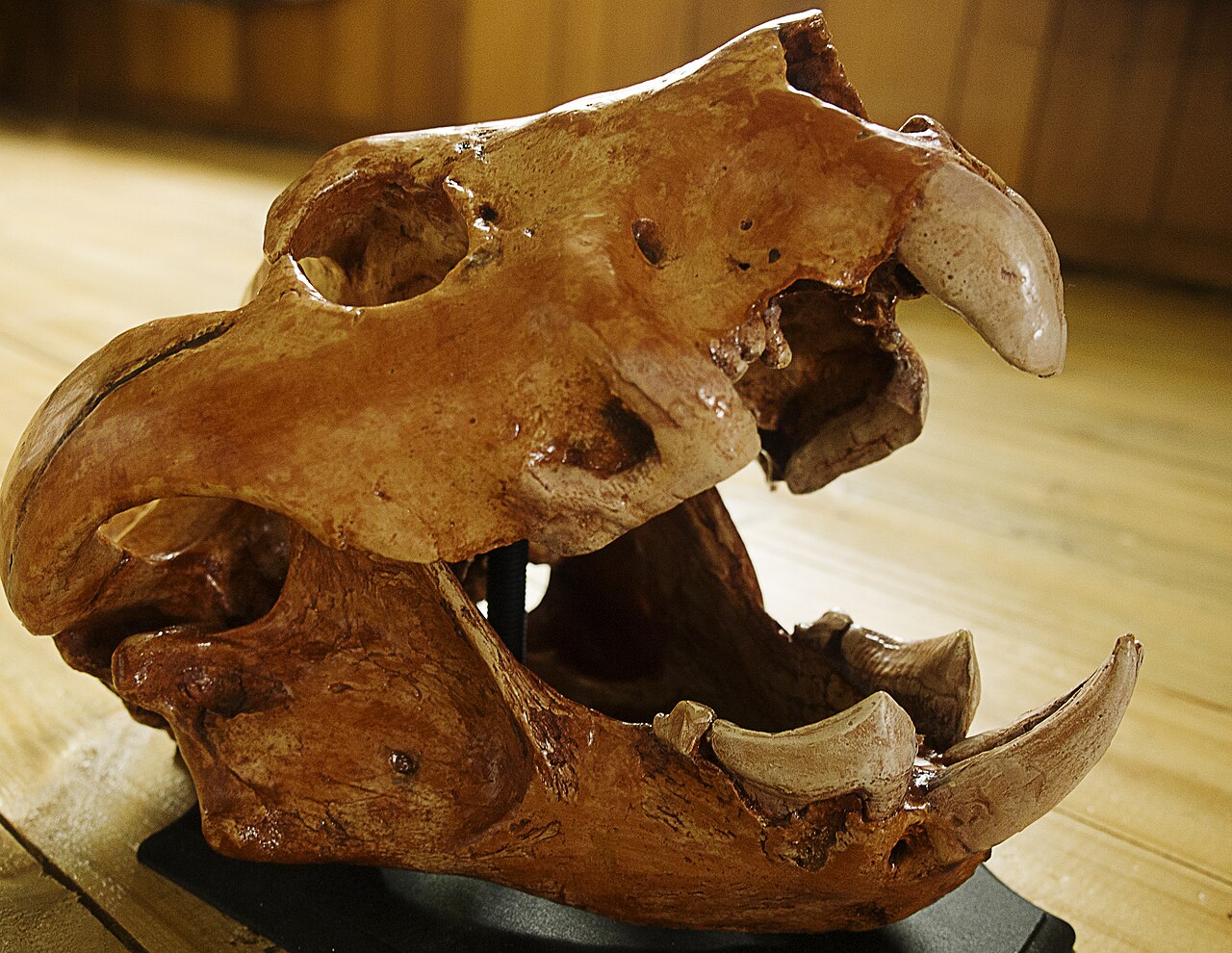
Thylacoleo combined a robust, short skull with highly specialised teeth. The premolars were enlarged and blade‑like, adapted for slicing flesh, while the jaws and associated muscles suggest concentrated bite force at the front of the mouth. Forelimbs were powerful with large attachment areas for muscles, and the first digit on each forepaw was semi‑opposable with an enlarged claw. The claws could be sheathed or protected and were effective for gripping and climbing. For discussion of fossil material see fossil remains.
Claws, limbs and locomotion
Forelimb strength and retractable-like claws imply that Thylacoleo could grapple with prey and may have been competent at climbing trees or rocky outcrops. The hind foot retained a reduced first digit and pads that resemble those of arboreal possums, and it is uncertain whether the genus exhibited the fused second and third toes (syndactyly) found in some related diprotodonts; see diprotodonts for comparison. Such traits have prompted contrasting reconstructions: an ambush predator that used elevation to pounce, or a ground‑based stalker that relied on strength and a powerful bite.
Feeding mechanics and prey
Biomechanical estimates indicate that Thylacoleo had among the most powerful bite forces known for its size. Its dentition and jaw mechanics suggest it delivered deep, crushing or slicing bites rather than extended chewing. Probable prey included sizeable browsing marsupials such as giant kangaroos and large wombat-like herbivores; see an example at giant kangaroo. Size reconstructions vary: some large individuals have been estimated to approach 130 kg in mass (about 287 lb), with body lengths near 1.5 m and shoulder heights around 75 cm (roughly 5 ft long and 2 ft tall).
Fossil record and key localities
Important fossils come from cave deposits, lacustrine and shelter contexts and arid limestone plains. Notable finds and well‑preserved material have been recovered from regions such as the Nullarbor Plain, which preserve bones and trackways in sheltered deposits; see Nullarbor Plain. Continued discoveries refine knowledge of its anatomy, age range and geographic distribution.
Extinction and paleoecology
The disappearance of Thylacoleo coincides with broader changes in Pleistocene Australia. Its extinction occurred during a period when climates shifted and human populations expanded across the continent. Most researchers favour a multifactorial explanation that includes habitat change, reduced prey availability and indirect or direct human impacts, rather than a single cause. For discussion of climatic and anthropogenic factors see human activity and climate change and broader patterns among Australian megafauna.
Scientific significance and public interest
Thylacoleo is often highlighted in discussions of convergent evolution because it evolved powerful, carnivore‑like features from an ancestry of mostly herbivorous marsupials. It remains a focal taxon in studies of predator ecology, Pleistocene food webs and the interaction between early humans and megafauna. Fossils are displayed in museums and cited in educational resources and summaries; for curated materials consult institutional pages and specialist reviews linked here and in further reading.
- Taxonomic context and classification: classification notes.
- Geographic setting: Australia, including arid and temperate provinces.
- Anatomical comparisons: largest marsupial carnivore summaries and studies.
- Primary fossil sources: fossil remains and cave deposits such as the Nullarbor Plain.
- Ecological and extinction studies: human activity and climate change and the fate of Australian megafauna.
- Comparative anatomy: see diprotodonts and other marsupial groups.
- Representative prey and size estimates: giant kangaroo, estimated mass near 130 kg (287 lb), length about 1.5 m (5 ft) and shoulder height near 75 cm.
Ongoing fieldwork and reanalysis of existing specimens continue to refine our understanding of the marsupial lion. As with many Pleistocene taxa, reconstructions balance direct fossil evidence with cautious interpretation where data are limited. For authoritative summaries and primary literature, consult specialist palaeontological sources and museum collections that curate Thylacoleo material.
Questions and answers
Q: What animal is the text discussing?
A: The text is discussing the Marsupial lion, Thylacoleo.
Q: When did this animal live in Australia?
A: The Marsupial lion lived in Australia from 1,600,000 to 46,000 years ago.
Q: What caused the extinction of this species?
A: Humans and climate change probably caused the extinction of the Australian megafauna about 45,000 years ago.
Q: How was it adapted for hunting its prey?
A: It had retractable claws which allowed them to remain sharp by protecting them from wear when walking. It also had semi-opposable first digits on each hand with an enlarged claw which would have been used to grapple with its prey. Additionally, it had four functional toes on its hind feet with a roughened pad similar to that of possums which may have assisted with climbing.
Q: How powerful was its bite compared to other mammals?
A: Biologists estimate that it had the most powerful bite of any mammal, alive or extinct.
Q: What size was it approximately?
A: The marsupial lion could weigh up to 130 kg (287 lb) and was about 1.5 m (5 ft) long and stood about 75 cm (2 ft) tall.
Related articles
Author
AlegsaOnline.com Marsupial lion (Thylacoleo): extinct Australian carnivorous marsupial Leandro Alegsa
URL: https://en.alegsaonline.com/art/62291
Sources
- lostkingdoms.com : "Australia's Lost Kingdoms - Pleistocene marsupial lion"
- abc.net.au : "News in science - marsupial lion reignites megafauna debate - 25/01/2007"
- pbs.org : "Bone diggers – anatomy of Thylacoleo"
- theage.com.au : "Ice Age marsupial lion a real nipper of a beast - National - www.theage.com.au"
- theaustralian.news.com.au : "Marsupial lion was fast killer"
- smh.com.au : "Underground monsters found - Science - Specials - smh.com.au" · web.archive.org
- news.yahoo.com : news.yahoo.com
- news.com.au : "Mega-marsupial grave in dry lake"