
Marne (river in France)
The Marne is a major river in northeastern France, a right tributary of the Seine. It shaped regional geography, lent its name to four departments, and was the site of two important First World War battles.
The Marne is a prominent river in northeastern France. Its main source lies on the Langres plateau and the river flows generally northwest across a varied landscape before joining the Seine to the east and southeast of Paris. Coordinates given for a central point on its course are often cited at 48°49′01″N 2°24′34″E. Over centuries the Marne's valley has influenced settlement patterns, transport routes and agricultural use in the surrounding region.
Image gallery
10 Images


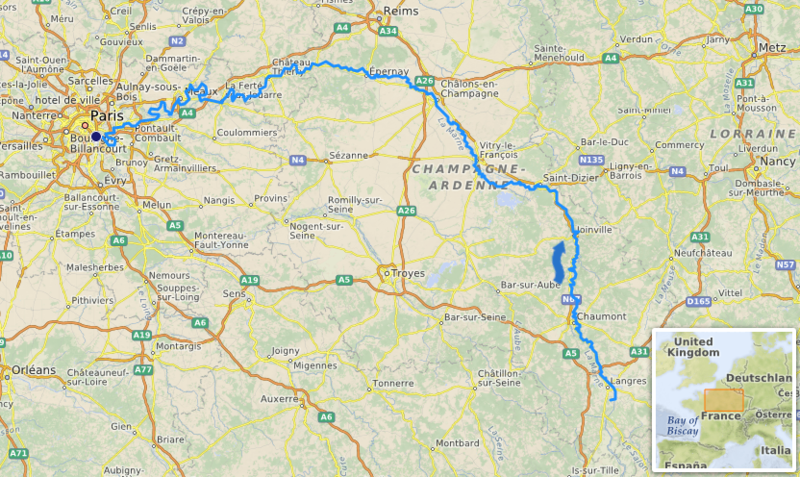

Course and administrative significance
The Marne traverses plateaux, chalky slopes and open floodplains. It passes by or near several historic towns and urban centres, and is associated with administrative divisions: four French departments take their names from the river and its valley. Those departments are listed here as examples of the river's regional importance:
These names reflect how the Marne has been a reference point for local administration and identity; for further administrative context see departments named after the Marne.
Hydrology, navigation and tributaries
The Marne receives water from many smaller streams and tributaries which contribute to its seasonal flow; among those frequently mentioned in geographic descriptions are the Ourcq and the Grand Morin. Parts of the river have been modified: sections are canalised or run alongside lateral canals, and they form part of a broader inland waterway network used historically for commerce and today also for leisure and tourism. Locks, towpaths and riverworks illustrate the long relationship between the Marne and navigation.
Towns, landscapes and economy
The Marne valley crosses areas renowned for agriculture and viticulture. Slopes and terraces in parts of the basin lie within the Champagne-producing region and support vineyards that contribute to a well-known wine industry. Towns along the course have benefitted from river transport, water supply and fertile soils; riverbanks host mills, bridges and historic riverside streets that are elements of local cultural heritage.
History and the Battles of the Marne
The river is closely associated with two major engagements in World War I. The First Battle of the Marne in 1914 stopped a rapid advance toward Paris and altered the early course of the conflict; a later battle in 1918 helped to halt further large-scale offensives. Both events left a lasting imprint on the landscape and on collective memory, and numerous memorials, cemeteries and preserved battle-sites remain in the region.
Environment and management
Water management, flood-control and habitat conservation are ongoing concerns for the Marne. Authorities and local organisations work to balance navigation, agricultural irrigation, urban water needs and the protection of aquatic and riparian habitats. Conservation efforts often focus on water quality, floodplain restoration and maintaining habitats for fish and wetland species.
The Marne continues to be valued as a transport corridor, an agricultural resource, a cultural landscape and a site of historical memory. For practical information, guidance and regional resources consult local authorities and dedicated regional sites linked to the river's course.
Questions and answers
Q: What are the coordinates of the Marne river in France?
A: The coordinates of the Marne river in France are 48°49′01″N 2°24′34″E / 48.81694°N 2.40944°E / 48.81694; 2.40944.
Q: What type of river is the Marne?
A: The Marne is a river in France.
Q: What is the Marne's relationship to the Seine river?
A: The Marne is a right tributary of the Seine river.
Q: Which regions in France are named after the Marne river?
A: Four departments in France are named after the Marne river, including Haute-Marne, Marne, Seine-et-Marne, and Val-de-Marne.
Q: Why is the Marne river famous?
A: The Marne river is famous for being the site of two battles during the First World War, one in 1914 and the other in 1918.
Q: Where is the Marne river located in relation to Paris?
A: The Marne river is located east and southeast of Paris.
Q: What is the significance of the Marne battles during the First World War?
A: The Marne battles during the First World War were significant events, with the first in 1914 marking the end of Germany's hopes for a swift victory, and the second in 1918 leading to the eventual Allied victory in the war.
Related articles
Author
AlegsaOnline.com Marne (river in France) Leandro Alegsa
URL: https://en.alegsaonline.com/art/62189
Sources
- commons.wikimedia.org : Marne River
- services.sandre.eaufrance.fr : "La Marne (F---0100)"
- hydro.eaufrance.fr : "La Marne à Gournay-sur-Marne"
- geoportail.gouv.fr : "Source de la Marne"
- geoportail.gouv.fr : "Embouchure de la Marne"