
Arsine (AsH3): properties, production, history, uses and hazards
Arsine (AsH3) is a colorless, highly toxic gaseous hydride of arsenic used in semiconductor manufacture and known from historical forensic tests. It is a molecular, pyramidal compound with serious safety risks.
Overview
Arsine is the common name for the inorganic compound with formula AsH3. It is a volatile, colorless gas with a characteristic unpleasant odor at higher concentrations and is the simplest stable hydride of arsenic. Chemically it is a covalent molecular hydride rather than an ionic substance; hydrogen atoms in the molecule are commonly treated in formal oxidation-state terms as +1 while arsenic carries the corresponding negative formal value.
Image gallery
3 Images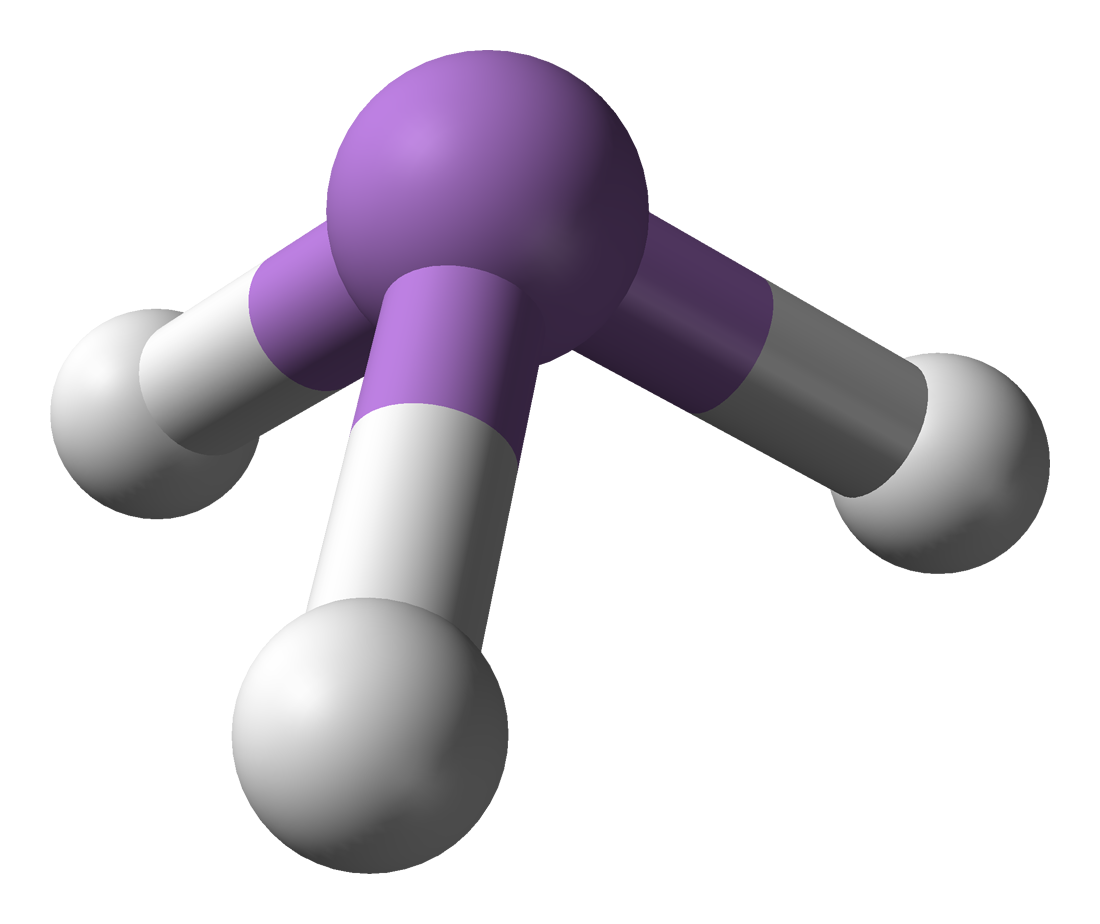


Structure and physical properties
AsH3 adopts a pyramidal molecular geometry with a lone pair on the arsenic atom, making it analogous in shape to ammonia but far less basic. It is denser than air, flammable, and has a low boiling point so it is handled as a gas at ambient temperatures. The compound is only weakly polar and does not engage in hydrogen bonding like lighter hydrides. These properties contribute to its behavior in the environment and in industrial processes.
Production and common uses
Arsine can be generated when arsenic-containing materials react with nascent hydrogen or acids — for example in laboratory reductions of arsenic(III) compounds. It also appears unintentionally in some metallurgical and chemical operations. Industrially, pure arsine is primarily used as a precursor gas in semiconductor manufacture and epitaxial growth techniques (for introducing arsenic into III–V materials and doping silicon), where it serves as a controlled source of arsenic during vapor-phase deposition.
History and analytical relevance
Arsine has played a role in analytical and forensic chemistry. In the 19th century the Marsh test and related procedures produced arsine in order to detect trace arsenic in suspected poisoning cases; see procedures such as the Marsh test. Modern analytical methods use instrumental techniques, but the historical connection remains a notable chapter in toxicology.
Hazards, toxicity and safety
Arsine is highly toxic by inhalation and can cause severe hemolysis, kidney injury and pulmonary effects; exposures can be fatal. It is also highly flammable and capable of forming explosive mixtures with air. For these reasons industrial use requires continuous monitoring, ventilation, gas detection, and strict emergency procedures. Guidance on exposure limits and protective measures is provided by occupational and environmental agencies; for general information see safety resources and industrial best practices.
Notable comparisons and facts
- Arsine belongs to the group 15 hydrides alongside phosphine (PH3) and stibine (SbH3); toxicity and thermal stability increase down the group.
- Because it is a molecular covalent hydride, AsH3 should not be described as containing separated hydrogen and arsenide ions—its bonding is predominantly covalent (hydride chemistry).
- Analytical detection in modern labs often uses gas-phase or atomic spectroscopic methods; historical procedures and demonstrations remain documented in chemical literature (arsenic chemistry).
Given its combination of utility in electronics manufacture and severe hazard to health, arsine is managed under strict regulations where it is manufactured or used. For specific regulatory and handling details consult national authorities and industrial guidance (AsH3 information).
Questions and answers
Q: What is Arsine?
A: Arsine is a chemical compound known as arsenic hydride or hydrogen arsenide.
Q: What is the chemical formula of Arsine?
A: The chemical formula of Arsine is AsH3.
Q: What ions does Arsine have in it?
A: Arsine has hydrogen and arsenide ions in it.
Q: What is the oxidation state of hydrogen in Arsine?
A: The hydrogen in Arsine is in its +1 oxidation state.
Q: Is Arsine a chemical compound?
A: Yes, Arsine is a chemical compound.
Q: What is another name for Arsine?
A: Arsine is also known as arsenic hydride or hydrogen arsenide.
Q: Can you provide the chemical formula of Arsine?
A: Yes, the chemical formula of Arsine is AsH3.
Related articles
Author
AlegsaOnline.com Arsine (AsH3): properties, production, history, uses and hazards Leandro Alegsa
URL: https://en.alegsaonline.com/art/6203