
Marching band: structure, styles, history, and performance practices
Comprehensive overview of marching bands: instruments, uniforms, movement, repertoire, organization, styles (parade, field, corps), competitions, safety, and community roles.
A marching band is an organized ensemble of instrumental performers who combine musical execution with coordinated movement. Members are typically instrumental musicians who play while walking, marching, and forming visual patterns. Ensembles range from small community units to large high-school, collegiate and independent competitive corps. The activity balances musical goals with visual design: repertoire, instrumentation and drill work together to create an effective outdoor presentation.
Image gallery
10 Images
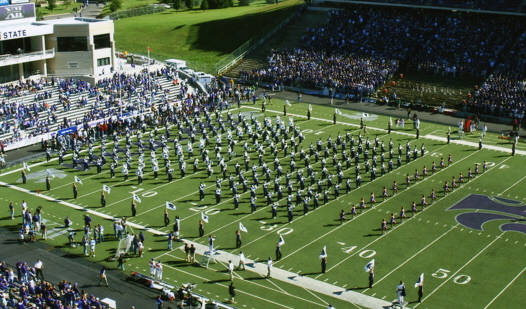


Typical components and equipment
Instrumentation commonly includes brass (trumpets, trombones and other brass instruments), woodwinds (clarinets, flutes, saxophones and other woodwinds) and percussion sections. The percussion group often divides into the battery (marching snare, tenor and bass drums) and the front ensemble or "pit" (stationary mallet instruments and auxiliary percussion). Many bands also feature a color guard that uses flags, rifles and props to interpret the music visually, plus one or more drum majors who direct tempo and ensemble discipline.
Styles, formations and presentation
Marching bands perform in several formats. Parade bands move along a route with music suited to forward motion and public engagement, while field bands perform choreographed shows on turf during halftime or contests. Competitive approaches range from traditional entertainment-focused college shows to corps-style ensembles that emphasize precision, dynamic contrast and elaborate staging. Drill designers coordinate formations, spacing and transitions to match musical phrasing and rhythmic drive; effective shows combine sound projection with synchronized movement.
History and development
The marching band tradition developed from military and civic band practices, where mobility and clear ensemble sound were essential. Over time educational institutions adapted those models for school spirit, ceremony and entertainment. Advances in instrument construction, arranging techniques, amplification and drill notation have enabled more complex musical and visual presentations. Organized circuits and drum corps helped professionalize competition and set standards for judging and show design.
Repertoire, arranging and sound
Repertoire typically emphasizes strong rhythmic content and clear melodic lines that project outdoors; common choices include marches, show tunes, popular music transcriptions and original compositions. Arrangers must balance voicing, projection and stamina for performers on the move. Percussion and rhythmic elements are especially important for tempo clarity and drive, and many programs include dedicated resources on marching percussion and ensemble coordination. Visual choices often reflect musical themes and support audience engagement.
Organization, training and leadership
Ensembles are usually led by directors and supported by sectional instructors, staff arrangers and student leaders. Training focuses on marching technique, posture, breath control, ensemble balance and memorization of music and drill. Leadership roles can include drum major, section leaders and color guard captains. Bands may follow institutional guidelines for attire and presentation, with uniforms and insignia helping to build identity and cohesion; see discussions of rhythmic and visual coordination and uniform design.
Competitions, adjudication and governing bodies
Competitive events are judged on musical performance, visual effect, general effect and percussion/auxiliary captions. Different circuits and organizations run festivals and championships; regional and national governing bodies set rules, instrumentation limits and adjudication criteria. Many groups prepare seasonally for contest schedules and also perform at athletic events such as football games, parades and civic ceremonies that support community outreach and tradition; additional resources are often available from band organizations.
Safety, inclusivity and community role
Safety practices address heat, hydration, secure instrument harnesses and hearing protection. Programs increasingly emphasize accessibility and inclusion, adapting repertoire and roles to welcome diverse participants. Marching bands offer musical education, social development and community visibility, serving as training grounds for young musicians and a public face for schools, civic groups and competitive organizations. For practical guidance on drill, equipment and pedagogy, ensembles consult materials on percussion, drill design and administrative topics provided by professional band organizations and governing bodies.
- Key elements: coordinated movement, brass/woodwind/percussion balance, visual design and repertoire selection.
- Common venues: parades, athletic events, field competitions and civic ceremonies.
- Roles within a band: director, drum major, section leaders, pit technicians, color guard staff.
Questions and answers
Q: What is a marching band?
A: A marching band is a band of instrumental musicians who march while playing instruments.
Q: What kind of instruments do marching bands typically use?
A: Marching bands typically use brass instruments, woodwinds, and percussion instruments.
Q: What kind of music do marching bands usually play?
A: The music usually has a strong rhythmic component suitable for marching.
Q: What is the purpose of a uniform in a marching band?
A: Marching bands use a uniform, often bearing the name and emblem of their organization, to create a sense of unity and identity.
Q: What is a color guard in a marching band?
A: Many bands have a color guard, who perform with flags and other props to add visual interest to the performance.
Q: Where do marching bands perform besides parade performances?
A: In addition to traditional parade performances, many bands also perform field shows at special events (such as football games) or at competitions.
Q: What is the main difference between a marching band and a traditional band?
A: The main difference is that marching bands combine movement – usually some type of marching and other movements – with their musical performance.
Related articles
Author
AlegsaOnline.com Marching band: structure, styles, history, and performance practices Leandro Alegsa
URL: https://en.alegsaonline.com/art/61655