
Marbles (game): history, types, rules, and cultural significance
Overview of marbles as toys and games: materials, common rules and variations, archaeological origins, collecting and manufacture, regional names, and cultural importance.
Overview
Marbles are small spherical objects used as toys and playing pieces in a family of traditional games played worldwide. Most modern playing marbles are made of glass and range in size from small beads to larger shooter marbles; players use a flicking or shooting motion to strike other marbles, hit a target, or move pieces within a marked area. Because of their simple equipment and flexible rules, marbles have been popular in informal play, organised tournaments and as collectible objects. For general examples and resources see marbles overview.
Image gallery
10 Images
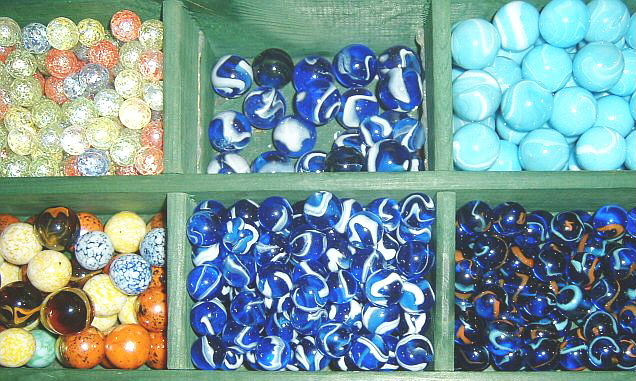


Materials, sizes and common types
Historically marbles have been made from a variety of materials. Common types encountered today include:
- Glass – the prevalent modern material, capable of many decorative effects such as swirls, cores and transparent or opalescent finishes.
- Clay or ceramic – once widespread and still produced by artisans; these tend to be heavier and may show glazing or paint.
- Stone and agate – older marbles and some collectible examples are carved from stone or semi-precious materials and are valued for their weight and finish.
- Metal, wood and plastic – less traditional but used for novelty marbles, practice pieces or themed sets.
Collectors and players use informal terms to describe marbles by appearance and function. Examples include cat's eyes (glass with a coloured ribbon inside), aggies (agate-like stones), and taw (a larger shooter marble or the name for the shooter in some dialects). Sizes are not strictly standardised; common playing sizes are roughly the diameter of a fingernail to larger shooter marbles that are noticeably bigger, and specialty marbles can be significantly larger.
Basic play and typical variations
Rules for marbles are highly local and flexible; many games are created and negotiated by the players. Some widespread formats include:
- Ring (or "ringer") – a circle is drawn on the ground and marbles are placed within it. Players take turns shooting from a set line to knock marbles out; marbles knocked out are typically won by the shooter.
- Target shooting – a target marble is placed and players attempt to strike it or move it into scoring positions; success may be judged by where the target stops or whether it is displaced.
- Knuckling down – a constraint in some rules requiring the shooter to place a knuckle or hand on the ground while shooting to reduce advantage from stance or reach.
Shooting techniques usually involve flicking a marble with the thumb, using a larger shooter marble, or employing fingertip rolls. Scoring systems vary: some games award captured marbles, others use points or elimination. Team play and staged tournaments may formalise rules for fairness and consistency.
History and archaeological record
Small spherical play objects resembling marbles appear in the archaeological record across many ancient cultures. Excavations have recovered round toys and balls from sites associated with the Indus Valley civilisation such as Mohenjo-daro, and similar objects have been found in burials and domestic contexts in ancient Egypt and in Roman sites, indicating that children’s play with small spheres is an old and widespread practice. For regional archaeological summaries see Indus Valley, Ancient Egypt and Ancient Rome.
In more recent centuries marbles were made from locally available materials such as polished stone, clay and glass. Industrial glass production from the 19th century onward allowed mass manufacture of decorative marbles, making them inexpensive and widely distributed as children's toys. Handmade and early industrial examples are now often of interest to collectors for their techniques and historical value.
Manufacture and identifying features
Glass marbles can be produced by hand or machine. Hand-formed examples may display irregularities, pontil marks or distinctive patterns from the maker's technique, while machine-made marbles tend to be more uniform. Decorative effects include internal swirls, cores (a central ribbon or mass of colour), and layering that creates depth. Clay and stone marbles are identifiable by their texture, weight and surface wear. Dating and attributing antique marbles typically relies on material, manufacturing clues and provenance rather than precise universal markers.
Collecting and care
Collecting marbles is a hobby that values rarity, condition, age and aesthetic patterns. Collectors often categorise marbles by material, pattern type and manufacturing era. Care for marbles involves gentle cleaning and storing them separated to avoid abrasion; acidic or harsh cleaners should be avoided, particularly on older or painted pieces. Documentation of origin or provenance adds value but may be difficult to verify for many historical pieces, so cautious description is advised.
Regional names, culture and safety
Regional vocabulary for marbles varies: words such as taw or taws appear in parts of northern England and older English accounts, while other languages and dialects have their own terms. Marbles have appeared in literature, folklore and popular culture as symbols of childhood, competition and skill. Contemporary concerns about safety focus on small parts as choking hazards for young children; supervision and age-appropriate use are recommended.
Modern practice and organised play
Although largely informal, marbles have organised clubs and competitions that preserve traditional rules and promote collecting knowledge. Local tournaments often adopt specific rule sets for fairness, measurement of shooting lines and handling disputes. The game's simple physical mechanics—aim, force and spin—combined with adaptable social rules help explain why marbles continue to be played, collected and studied as part of material culture and childhood history.
Further reading
For introductions to playing styles, collecting guidelines and historical overviews consult general toy history resources and specialised marbles references such as marbles overview. Regional archaeological and museum publications provide more detailed information on ancient finds and context: see the links for the Indus Valley, Egypt and Rome above for starting points.
Questions and answers
Q: What is Marbles?
A: Marbles is a game played with small, round glass balls called marbles.
Q: What is the size of marbles?
A: The size of marbles varies from less than 1/30 inch (0.111 cm) to over 3 inches (7.75 cm), but usually they are about 1/2 inch to 1 inch (1.3 to 2.6 cm) in diameter.
Q: Are marbles attractive?
A: Yes, marbles are most attractive and are often collected by children.
Q: What is the name of the game and objects in the North of England?
A: In the North of England, the objects and the game are sometimes called 'taws'.
Q: Are there standard rules for playing Marbles?
A: No, the rules for playing Marbles are made up by the players, and there are many variations. However, one standard idea is to have a target marble, and players flick their marbles with their thumbnail to hit the target.
Q: Where were marbles found in ancient civilizations?
A: Marbles were found in the ancient civilizations of Mohenjo-daro, Ancient Egypt and Rome.
Q: How do players play another version of Marbles?
A: In another version of Marbles, players try to hit each other's marbles out of a target zone.
Author
AlegsaOnline.com Marbles (game): history, types, rules, and cultural significance Leandro Alegsa
URL: https://en.alegsaonline.com/art/61572
Sources
- bbc.co.uk : "Losing your Marbles"
- timesonline.co.uk : "Village rolls out a welcome for World Marbles Championships"
- time.com : "Sport: At Tinsley Green"
- guardian.co.uk : "Event preview: British And World Marbles Championship, Tinsley Green"
- guardian.co.uk : "Going under in the marble halls of Tinsley Green"