
Arrondissements of the Pyrénées-Orientales department
Overview of the three arrondissements in Pyrénées-Orientales: their organization, functions, history, and relationship with communes and the departmental prefecture.
Overview
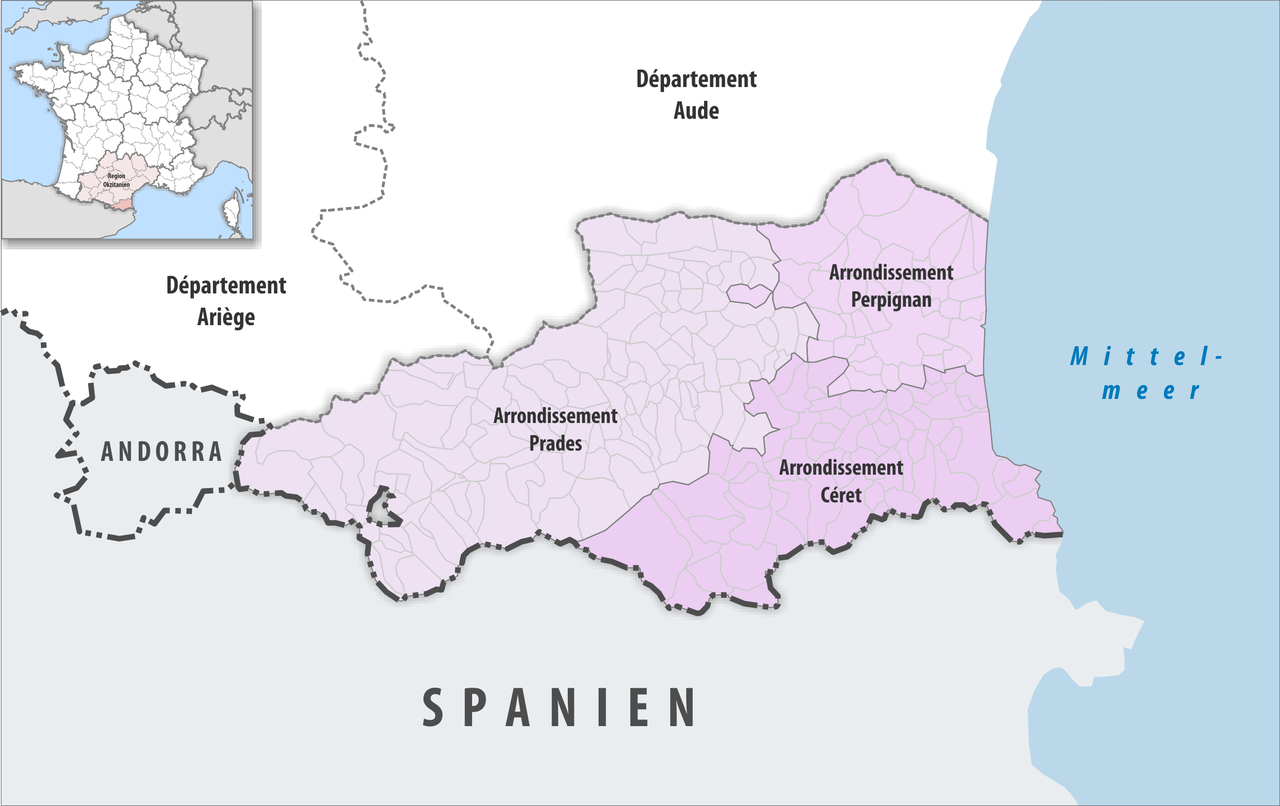
The Pyrénées-Orientales department lies in southern France and is divided, like other French departments, into administrative districts called arrondissements. In English these may be translated as districts or, in some contexts, as boroughs (boroughs). Arrondissements serve as intermediate territorial units through which the central state organises many public services and coordinates activity between the department and the local municipalities.
Image gallery
2 Images
Organization and role
Each arrondissement has an administrative centre known as a subprefecture, unless the department's prefecture is situated within that arrondissement; in that case the prefecture performs both departmental and arrondissement functions. Arrondissements are subdivisions of the French departments and are themselves composed of communes (communes), the basic units of local government. They do not have elected deliberative assemblies; their purpose is to host state services and the local offices of national administrations.
History and development
The arrondissement system dates from the administrative reforms following the French Revolution and was refined in the 19th century to produce a regular territorial hierarchy. Over the decades the number and limits of arrondissements have been changed periodically in response to population movements, municipal mergers and national reorganisations. In Pyrénées-Orientales, the present three-arrondissement structure is the outcome of this historical evolution and reflects the department's particular geography and settlement patterns.
Present-day arrondissements
- Perpignan — the departmental prefecture and principal urban centre; it acts both as prefecture and as the arrondissement capital, concentrating many state services and administrative functions.
- Céret — a subprefecture serving the southern valleys and nearby coastal hinterland, an area notable for its Catalan cultural heritage and mixed rural and small-town economy.
- Prades — a subprefecture that covers more upland and mountain territory to the west, with administration adapted to dispersed settlements and the challenges of mountain infrastructure.
Functions and practical importance
Arrondissements are important for the local delivery of education administration, policing coordination, civil registry services and the organisation of state-driven programmes. They are used for statistical reporting, for some judicial and administrative arrangements, and as operational territories for prefectural services. Because they group many communes, arrondissements are useful for coordinating intercommunal projects, regional planning and emergency response across municipal boundaries.
Regional context and cooperation
The Pyrénées-Orientales arrondissements underline the department's contrasts — Mediterranean coast, agricultural plains and the Pyrenees mountains — and its border position adjacent to Catalonia in Spain. This location encourages cross-border economic and cultural ties, regional transport links and cooperation on issues such as tourism, environmental protection and transnational commercial activity. For readers seeking more on the administrative framework and local government units, consult the entries on departments, the role of the subprefecture/prefecture and the organisation of communes.
Questions and answers
Q: What are arrondissements in the Pyrénées-Orientales department?
A: Arrondissements are administrative subdivisions in the Pyrénées-Orientales department of France.
Q: How many arrondissements are there in the Pyrénées-Orientales department?
A: There are three arrondissements in the Pyrénées-Orientales department.
Q: What is the English translation of arrondissements?
A: Arrondissements can be translated into English as districts or boroughs.
Q: What is the capital of an arrondissement called?
A: The capital of an arrondissement is called a subprefecture.
Q: If the capital of a department is located in an arrondissement, what is its function?
A: The capital of the department that is located in an arrondissement serves as both a prefecture and a subprefecture.
Q: How are arrondissements further divided?
A: Arrondissements are further divided into communes.
Q: What are the arrondissements in the Pyrénées-Orientales department?
A: The arrondissements in the Pyrénées-Orientales department are not specified in the provided text.
Related articles
Author
AlegsaOnline.com Arrondissements of the Pyrénées-Orientales department Leandro Alegsa
URL: https://en.alegsaonline.com/art/6149
Sources
- insee.fr : "Département des Pyrénées-Orientales (66)"
- insee.fr : "Régions, départements, arrondissements, cantons et communes"
- insee.fr : "Département des Pyrénées-Orientales (66)"
- splaf.free.fr : "Historique des Pyrénées-Orientales"