
Mantis shrimp: the stomatopod predators with extraordinary vision and strikes
Mantis shrimp are marine stomatopods—colourful, often reef-dwelling crustaceans known for complex eyes and extremely fast raptorial strikes used to spear or smash prey.
Mantis shrimp are marine crustaceans belonging to the order Stomatopoda. Although commonly called "shrimp," they are a distinct group within crustaceans; they are predatory, benthic animals found mostly in shallow seas. There are roughly about 400 species, ranging in size from a few centimetres to some larger species approaching 30 cm. Their vivid colours, distinctive body posture and powerful forelimbs make them one of the most recognisable groups of marine arthropods.
Image gallery
10 Images
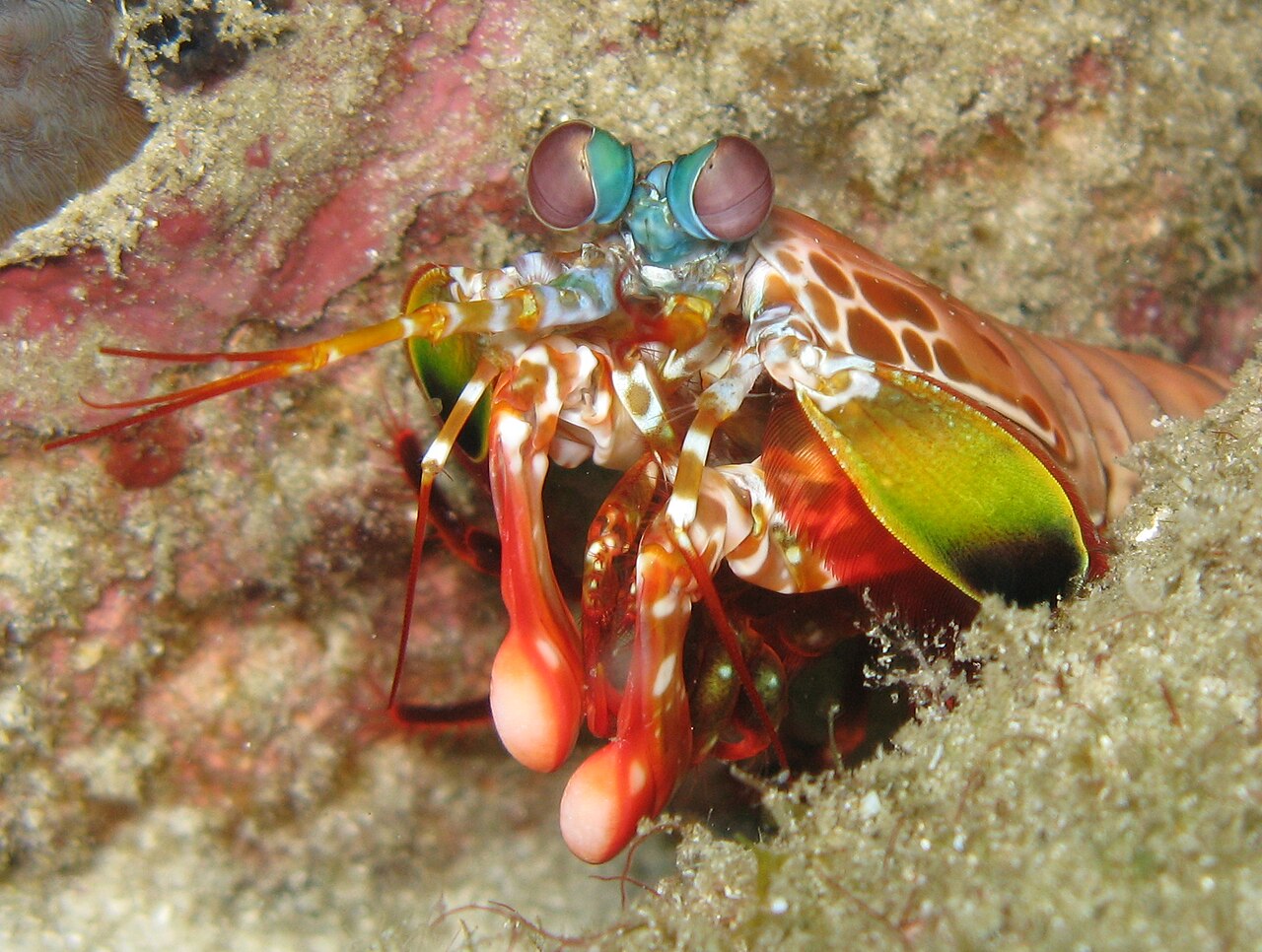

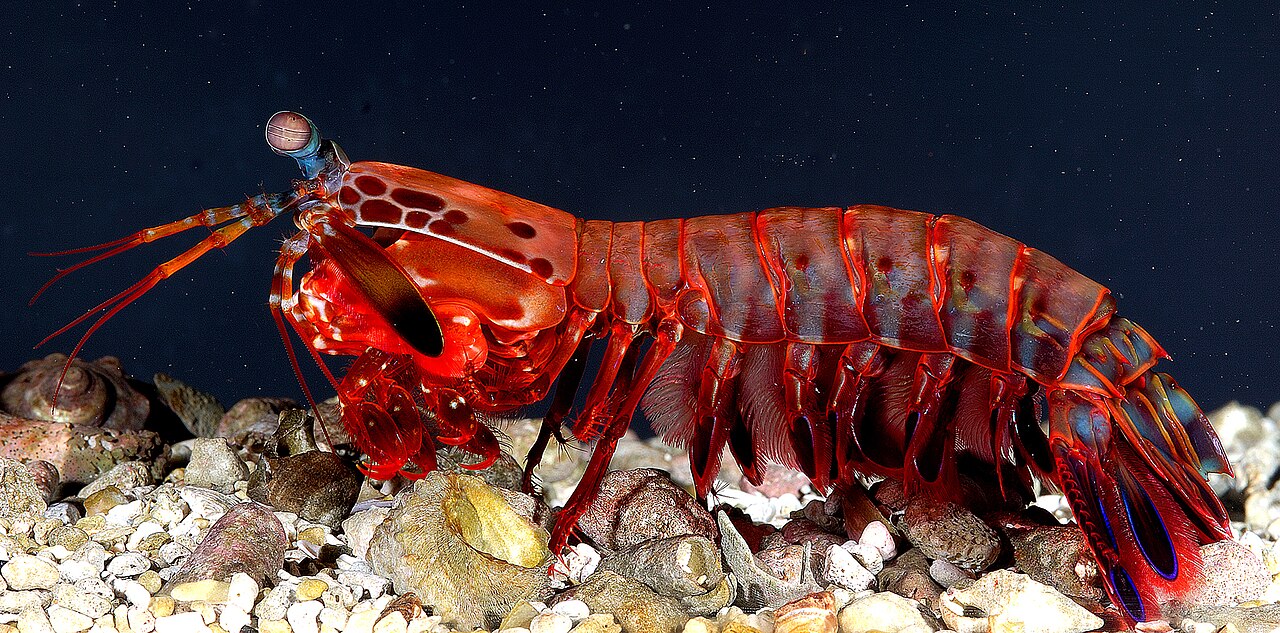


Physical characteristics and anatomy
Mantis shrimp have a segmented exoskeleton, a flattened body, and a pair of prominent raptorial appendages used for hunting. Their head bears stalked compound eyes and robust mandibles. Unlike true shrimps, their thorax and abdomen show adaptations for ambush and rapid striking rather than long-distance swimming. Many species build or occupy burrows in sand, rubble or coral where they shelter and ambush prey.
Vision and sensory abilities
The eyes of mantis shrimp are unusually complex. Mounted on mobile stalks, each eye is divided into regions that allow it to analyse colour, polarisation and depth independently. They possess a large number of photoreceptor types and can detect ultraviolet and polarised light, giving them a visual capability rare among animals. This sophisticated vision helps in prey detection, intra‑species signalling and navigation.
Hunting styles: spearers and smashers
Mantis shrimp use two main types of raptorial strikes. "Spearers" have sharp, spiny appendages that stab soft-bodied prey, while "smashers" have thick, club-like appendages used to deliver extremely rapid, powerful blows that crack shells and exoskeletons. These strikes are among the fastest biological movements recorded, produced by a spring-and-latch mechanism that stores and releases energy. Their weapons can break mollusc shells and have been known to damage aquarium glass.
Behaviour, habitat and distribution
Most mantis shrimp inhabit shallow tropical and subtropical environments such as coral reefs, seagrass beds and sandy bottoms. They are predominantly marine and benthic; many species excavate burrows or occupy crevices where they rest and rear offspring. Their distribution is global in warm seas, with higher diversity in Indo-Pacific reef systems. For general information on crustaceans see crustacean resources and habitat summaries at tropical and subtropical habitats.
Life cycle and social behaviour
Reproductive strategies vary: some species form monogamous pairs that share a burrow and care for eggs, while others are solitary and mate more briefly. Females brood eggs under the body until larvae hatch; many species have planktonic larval stages that disperse with currents before settling. Lifespans are typically several years, depending on species and environmental conditions.
Human significance and notable facts
- Mantis shrimp are popular in public aquaria and among hobbyists because of their colours, but they require secure enclosures due to their striking ability.
- Researchers study their vision for insights into photoreception and their strike mechanics for bioinspired materials and impact science.
- A well-known example in aquarium trade and popular culture is the colourful "peacock" mantis shrimp, valued for its vivid appearance and behaviour.
Overall, mantis shrimp are a striking example of evolutionary specialization: their combination of visual sophistication and extreme biomechanics has made them subjects of interest across biology, ecology and engineering. For further taxonomy and species lists consult specialized references linked above.
Questions and answers
Q: What are mantis shrimps?
A: Mantis shrimps are crustacean stomatopods, not actually shrimps but members of the order Stomatopoda.
Q: How many species of mantis shrimps are there?
A: There are about 400 species of mantis shrimps.
Q: How do mantis shrimps kill their prey?
A: Mantis shrimps kill their prey by hitting them at high speed.
Q: What is the body posture of mantis shrimps?
A: Mantis shrimps hold their body in a manner like that of a praying mantis.
Q: Why do mantis shrimps have large, complex eyes?
A: Mantis shrimps have large, complex eyes for the purpose of capturing their prey.
Q: How long can some species of mantis shrimp be?
A: Some species of mantis shrimp can be 30 cm long.
Q: Where do mantis shrimps live and what are their habitats like?
A: Mantis shrimps live in shallow tropical and subtropical habitats such as coral reefs. They are highly coloured.
Related articles
Author
AlegsaOnline.com Mantis shrimp: the stomatopod predators with extraordinary vision and strikes Leandro Alegsa
URL: https://en.alegsaonline.com/art/61436
Sources
- doi.org : 10.1038/428819a
- pubmed.ncbi.nlm.nih.gov : 15103366
- bbc.co.uk : "Mantis Shrimp"
- doi.org : 10.1242/jeb.01831
- pubmed.ncbi.nlm.nih.gov : 16169943
- dailycal.org : "Mantis shrimp boasts most advanced eyes"
- nature.com : "Ultraviolet vision: the colourful world of the mantis shrimp"
- doi.org : 10.1038/44751
- pubmed.ncbi.nlm.nih.gov : 10553902
- the.honoluluadvertiser.com : "Large shrimp thriving in Ala Wai Canal muck"