
Arrondissements of the Côte-d'Or department
The Côte-d'Or department in eastern France is divided into three arrondissements—Dijon, Beaune and Montbard—administrative subdivisions headed by subprefects and further divided into communes.
The department of Côte-d'Or in eastern France is organised into three arrondissements, a level of administration used across French departments. An arrondissement is often translated as a district (and in some contexts compared to a borough). Each arrondissement has an administrative centre, called a subprefecture, unless the department's prefecture lies in the same place and performs both roles.
Image gallery
1 Image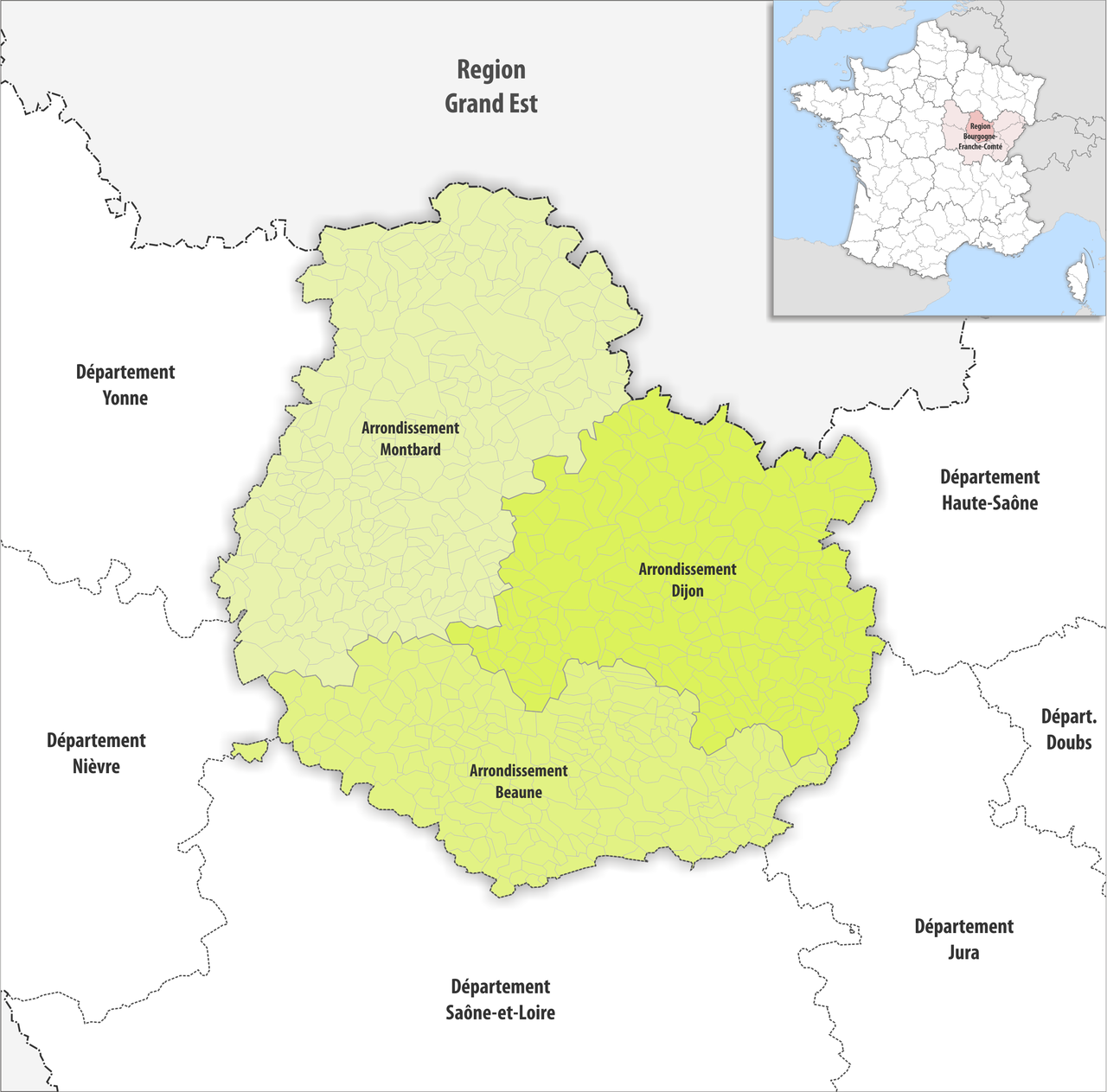
Organization and subdivisions
Arrondissements sit between the department and the local communes. They are administrative groupings rather than autonomous governments: their principal functions are to coordinate state services at a scale smaller than the department and to provide a link between central administration and municipal authorities. Arrondissements are themselves divided into communes, the smallest units of local administration (communes), which handle most day-to-day local government tasks.
The three arrondissements
- Dijon — the departmental prefecture and the principal urban centre; when a prefecture is located in an arrondissement it also serves as that arrondissement's administrative centre.
- Beaune — centred on the historic town of Beaune, an area noted for viticulture and a mix of small towns and rural communes.
- Montbard — a more rural arrondissement that includes smaller towns, agricultural land and several heritage sites.
Historical context
The modern system of arrondissements dates back to reforms at the beginning of the 19th century, established to rationalise the state's territorial administration. While their exact boundaries and numbers have been adjusted over time in response to population and administrative reforms, arrondissements remain a stable tier for organising prefectural services and compiling statistical information.
Function and significance
Although arrondissements do not have elected assemblies, they are significant for public administration: subprefects represent central government, manage coordination of public services, and oversee implementation of national policies locally. They also provide an organisational frame for judicial, educational and electoral arrangements at a scale between the departmental and communal levels.
In practice, the identity of an arrondissement often reflects local geography, economy and history: for Côte-d'Or, Dijon provides the urban and administrative hub, Beaune reflects the region's wine-producing heritage, and Montbard retains a rural character with cultural landmarks that attract visitors and support local communities.
Questions and answers
Q: How many arrondissements are there in the Côte-d'Or department?
A: There are 3 arrondissements in the Côte-d'Or department.
Q: What are arrondissements?
A: Arrondissements are districts in French departments, which may be translated into English as districts or boroughs.
Q: What is the capital of an arrondissement called?
A: The capital of an arrondissement is called a subprefecture.
Q: What happens if the prefecture of the department is in an arrondissement?
A: If the prefecture of the department is in an arrondissement, that prefecture is the capital of the arrondissement, acting both as a prefecture and as a subprefecture.
Q: How are arrondissements further divided?
A: Arrondissements are further divided into communes.
Q: What is the name of the Côte-d'Or department's capital?
A: The name of the Côte-d'Or department's capital is not provided in the text.
Q: What are the names of the arrondissements in the Côte-d'Or department?
A: The text doesn't provide the names of the arrondissements in the Côte-d'Or department.
Related articles
Author
AlegsaOnline.com Arrondissements of the Côte-d'Or department Leandro Alegsa
URL: https://en.alegsaonline.com/art/6110
Sources
- insee.fr : "Département de la Côte-d'Or (21)"
- insee.fr : "Régions, départements, arrondissements, cantons et communes"
- insee.fr : "Département de la Côte-d'Or (21)"
- splaf.free.fr : "Historique de la Côte-d'Or"