
Malthusianism: theory, history, and enduring influence
Malthusianism is the political and economic theory originating with Thomas Malthus that population growth can outpace resources, prompting debate about limits, policy, and technological mitigation.
Overview
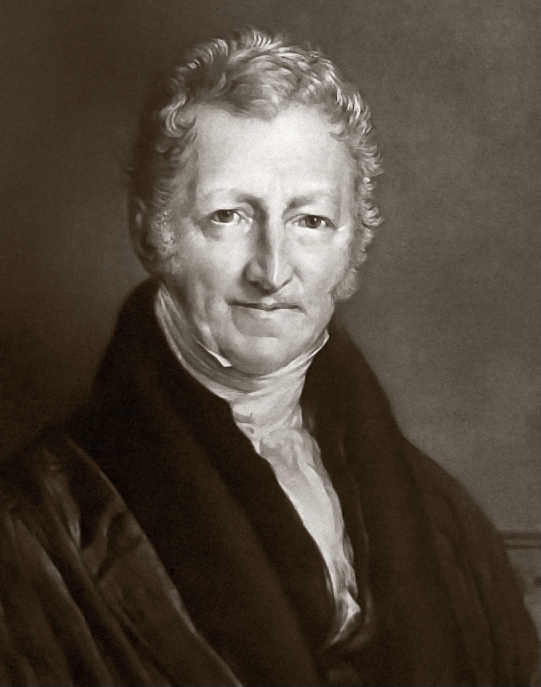
Malthusianism refers to a set of ideas first articulated by the English cleric and political economist Thomas Robert Malthus in the late 18th century. In his 1798 work, An Essay on the Principle of Population, Malthus proposed that human numbers, if unchecked, tend to increase in a geometric or exponential ratio while food production and other resources increase only in an arithmetic or linear ratio. This mismatch, he argued, would produce periodic shortages, disease, famine and population checks, a scenario often summarized as the "Malthusian catastrophe." The idea has since developed into a broader family of arguments about limits to growth and the relationship between population and resources.
Image gallery
8 Images




Core tenets and models
At the center of Malthusian thought are a few interrelated claims. First, population has a natural tendency to grow rapidly in the absence of checks. Second, productive capacity—especially agricultural output—was assumed to rise more slowly. Third, when population outstrips subsistence, negative checks (such as famine, disease and war) and preventive checks (such as moral restraint) reduce growth. These propositions were formalized in simple growth models that contrast exponential population growth with arithmetic increases in subsistence goods.
- Population dynamics: growth tends to be multiplicative unless constrained.
- Resource limits: food and land were central in Malthus's original formulation.
- Checks on population: both natural and social mechanisms can slow growth.
Historical context and influence
Malthus wrote during the early Industrial Revolution and amid intense public debate about poverty, welfare and economic policy. His ideas influenced and provoked discussion among policymakers, philanthropists and writers. Critics and advocates invoked Malthusian reasoning in debates over poor relief and social reform: for example, opponents argued that indiscriminate charity would encourage dependency and worsen poverty, while supporters of relief sought alternatives to such conclusions. Malthusian themes are also associated with legislative and administrative responses in 19th-century Britain, including controversies surrounding the workhouse system and Poor Law reform.
Reception, critique and development
Responses to Malthus were varied. Some contemporaries embraced his caution about unlimited relief and the need to consider population pressures; others rejected the pessimism or accused him of overstating scarcity. Karl Marx offered a well-known critique, arguing that social relations and economic organization—rather than population per se—shape scarcity. At the same time, Malthus's emphasis on population dynamics influenced thinkers such as Charles Darwin, whose theory of natural selection drew on ideas of competition and struggle for limited resources. Intellectuals like Harriet Martineau played roles in popularizing and debating these concepts in broader social circles.
Neo-Malthusianism and modern debates
During the 20th century, a revived form of Malthusian concern—often called neo-Malthusianism—linked population growth to environmental degradation, resource depletion and economic strain. Public debate has centered on whether technological innovation, agricultural intensification and demographic transitions can overcome the constraints Malthus described. Proponents of Malthusian-style warnings point to ecological limits and finite planetary boundaries; critics emphasize human ingenuity, market adaptation and the role of institutions in shaping outcomes.
Applications, examples and distinctions
Malthusian ideas have informed a range of policy and scholarly domains: population policy, family planning, environmentalism and development studies. It is important to distinguish classical Malthusianism—focused on agriculture and subsistence in the preindustrial world—from later uses of the term that address modern industrial societies, energy systems and global environmental risk. Contemporary analysts often combine demographic data with models of consumption, technology and governance to assess whether and where Malthusian constraints are likely to reassert themselves.
Notable facts and legacy
- Malthus did not predict the particular technologies that later expanded food supply; his argument was about structural tension between growth rates.
- The phrase "Malthusian catastrophe" summarizes a class of outcomes in which population growth overwhelms resource availability; alternate outcomes depend on innovation and social change.
- Historic debates tied to his work touched on public charity, migration, and labor markets; some contemporaries feared that relief measures would increase the number of the dependent poor.
Malthusianism remains a touchstone in discussions about limits, ethics and policy: it prompts questions about how societies balance population trends, resource management and technological change. For introductions and further reading see general surveys and historical treatments accessible through academic and public resources, or follow specialized links on population theory and environmental limits at population-growth resources and demographic reference pages such as population studies.
Though contested, the basic dilemma Malthus posed—how growth interacts with finite resources—continues to frame modern debates in demography, economics and environmental policy.
Questions and answers
Q: Who was Thomas Robert Malthus?
A: Thomas Robert Malthus was an economist who lived during the industrial revolution. He is best known for his book, An Essay on the Principle of Population, which describes the Malthusian growth model.
Q: What did Malthus say about population growth?
A: According to Malthus' theory, population growth is exponential while food supply only grows arithmetically. This means that if there are no limits to population growth, it will not be possible to produce enough food for everyone and this could lead to a "Malthusian catastrophe".
Q: What were some of the ideas developed from Malthus' work?
A: The Tory party had paternalistic ideas such as charity for the poor which Mathus argued would not work and would only lead to increased numbers of the poor. These ideas were developed into Whig economic ideas such as The Poor Law Amendment Act of 1834 which brought in construction of workhouses despite riots and arson.
Q: Who supported these ideas?
A: These ideas were widespread in progressive social circles and one supporter was novelist Harriet Martineau whose circle included Charles Darwin. Darwin's theory was also influenced by Mathus' work.
Q: What did Karl Marx think about Malthussianism?
A: Karl Marx criticized Mathussianism as being nothing more than a schoolboyish plagiary of other authors and postulated that progress in science and technology would allow for indefinite exponential population growth.
Q: Are people still concerned with overpopulation today?
A: Yes, many people today still believe that Mathus was right about human population growth getting out of hand.
Related articles
Author
AlegsaOnline.com Malthusianism: theory, history, and enduring influence Leandro Alegsa
URL: https://en.alegsaonline.com/art/61084
Sources
- cooper.edu : cooper.edu
- books.google.com : books.google.com/books?id=z7LeJ4i0-vAC&pg=PA126&lpg=PA126&dq=%22malthusian+bill+designed+…