
Arrondissements of the Bouches‑du‑Rhône department
Overview of the four arrondissements that divide Bouches‑du‑Rhône: their role, organisation, history, and relation to communes and departmental institutions.
Overview
The department of Bouches‑du‑Rhône is divided into four administrative arrondissements. In France, arrondissements are subdivisions of departments and function as territorial subdivisions of the central state rather than elected bodies. In English they are often translated as districts or, in some contexts, as boroughs. The institutional concept and practice are described more generally under arrondissements.
Image gallery
1 Image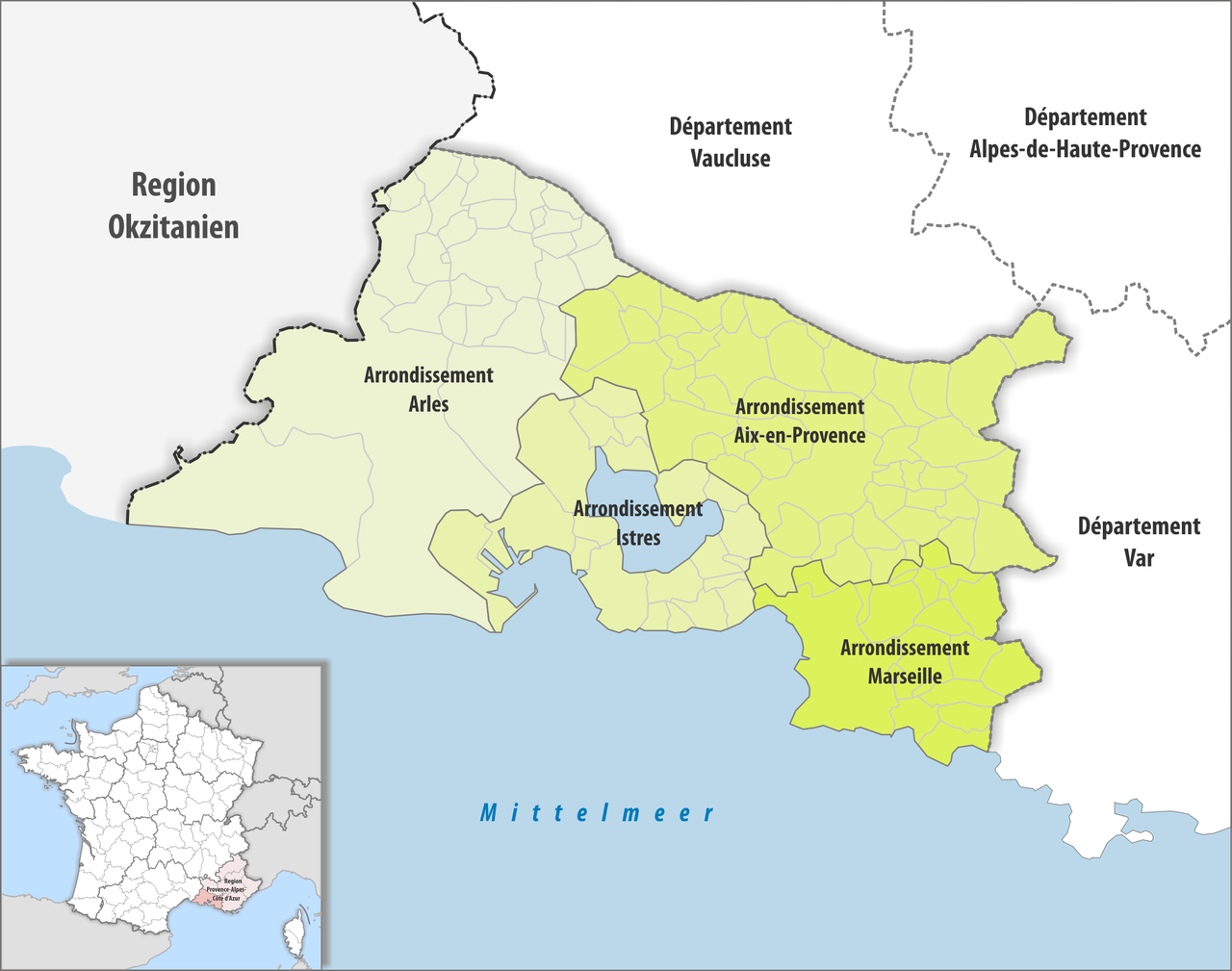
Organisation and functions
An arrondissement groups a number of communes for purposes of state administration, coordination of public services and the application of national policy at a local level. It does not have an assembly of its own: the state is represented there by a subprefect whose office is called a subprefecture. When the department's prefecture lies in an arrondissement, that city acts both as prefecture and as subprefectural seat. Arrondissements are further divided into communes (communes) and are often used alongside cantons for judicial and electoral arrangements.
The four arrondissements
- Marseille — the prefecture of the department and its largest urban centre. Marseille serves as the administrative hub for the surrounding arrondissement and hosts many departmental services; the city itself is also subdivided into municipal arrondissements for local governance.
- Aix‑en‑Provence — centred on the historic city of Aix, this arrondissement includes suburban, rural and peri‑urban communes and acts as a regional service centre with cultural and educational institutions.
- Arles — covering a broad western and riverine area including parts of the Camargue, Arles combines agricultural, natural and heritage landscapes and manages administration for a dispersed set of communes.
- Istres — an arrondissement characterised by urban and industrial zones, coastal and lagoon environments; it includes towns and ports that contribute to the department's economic diversity.
History and evolution
The arrondissement system in France originated with administrative reforms around the end of the 18th and the start of the 19th centuries. Since then the boundaries and the internal organisation of arrondissements in Bouches‑du‑Rhône have been adjusted periodically to reflect demographic shifts, municipal changes and reforms in state administration. Such modifications have been administrative rather than political: they aim to improve service delivery and the representation of central government locally.
Practical significance
For residents and local authorities the arrondissement matters mainly as the level at which certain state services are organised: civil administration, some judicial services, coordination of public works and disaster management, and statistical reporting. Detailed information about competences, locations and services is available from departmental and local state offices; users should consult the prefecture and the subprefectures for contact details and practical guidance (prefecture/subprefecture). For background on communes and local government responsibilities see resources on communes.
Questions and answers
Q: How many arrondissements are there in the Bouches-du-Rhône department?
A: There are 4 arrondissements in the Bouches-du-Rhône department.
Q: What are arrondissements in France?
A: Arrondissements are administrative divisions that can be translated into English as districts or boroughs.
Q: What is the capital of an arrondissement called in France?
A: The capital of an arrondissement is called a subprefecture.
Q: What happens if the prefecture of a department is in an arrondissement?
A: If the prefecture of a department is in an arrondissement, that prefecture acts as both the capital of the department and the capital of the arrondissement.
Q: What are arrondissements further divided into in France?
A: Arrondissements are further divided into communes in France.
Q: Which department has 4 arrondissements in France?
A: The Bouches-du-Rhône department in France has 4 arrondissements.
Q: What are the names of the arrondissements in Bouches-du-Rhône?
A: The names of the arrondissements in Bouches-du-Rhône are not provided in the given text.
Related articles
Author
AlegsaOnline.com Arrondissements of the Bouches‑du‑Rhône department Leandro Alegsa
URL: https://en.alegsaonline.com/art/6104
Sources
- insee.fr : "Département des Bouches-du-Rhône (13) et Arrondissements"
- splaf.free.fr : "Historique des Bouches-du-Rhône"