
Arrondissements of the Aude department
Overview of the three arrondissements of the Aude department: their role, capitals, history, administrative functions and distinctions within France’s territorial organisation.
Overview
The Aude department is divided into three administrative arrondissements. In France, departments such as Aude and others are organised into arrondissements as intermediate state subdivisions beneath the department level. The French system of departments and their arrondissements provides a framework for delivering national services and for local administration.
Image gallery
1 Image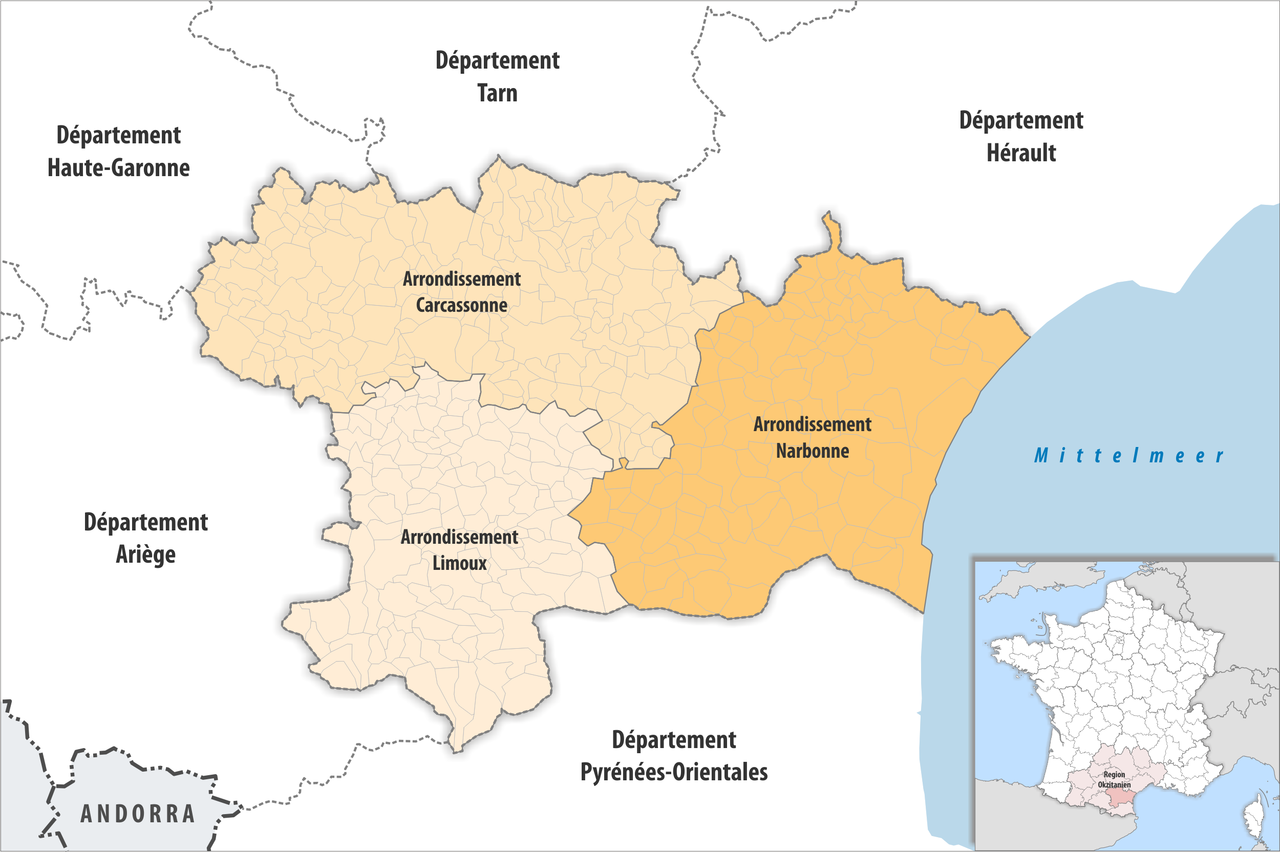
Definition and role
An arrondissement is an administrative district headed by a subprefect and centered on a chief town, often translated in English as a district or, in some municipal contexts, as a borough. The administrative centre of an arrondissement is called a subprefecture, unless the department’s prefecture is located there; in that case the prefecture performs both roles. Arrondissements are composed of communes, the smallest administrative units in France, each administered by a mayor and municipal council (communes).
Arrondissements of Aude
- Carcassonne — the department prefecture and capital of its arrondissement; known for its medieval citadel and administrative importance.
- Limoux — a subprefecture serving a largely rural and vineyard-covered territory to the south of Carcassonne.
- Narbonne — a coastal subprefecture with historical ties to Roman and medieval trade routes.
Each of these arrondissements groups many communes and serves as a local base for state services such as education, policing, and transport administration. The subprefect represents the central government at arrondissement level and coordinates with mayors and departmental authorities.
History and development
Arrondissements were established across France during the administrative reforms of the early 19th century to improve state presence and coordination at the local level. Over time boundaries and responsibilities have been adjusted to reflect demographic and administrative change, but the basic hierarchy—region, department, arrondissement, commune—remains central to French territorial organisation.
Distinctions and practical importance
It is important not to confuse these arrondissements with municipal arrondissements found in large cities; the former are territorial subdivisions of a department while the latter are subdivisions within a single commune. Arrondissements do not have elected deliberative assemblies; their function is primarily administrative. For further reading on the department and its subdivisions see general resources about the French departmental system and how prefectures and communes interact with arrondissement-level administration. Additional background on the term and comparable units appears in documents addressing Aude and national territorial organisation (departments, arrondissements).
Questions and answers
Q: How many arrondissements are there in the Aude department?
A: There are 3 arrondissements in the Aude department.
Q: What are arrondissements?
A: Arrondissements are divisions of French departments, which can be translated to districts or boroughs in English.
Q: What is the capital of an arrondissement called?
A: The capital of an arrondissement is called a subprefecture.
Q: What happens if the capital of a department is located in an arrondissement?
A: If the capital of a department is located in an arrondissement, that capital acts as both the prefecture and subprefecture of the arrondissement.
Q: How are arrondissements further divided?
A: Arrondissements are further divided into communes.
Q: Which department are the arrondissements in the text from?
A: The arrondissements mentioned in the text are from the Aude department.
Q: How many arrondissements in total are there in France?
A: The text does not specify how many arrondissements there are in total in France.
Tags
Related articles
Author
AlegsaOnline.com Arrondissements of the Aude department Leandro Alegsa
URL: https://en.alegsaonline.com/art/6101
Sources
- insee.fr : "Département de L'Aude (11)"
- splaf.free.fr : "Historique de l'Aude"