
Makalu
Makalu is the world’s fifth-highest mountain at 8,485 m on the Nepal–China border. A steep, four-sided pyramid in the Mahalangur Himalaya, it is noted for technical climbs, glaciers and protected high‑altitude ecosystems.
Overview
Makalu is the world’s fifth-highest mountain and rises to 8,485 metres above sea level. It occupies a remote position on the main ridge of the Mahalangur Himalaya and straddles the international boundary between Nepal and the Tibet Autonomous Region of China. Its steep relief and isolated summit make it a striking feature of the Himalayan skyline. For reference to its global position and elevation see ranking and elevation.
Image gallery
7 Images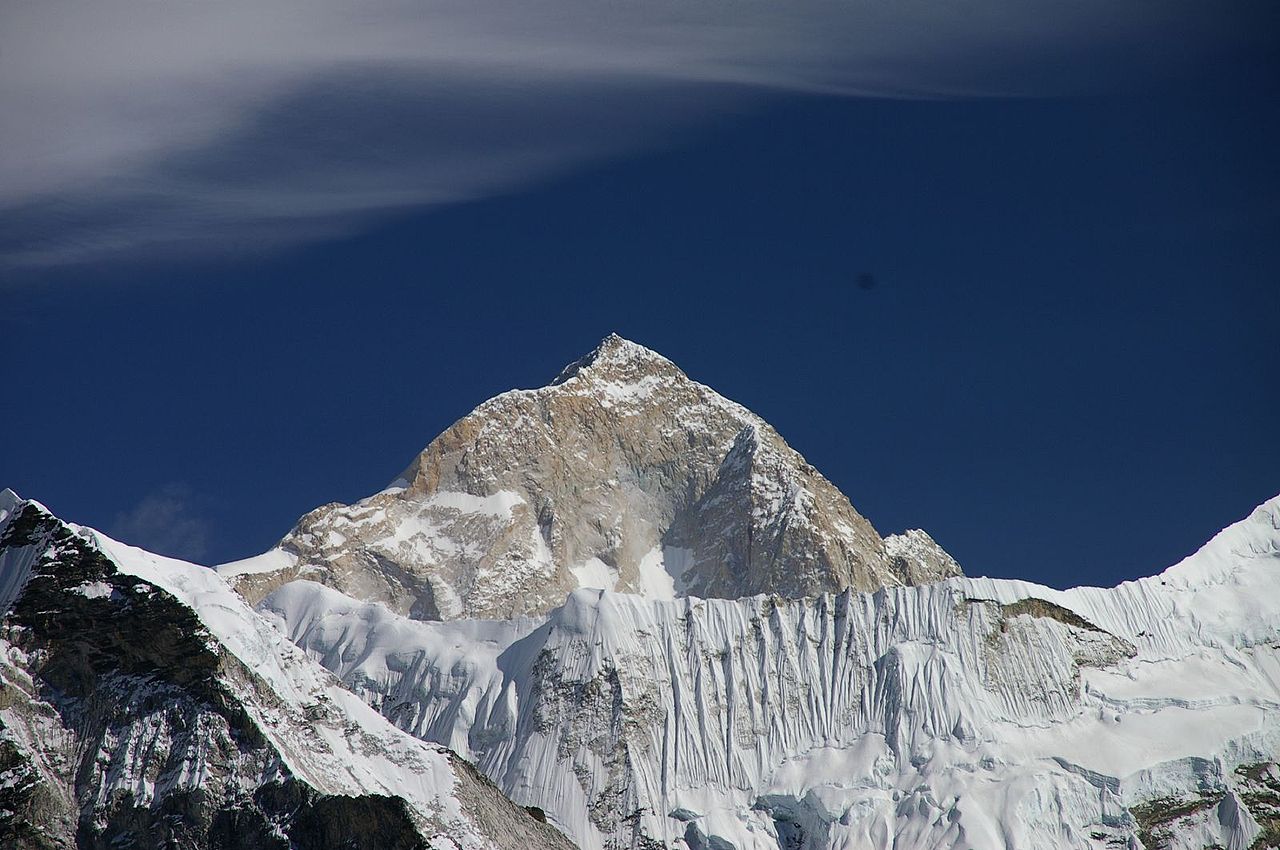


Geography and form
The peak is famous for a sharply pointed, four-sided pyramidal summit with pronounced ridges and steep faces. The Makalu massif includes subsidiary summits such as Kangchungtse (commonly called Makalu II) and feeds glaciers that descend into deep alpine valleys. Much of the surrounding terrain is rugged and remote; its physical form and local setting are often described in studies of Himalayan morphology and alpine glaciation. See notes on its shape and position in Nepal.
Climbing history and routes
Makalu drew international attention during the mid-20th century and was first climbed successfully in 1955 by a French expedition. Compared with some 8,000-metre peaks that offer less technical high-altitude routes, Makalu presents sustained steep rock and ice sections, exposed ridgelines and objective hazards such as seracs and avalanches. Climbers require advanced alpine skills, careful acclimatisation and logistical planning; approaches from the Nepalese and Tibetan sides offer different practical challenges and permit regimes. Access from the Tibetan side and Nepalese approaches are both part of its climbing story.
Ecology, conservation and local context
The mountain’s slopes support high-altitude forests, alpine meadows and a range of Himalayan wildlife. Portions of the area around Makalu are included in conservation initiatives and protected zones that aim to balance biodiversity protection with trekking and mountaineering. Local communities—among them Sherpa and other ethnic groups—have long-standing cultural and economic ties to the valleys and trails that lead toward the massif.
Key facts
- Elevation: 8,485 m (27,838 ft).
- Global rank: 5th highest mountain.
- Distinctive features: four-sided pyramidal summit and subsidiary peak Kangchungtse (Makalu II).
Questions and answers
Q: What is Makalu?
A: Makalu is the fifth tallest mountain in the world.
Q: How tall is Makalu?
A: Makalu has a height of 8,485 metres (27,838 ft) above sea level.
Q: What is the shape of Makalu?
A: Makalu has a pyramid-shaped structure with four sides.
Q: Where is Makalu located?
A: Makalu is located on the border of Nepal and China.
Q: What is the height of Makalu above sea level?
A: Makalu has a height of 8,485 metres (27,838 ft) above sea level.
Q: What is the ranking of Makalu in the world's tallest mountains?
A: Makalu is the fifth tallest mountain in the world.
Q: What is the unique feature of the structure of Makalu?
A: The unique feature of the structure of Makalu is that it has a pyramid-shaped structure with four sides.
Related articles
Author
AlegsaOnline.com Makalu Leandro Alegsa
URL: https://en.alegsaonline.com/art/60877
Sources
- mountain-forecast.com : details on location
- nepalvillagetrek.com : Details on height and climbing
- commons.wikimedia.org : Makalu
- wikidata.org : wikidata.org/wiki/Q169986
- d-nb.info : 4037154-2
- id.loc.gov : sh2001002158
- id.ndl.go.jp : 00629267
- aleph.nkp.cz : xx0121395
- viaf.org : 259957757
- worldcat.org : viaf-259957757