
Major histocompatibility complex (MHC)
The major histocompatibility complex is a set of cell-surface proteins encoded by a diverse gene family that present peptide fragments to T cells and shape adaptive immune responses.
The major histocompatibility complex, commonly abbreviated MHC, is a collection of cell-surface proteins that display fragments of proteins (peptides) for recognition by T lymphocytes. In many texts the term refers both to the protein molecules and to the genomic region that encodes them. A typical MHC molecule sits in the membrane of immune and other nucleated cells and allows the immune system to monitor internal and external proteins; the genes that encode these proteins belong to a large gene family found throughout jawed vertebrates and other vertebrates.
Image gallery
5 Images



Structure and classes
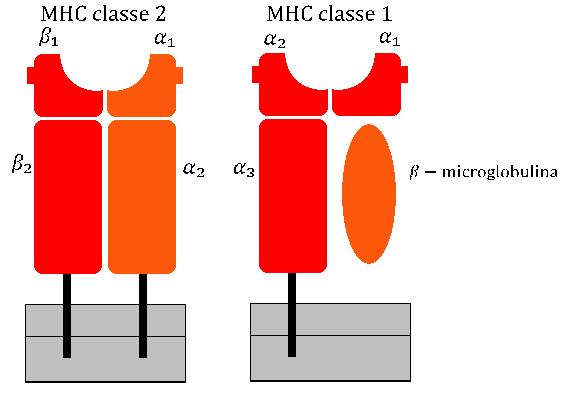
MHC proteins are conventionally grouped into classes with distinct roles. Class I molecules present peptides derived from proteins inside the cell to CD8+ (cytotoxic) T cells, while class II molecules present peptides derived from extracellular proteins to CD4+ (helper) T cells. A separate class, sometimes called class III, includes genes in the same genomic region that contribute to inflammation and complement activity. A characteristic feature of class I and II molecules is the peptide-binding groove, which binds short peptide fragments for display on the cell surface.
Function and mechanism
- MHC proteins capture and present peptide fragments.
- T cells survey these displayed peptides to detect foreign antigens or altered self-proteins.
- This antigen presentation is central to adaptive immunity and determines T-cell activation.
Genetics, diversity, and evolution
MHC genes are among the most polymorphic in vertebrate genomes. High allele diversity and combinations (haplotypes) influence individual immune responsiveness and population-level resistance to pathogens. This diversity is shaped by evolutionary forces such as balancing selection. In humans the MHC region includes the human leukocyte antigen (HLA) genes, widely studied for their genetic variability.
Clinical relevance and examples
MHC compatibility is a major factor in organ and tissue transplantation because mismatched MHC molecules can provoke graft rejection. MHC-linked variation also affects susceptibility to certain autoimmune diseases and the efficacy of vaccines. Researchers use MHC typing in clinical immunology and in studies that examine how the immune system recognizes peptides derived from infections or cancer.
For further reading on molecular details, genetic organization, comparative evolution, and clinical tests see specialized resources: overview of MHC molecules, genetic studies, gene family descriptions, vertebrate comparisons, antigen processing, peptide binding, pathogen interactions, and cell-surface presentation.
Questions and answers
Q: What is a major histocompatibility complex?
A: It is a molecule on the outside of immune cells such as white blood cells.
Q: How is the MHC molecule coded?
A: It is coded for by a large gene family in all vertebrates.
Q: What is the function of MHC molecules?
A: The function of MHC molecules is to sense foreign antigens, and bind peptide fragments from pathogens onto their cell surface.
Q: What happens once the peptide fragments are recognized by T-cells?
A: Adaptive immunity depends on this reaction.
Q: What is the importance of the MHC molecule in adaptive immunity?
A: MHC molecules play a crucial role in adaptive immunity by allowing T-cells to recognize foreign antigens.
Q: What do MHC molecules bind onto their cell surface?
A: MHC molecules bind peptide fragments from pathogens onto their cell surface.
Q: In which organisms are MHC molecules found?
A: MHC molecules are found in all vertebrates.
Related articles
Author
AlegsaOnline.com Major histocompatibility complex (MHC) Leandro Alegsa
URL: https://en.alegsaonline.com/art/60854