
Mahakala — a small basal dromaeosaur from the Late Cretaceous
Mahakala is a small Late Cretaceous dromaeosaurid from Mongolia whose basal anatomy and short forelimbs inform debates about the origin of flight and body-size evolution in paravian dinosaurs.
Overview
Mahakala is a genus of small dromaeosaurid theropod discovered in the Gobi Desert of Mongolia and described from a partial skeleton in the 21st century. It lived during the Late Cretaceous, roughly 80 million years ago, and is notable for combining a mixture of primitive (basal) skeletal features with very small body size. Its anatomy has been cited in discussions about how flight and small body size evolved among paravian dinosaurs.
Image gallery
10 Images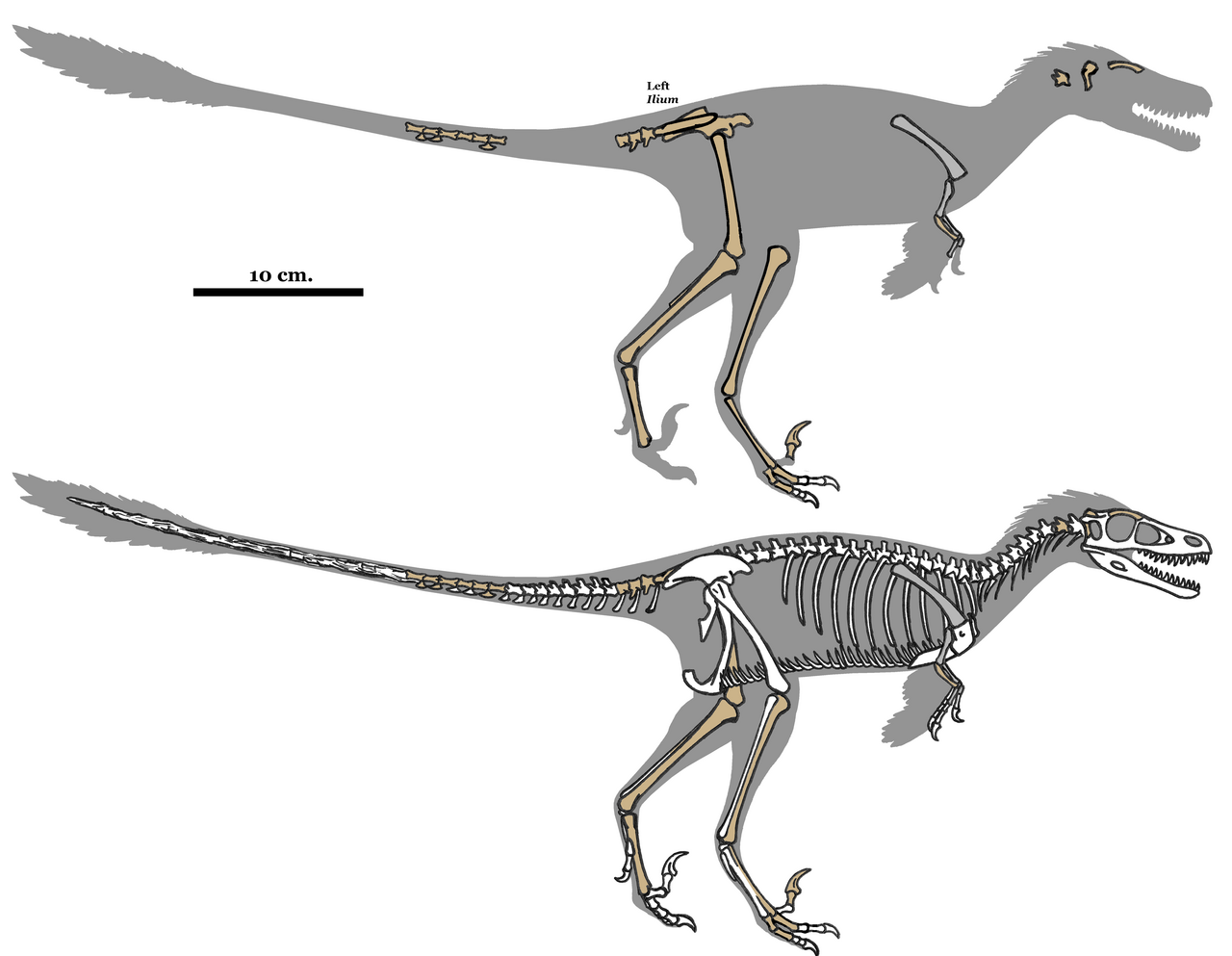


Anatomy and appearance
Individuals of Mahakala were very small compared with many better-known dromaeosaurs, with an estimated body length under one metre. The preserved remains show a compact body plan and relatively short forelimbs compared with later, more bird-like paravians. Several features of the pelvis and hindlimbs align it with early members of the broader deinonychosaur group, while some traits resemble those found in troodontids and early avialans.
Classification and relationships
Mahakala is placed within Dromaeosauridae, a clade of closely related, typically agile, feathered theropods. Its combination of traits identifies it as a basal member of that family rather than a close relative of true birds (Avialae). Because it shares characters with troodontids and avialans, Mahakala has been used in studies that reconstruct the early branching pattern of paravian dinosaurs and the sequence of anatomical changes that led to powered flight.
Discovery and geological context
The known specimen comes from Late Cretaceous strata of the Mongolian Gobi, an area rich in small theropod fossils. The holotype is a partial skeleton that preserves enough of the skeleton to permit a reliable placement within dromaeosaurids, but it lacks complete cranial material. Its age, locality, and preserved features make it an important data point for regional faunal lists and for evolutionary studies of Cretaceous Asian theropods.
Evolutionary significance
Because Mahakala combines a primitive skeletal plan with a small size, researchers have argued that diminutive body size preceded the evolution of long forelimbs and active flight in the paravian lineage. In other words, small size may have been a precondition for the later appearance of wing-assisted locomotion rather than a consequence of it. At the same time, Mahakala's short forearms exclude it from Avialae and underline that small, non-avian dromaeosaurs existed alongside more bird-like relatives.
Further resources
Questions and answers
Q: What is Mahakala?
A: Mahakala is a dinosaur, specifically a dromaeosaurid dinosaur.
Q: When did Mahakala live?
A: Mahakala lived 80 million years ago during the Upper Cretaceous period.
Q: Where was Mahakala found?
A: Mahakala was found in the Gobi Desert, Mongolia based on a partial skeleton.
Q: How big was Mahakala?
A: Mahakala was a small dromaeosaur, about 70 centimeters long (28 inches).
Q: Did Mahakala have features that are found in other dinosaur groups?
A: Yes, Mahakala's skeleton shows some features which are also found in early troodontids and avialans.
Q: Why is Mahakala ruled out of the Alialae?
A: Mahakala is ruled out of the Alialae due to its short forearms.
Q: What does Mahakala's small size suggest about the evolution of birds?
A: Mahakala's small size, and the small size of other basal deinonychosauria, suggests that small size came before flight in birds.
Related articles
Author
AlegsaOnline.com Mahakala — a small basal dromaeosaur from the Late Cretaceous Leandro Alegsa
URL: https://en.alegsaonline.com/art/60699
Sources
- sciencemag.org : "A basal dromaeosaurid and size evolution preceding avian flight"
- doi.org : 10.1126/science.1144066
- pubmed.ncbi.nlm.nih.gov : 17823350