
Mahābhārata: an overview of the epic, composition, themes, and legacy
A comprehensive introduction to the Mahābhārata: its story, structure, dating, major themes (dharma, duty, kingship), key episodes such as the Bhagavad Gita, and its cultural influence.
Overview
The Mahābhārata is an ancient Sanskrit epic that ranks among the longest and most influential narratives in world literature. It centers on a dynastic struggle between two branches of a royal family—the Kauravas and the Pāṇḍavas—and culminates in the great battle at Kurukṣetra. Beyond the war narrative, the work weaves together myth, genealogy, legal and ethical discussion, devotional passages and philosophical dialogue, including the celebrated Bhagavad Gītā.
Image gallery
10 Images


Composition and structure
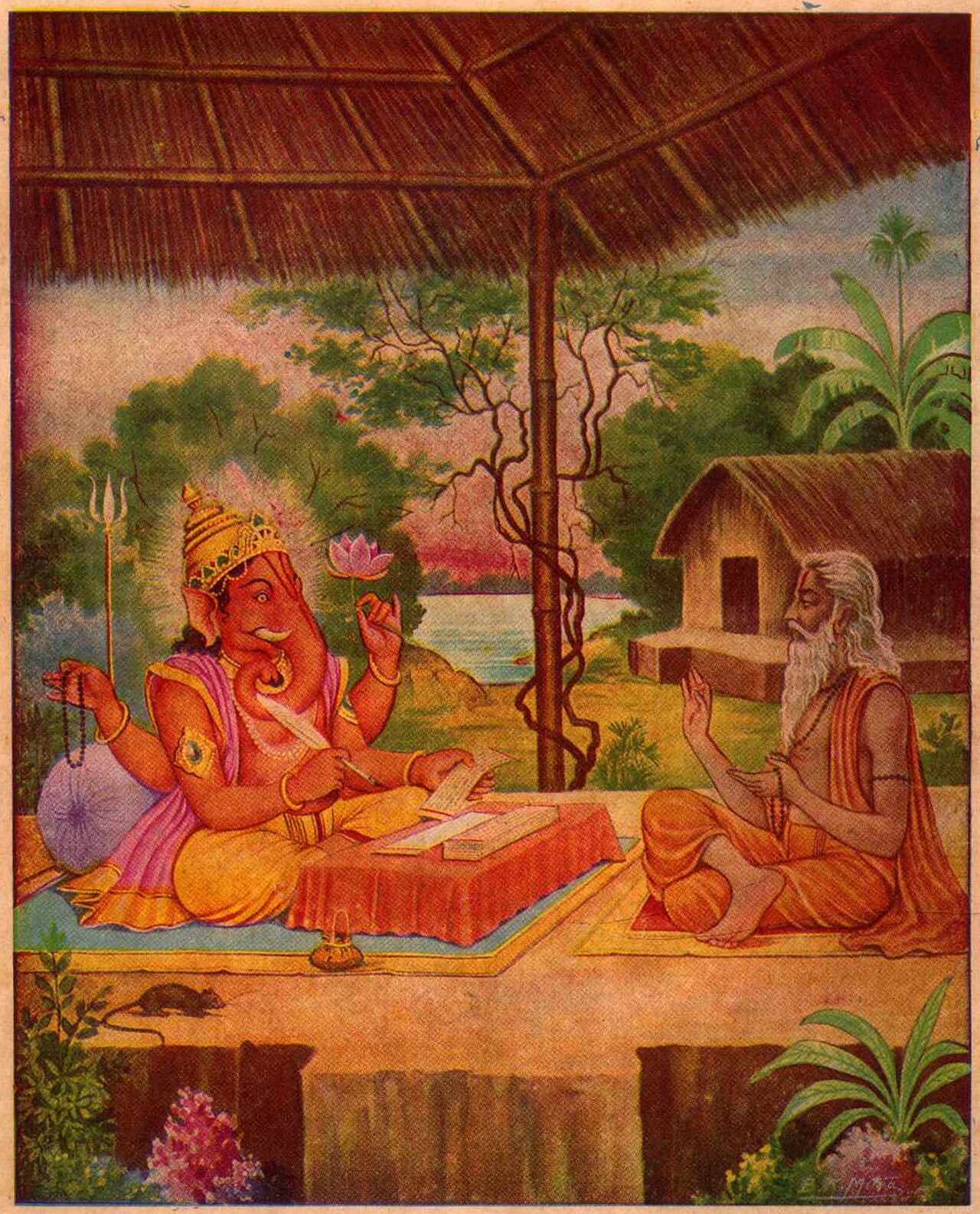
Composed over many centuries, the Mahābhārata reached something close to its present form in the early centuries of the Common Era. Traditional accounts attribute authorship to the sage Vyāsa, and the poem was transmitted through generations of reciters. The text is unusually composite: it contains narrative verse (śloka), extensive prose sections, and embedded tales and didactic passages. Scholars note that the epic may have been compiled and edited between roughly the last few centuries BCE and the early medieval period, with layers of interpolation and regional variations.
Contents and major episodes
The Mahābhārata is arranged into books (parvas) that present a main plot and many subsidiary stories. Some of the best-known episodes and subplots include:
- The rivalry and exile of the Pāṇḍavas.
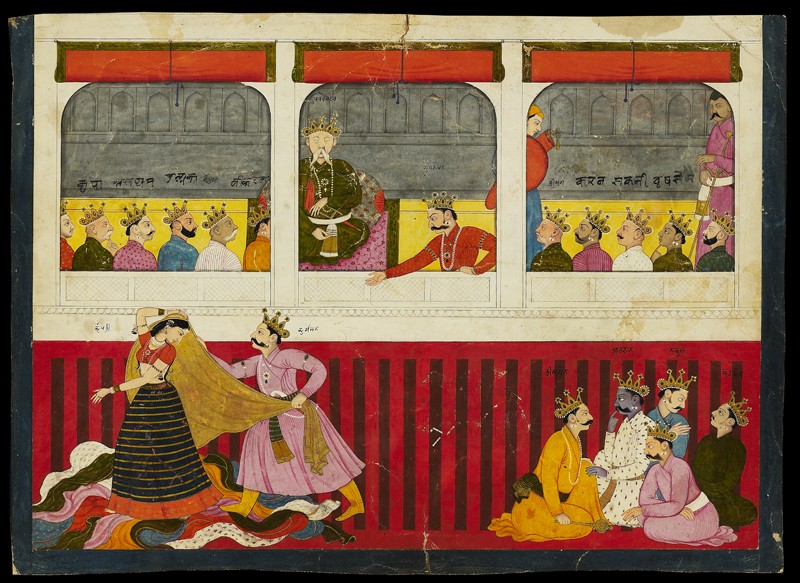
- The game of dice and the loss of kingdom and honor.
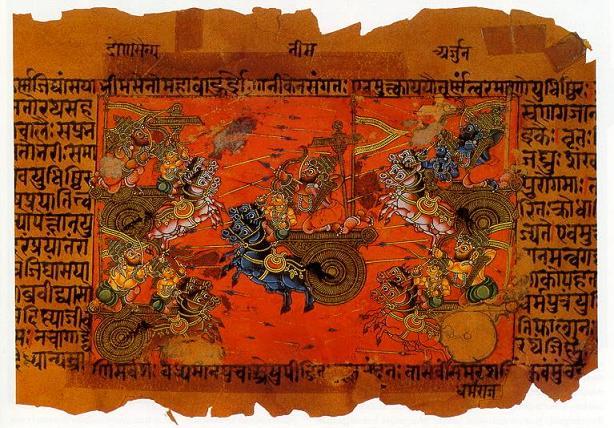
- The Kurukṣetra war and its aftermath.
- Many standalone tales—such as those of Savitri and Satyavān or the romances of Pururava and Urvaśī—that explore love, fate and dharma.
- The Bhagavad Gītā, a spiritual dialogue between Krishna and Arjuna set on the battlefield.
Supplementary material such as the Harivamsha has often been associated with the Mahābhārata and serves as an appendix that elaborates on the lineage and deeds of gods and heroes.
Themes and literary features
The epic explores a wide range of ethical and social questions. Central concerns include dharma (duty, law, right conduct), the nature of kingship, the tensions between personal desire and public obligation, and the moral complexity of warfare. The work also presents the traditional four goals of life (puruṣārtha)—dharma, artha (wealth), kāma (desire), and mokṣa (liberation)—as a recurrent frame for human action.
Literarily, the Mahābhārata blends heroic saga with legal discourse, ritual description and philosophical reflection; parts of the text are poetic, while others are explicitly expository or dialogic, and some sections are notable for long prose commentaries and interpolations.
Historical transmission and dating
Many scholars place the core episodes in a broad period from the final centuries before the Common Era into the early centuries CE; later layers continued to be added. By the time of the early medieval dynasties—often associated with the Gupta period—the epic had achieved wide circulation in varying recensions. The oral and manuscript traditions produced numerous regional variants; hence, no single 'original' text survives, but rather a family of related versions transmitted by bardic and priestly communities.
Influence and cultural importance
The Mahābhārata has exercised profound influence across South and Southeast Asia in literature, theatre, visual arts, law and religious thought. Comparisons are often drawn with the great literary and religious works of other cultures—such as the Bible, the epics of Homer, and the dramas and poetry of Shakespeare—to indicate its central role in shaping moral imagination and narrative traditions. Its scale is exceptional: traditional counts note that its verses number in the tens of thousands and the complete corpus is far longer than either the Iliad or the Odyssey, and significantly longer than the Rāmāyaṇa.
Notable features and legacy
Several features make the Mahābhārata distinctive: its layered composition and editorial growth, its mixture of genres, and its ethical ambiguity—heroes sometimes make questionable choices, and prescriptions about right conduct are debated within the text itself. As a repository of myth, law and theology, it remains a living source for ritual practice, philosophical reflection and artistic adaptation.
For introductions, translations and further study, see general resources and translations that collect the epic's major books, commentaries and selected episodes, and consult scholarly treatments that map its manuscript traditions and historical contexts. For a focused reading of the philosophical core, readers often begin with the Bhagavad Gītā and related expository passages, and then proceed to the broader narrative frame recorded by sages and reciters in traditional accounts such as the retelling attributed to Vyāsa and later narrative preservers.
Further reading and comparative studies remain available in many languages and formats for those who wish to explore the Mahābhārata's artistry, its ethical debates, and its continuing cultural impact.
Philosophical material | Prose sections | Vyāsa | Gupta era | Mahābhārata
Questions and answers
Q: What is the Mahābhārata?
A: The Mahābhārata is one of the two major Sanskrit epics of ancient India. It tells of issues between two groups of cousins in the Kurukshetra War, and also includes philosophical and devotional material.
Q: Who wrote the Mahābhārata?
A: The Mahābhārata is normally said to have been written by Vyasa. Most of it was probably put together between the 3rd century BCE and the 3rd century CE.
Q: How long is the Mahabharata?
A: The longest version has over 100,000 śloka or over 200,000 individual verse lines, as well as long sections of prose. In total, it has about 1.8 million words which makes it around ten times longer than both the Iliad and Odyssey combined and four times longer than Ramaayana.
Q: What are some stories featured in the Mahabharata?
A: Some stories featured in this epic include Bhagavad Gita, Damayanti, Shakuntala, Pururava & Urvashi, Savitri & Satyavan, Kacha & Devyani and Rishyasringa. It also includes a shortened version of Ramaayana.
Q: What topics does this epic cover?
A: This epic covers a number of topics such as aspects of Hinduism, Hindu mythology, ethics and Hindu way of life. There is also a nineteenth section named Harivamsha which deals with these topics in more detail.
Q: When did it become its final form?
A: The text probably became its final form by early Gupta period (c 4th century CE).
Q:What importance does this epic hold for world civilization?
A:The importance that this epic holds for world civilization has been compared to that of Bible , Quran , works Homer , Greek drama or William Shakespeare's works .It is sometimes called fifth Veda .
Related articles
Author
AlegsaOnline.com Mahābhārata: an overview of the epic, composition, themes, and legacy Leandro Alegsa
URL: https://en.alegsaonline.com/art/60698