
Bovine spongiform encephalopathy (Mad cow disease)
Bovine spongiform encephalopathy (BSE), commonly called mad cow disease, is a fatal prion disease of cattle linked to human variant CJD, noted for long incubation, brain degeneration and major agricultural impacts.
Overview
Bovine spongiform encephalopathy (BSE), widely known as mad cow disease, is a progressive, fatal disorder of the central nervous system in cattle. It belongs to the group of transmissible spongiform encephalopathies (TSEs), which are caused by abnormal forms of a prion protein. Unlike conventional infectious agents, these misfolded proteins carry disease without nucleic acids and cause characteristic sponge-like degeneration of brain tissue.
Image gallery
3 Images

Symptoms and pathology
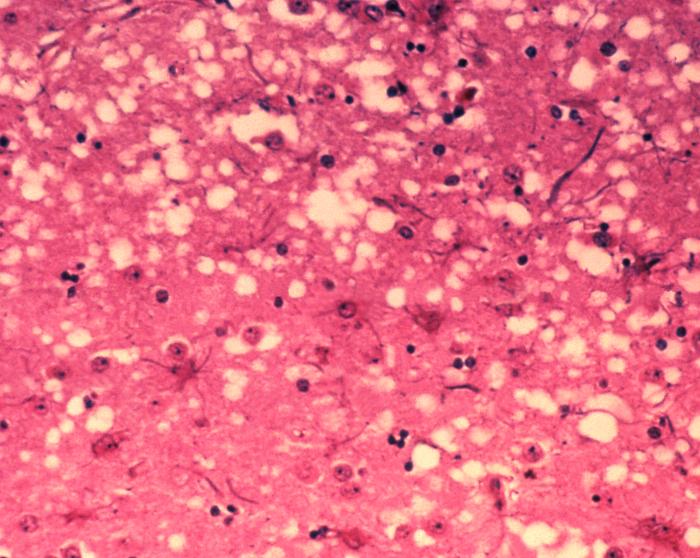
Infected animals develop subtle changes at first and then more obvious neurological and behavioral signs. Pathological hallmarks include vacuolation ("holes") in gray matter, neuronal loss and gliosis. Clinical features in cattle commonly include:
- Behavioral changes: nervousness, apprehension or aggression
- Coordination problems: ataxia, difficulty rising and abnormal gait
- Loss of condition despite continued appetite, reduced milk yield
- Sensory abnormalities and hypersensitivity to stimuli
Definitive diagnosis historically relies on postmortem examination of brain tissue with histology and biochemical tests that detect the protease-resistant prion isoform.
Transmission and incubation
BSE is primarily associated with exposure of cattle to feed contaminated with infected ruminant tissue; recycling of animal protein in feed amplified the epidemic. The disease has a long incubation period, typically measured in years rather than weeks, so animals may appear healthy while harbouring disease. Species barriers affect transmission efficiency, but consumption of BSE-contaminated beef products has been linked to a human form of the disease known as variant Creutzfeldt–Jakob disease (vCJD).
History and impact
Large-scale BSE outbreaks were identified in the United Kingdom and other countries in the 1980s and 1990s. In the mid-1990s public health authorities signalled that BSE could be transmitted to humans; a high-profile announcement by the UK government in 1996 heightened public concern and led to major policy changes. The epidemic caused severe disruption of the cattle industry: over 179,000 infected cattle were recorded in the worst-affected nation and approximately 4.4 million animals were culled in control efforts, triggering trade restrictions and lasting economic effects.
Control, prevention and public health measures
Control strategies reduced risk and include bans on feeding ruminant-derived protein to cattle, removal of specified risk material (high-risk tissues such as brain and spinal cord) from the food chain, targeted surveillance and testing, strict slaughterhouse controls and culling of confirmed cases. These measures, together with improved surveillance, have greatly reduced the incidence of classical BSE.
Related conditions and notable facts
BSE is one member of the wider family of prion diseases, which also includes scrapie in sheep and chronic wasting disease in cervids. Human prion diseases such as sporadic CJD differ in cause and epidemiology from vCJD, which is associated with BSE exposure. There is no cure for prion diseases: research focuses on diagnostics, understanding prion propagation and preventing exposure. Public-health responses and feed regulations have been central to preventing recurrence of large epidemics.
For further technical background and summaries of regulatory changes, see official guidance and reviews by health agencies and veterinary authorities (historical public health announcement).
Questions and answers
Q: What is Mad cow disease?
A: Mad cow disease is the common name of Bovine spongiform encephalopathy, which is a disease that affects a cow's nervous system and their physical state.
Q: What causes Mad cow disease?
A: Mad cow disease comes from the chemistry structure of prion protein.
Q: What happens to the brain of a cow with Mad cow disease?
A: When cattle get Mad cow disease, they have holes forming in their brains. The brain becomes spongy and begins to waste away.
Q: What are the symptoms of Mad cow disease in cattle?
A: The cattle become very violent and show signs of mental disorder and have trouble when they move.
Q: What is the incubation period of Mad cow disease?
A: The incubation period of Mad cow disease is about 4~5 years.
Q: How easily can cattle that are 4~5 years old get Mad cow disease?
A: Cattle that are 4~5 years old can get Mad cow disease very easily.
Q: How has Mad cow disease affected the cattle industry?
A: Mad cow disease has damaged the cattle industry. Some food was made from cattle that had the disease. In England, the nation that was worst affected, more than 179,000 cattle were infected and 4.4 million were killed in an attempt to get rid of the disease.
Related articles
Author
AlegsaOnline.com Bovine spongiform encephalopathy (Mad cow disease) Leandro Alegsa
URL: https://en.alegsaonline.com/art/60410