
Mackinac Bridge: connecting Michigan's peninsulas across the Straits of Mackinac
A comprehensive overview of the Mackinac Bridge: its design, history, role in Michigan transportation, and notable facts for visitors and scholars.
Overview
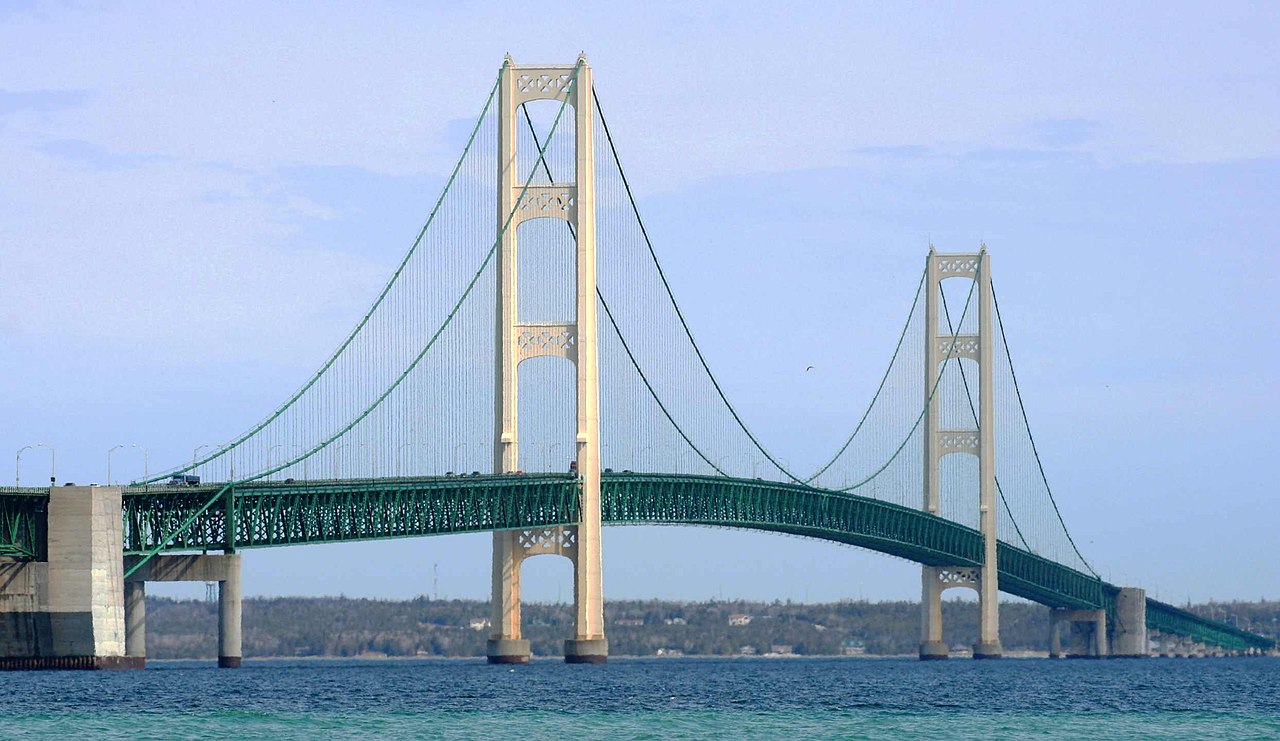
The Mackinac Bridge is a long suspension crossing that links Michigan's Lower Peninsula to the Upper Peninsula across the Straits of Mackinac. Spanning roughly five miles, it carries a four-lane highway and serves as the principal overland route between the two regions. The bridge is often described as an engineering landmark for its length, setting, and the scale of its towers and cables. Many sources and technical descriptions refer to it simply as a suspension bridge.
Image gallery
10 Images





Design and structure
The bridge's central section is a classic suspended span supported by two main towers and a pair of large main cables from which vertical suspender wires descend to hold the roadway. Major structural elements are made from steel and concrete to resist heavy traffic loads, wind, ice, and the corrosive environment of the Great Lakes. The suspended deck is held up by wires that hang from the curved main cables and transfer loads to the towers and anchorages. Typical descriptions of the materials emphasize steel and concrete, while the cable system is commonly discussed in terms of main cables and vertical suspenders attached to the curved main cables.
History and construction
Construction of the bridge was a major mid-20th-century infrastructure project carried out by the state. It opened to traffic in 1957 and transformed travel in the region by providing a year-round land connection where ferries had previously been the main option. The bridge was built to carry an interstate route and now forms part of Interstate highway networks, specifically Interstate 75, which is a key north–south corridor. From the start it has been financed in part by tolls: the authority that operates the crossing charges drivers a fee to use the structure, a practice described generically as a toll. Typical passenger-vehicle tolls have been modest, for example an amount often noted for cars is cited as $4.00 in recent years, though rates can change.
Geographic setting and operation
The Mackinac Bridge spans the narrow channel that links two of the Great Lakes: Lake Michigan on the west and Lake Huron on the east, together forming part of the larger Great Lakes system. The waterway beneath is commonly called the Straits of Mackinac. Because it connects distinct landmasses within the state of Michigan (Michigan is sometimes referenced separately in regional descriptions), the bridge provides a vital link between the Upper Peninsula and the Lower Peninsula, affecting commerce, emergency services, and daily life. Weather on the straits can be severe — high winds, ice, and lake-effect storms require continuous monitoring and maintenance by the authorities that operate the crossing. Visual features such as colored decorative lights are mounted on the main cable and towers so the structure is visible at night; these are often noted as colored lights that create a landmark visible for miles.
Impact, uses, and notable facts
The bridge reshaped tourism and the regional economy when it opened, encouraging more motor travel to northern forests, shoreline communities, and parks. Observers point to an economic boost in the decades after opening as visitors arrived by car rather than ferry. That regional growth, and ongoing maintenance and operations, are part of the bridge's legacy. In addition to serving freight and passenger vehicles, the crossing is sometimes closed temporarily for high winds or maintenance, and it is the site of annual events and commemorations. Interpretive and visitor centers, viewpoints, and historical displays near each end of the crossing help explain the bridge's construction and regional importance.
Practical information and references
- Route: part of Interstate 75, carrying four lanes of traffic and linking major highways (interstate connections).
- Setting: spans the Straits connecting Lake Michigan and Lake Huron, within the larger Great Lakes system.
- Materials and form: notable use of steel, concrete, and cable systems with suspenders hung from main cables.
- Administration: operated by a state authority that collects a toll (recent passenger tariffs noted as $4.00 in some reports).
- Local effects: credited with boosting travel and tourism to northern natural areas, including northern forests, and making year-round land access possible between peninsulas.
For detailed technical specifications, historical documents, and visitor details consult official resources or transportation histories linked through regional archives and transportation authorities represented online by informational pages and tourism guides (Upper Peninsula guides and other regional links are commonly available).
Questions and answers
Q: What is the Mackinac Bridge?
A: The Mackinac Bridge is a suspension bridge in Michigan that connects the state's Upper and Lower Peninsulas.
Q: How long is the Mackinac Bridge?
A: The Mackinac Bridge is 5 miles (8 kilometers) long.
Q: What highway does the Mackinac Bridge carry?
A: The Mackinac Bridge carries the four-lane interstate highway, Interstate 75.
Q: How was the Mackinac Bridge constructed?
A: The Mackinac Bridge was built by the state of Michigan and is made of steel and concrete. It hangs from wires that run down from two huge, curved cables.
Q: Does the Mackinac Bridge have a toll for motor vehicles?
A: Yes, the government agency that runs the Mackinac Bridge charges motor vehicles a toll to drive over it. In 2020, the toll was $4.00 for an automobile.
Q: What is significant about the location where the Mackinac Bridge passes over?
A: The Mackinac Bridge passes over a strait of water that connects two Great Lakes, Lake Michigan (to the west of the bridge) and Lake Huron (to the east).
Q: When was the Mackinac Bridge opened and what effect did it have on the region?
A: The Mackinac Bridge was opened in 1957 and it started a major economic boom in northern Michigan as tourists drove from all over North America to see the bridge, the Great Lakes, and the northern forests.
Related articles
Author
AlegsaOnline.com Mackinac Bridge: connecting Michigan's peninsulas across the Straits of Mackinac Leandro Alegsa
URL: https://en.alegsaonline.com/art/60360
Sources
- en.structurae.de : Mackinac Straits Bridge
- mackinacbridge.org : "Mackinac Bridge Fare Schedule"