
Macaw
Colorful, long-tailed New World parrots noted for intelligence, strong beaks, social bonds and striking plumage; native to Mexico, Central and South America and formerly the Caribbean.
Macaws are a group of large, often vividly colored parrots native to the New World. They belong to the wider parrot family, often referred to simply as parrots, and are especially well known for long tail feathers, a powerful curved beak and a patch of bare facial skin. Their natural range historically included Mexico, Central America, South America and, in earlier times, the Caribbean.
Image gallery
10 Images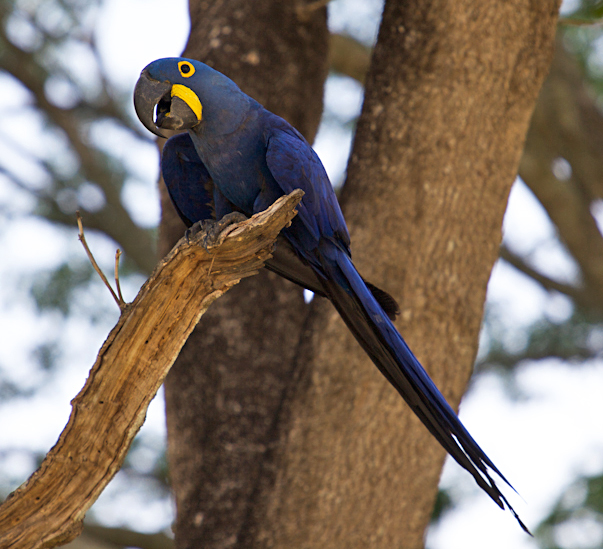





Key characteristics
Macaws show several distinctive physical and behavioral traits. Typical features include bright plumage with combinations of red, blue, yellow and green; elongated tails; a large, hooked beak adapted for cracking seeds and nuts; and a partially bare face around the eye. Sizes vary by species, with some macaws among the largest parrots. Many species are long-lived compared with other birds and may form strong pair bonds.
Behavior and intelligence
Like other parrots, macaws display notable cognitive abilities: they engage in vocal learning and can mimic sounds, solve problems, and learn complex tasks. Social behavior is important—individuals form monogamous pairs and often travel in small flocks. Common behaviors include mutual preening, communal roosting, and coordinated flight. In parts of their range macaws are observed visiting natural clay deposits, a behavior thought to help neutralize dietary toxins.
Habitat, diet and species notes
Macaws inhabit a variety of wooded environments such as tropical rainforests, gallery forests and savanna woodlands. They nest in tree cavities, large palms or rock crevices and feed largely on fruits, seeds, nuts and sometimes vegetation or insects. Several well-known species include the scarlet macaw and the hyacinth macaw; taxonomic treatments recognize multiple species and subspecies, some rare or threatened.
Conservation and human interactions
Many macaw populations have declined because of habitat loss, fragmentation, capture for the pet trade and hunting. Conservation responses include protected areas, habitat restoration, captive-breeding and community-based projects aimed at reducing illegal trade. As pets, macaws require substantial space, mental stimulation and long-term commitment, so they are not suitable for casual owners.
Notable facts and distinctions
- Several macaw species are among the largest parrots, distinguished by long tails and strong bills.
- Facial bare skin patterns are often used to recognize individual birds.
- Their bright colors and intelligence have made them important in indigenous cultures, ecotourism and aviculture.
Questions and answers
Q: What is a macaw?
A: A macaw is a species of New World parrot.
Q: Where are macaws native to?
A: Macaws are native to Mexico, Central America, South America, and formerly the Caribbean.
Q: How large can macaws grow?
A: Some species of macaws can grow to be the largest of all parrots.
Q: Are macaws intelligent birds?
A: Yes, like all parrots, macaws are unusually intelligent birds.
Q: What is common among parrots in terms of mating?
A: The usual thing for parrots is to pair for life and they stay together even out of the mating season.
Q: How do macaws often fly?
A: Macaws often fly in formation, with one bird above the other.
Q: Are there any endangered species among macaws?
A: Yes, several macaw species are endangered due to habitat loss and illegal pet trade.
Related articles
Author
AlegsaOnline.com Macaw Leandro Alegsa
URL: https://en.alegsaonline.com/art/60279
Sources
- pnas.org : On the biogeography of salt limitation