
M25 motorway — the London Orbital
The M25 is a 117-mile orbital motorway encircling Greater London. Opened in 1986, it links major radial routes and airports and is a vital but frequently congested element of Britain's road network.
The M25 motorway, commonly called the London Orbital, is a ring road that encircles Greater London. Stretching about 117 miles (188 km), it is one of the longest orbital motorways in the world and serves as a principal bypass for traffic that would otherwise pass through the capital. The route does not penetrate central London; instead it connects the radial motorways and trunk roads that lead into the city, creating a continuous high-capacity route around the metropolitan area.
Image gallery
10 Images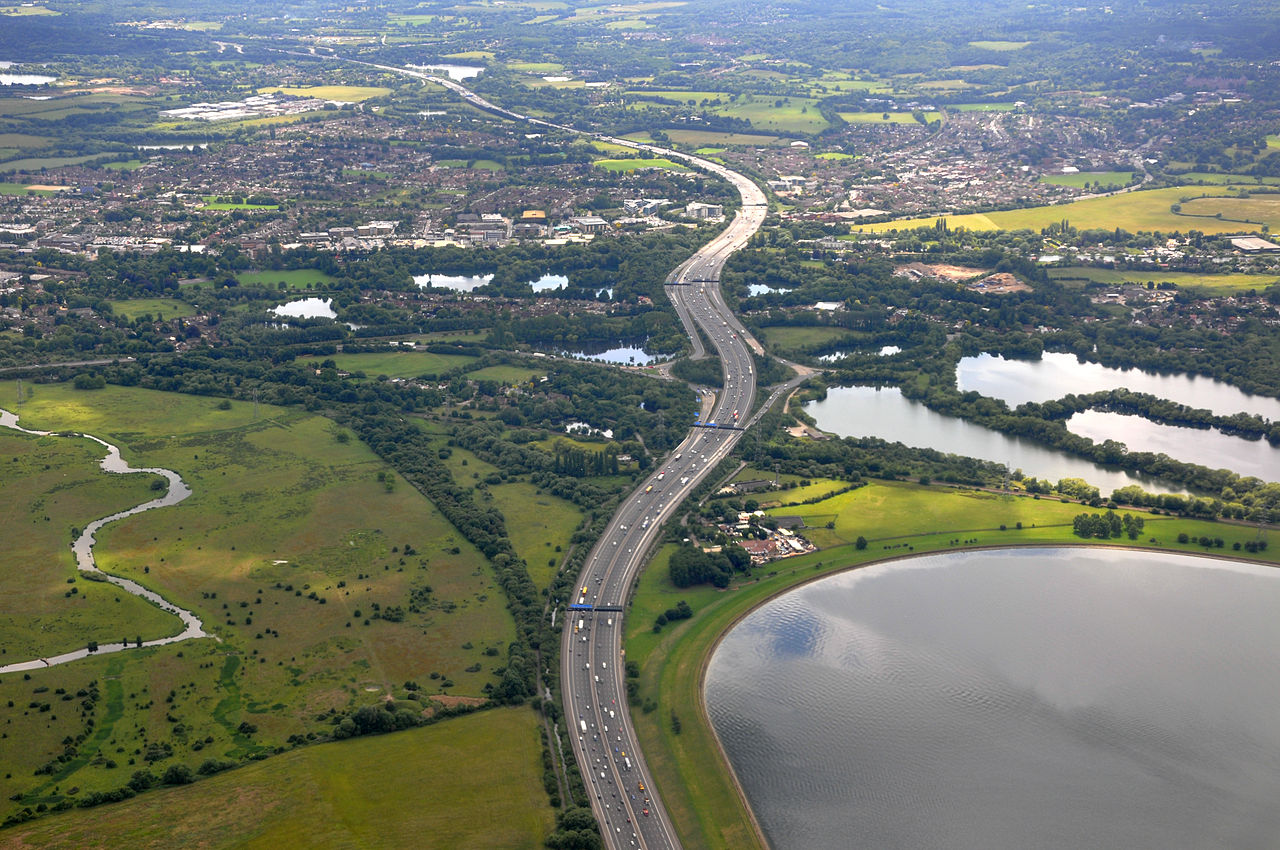




Route and characteristics
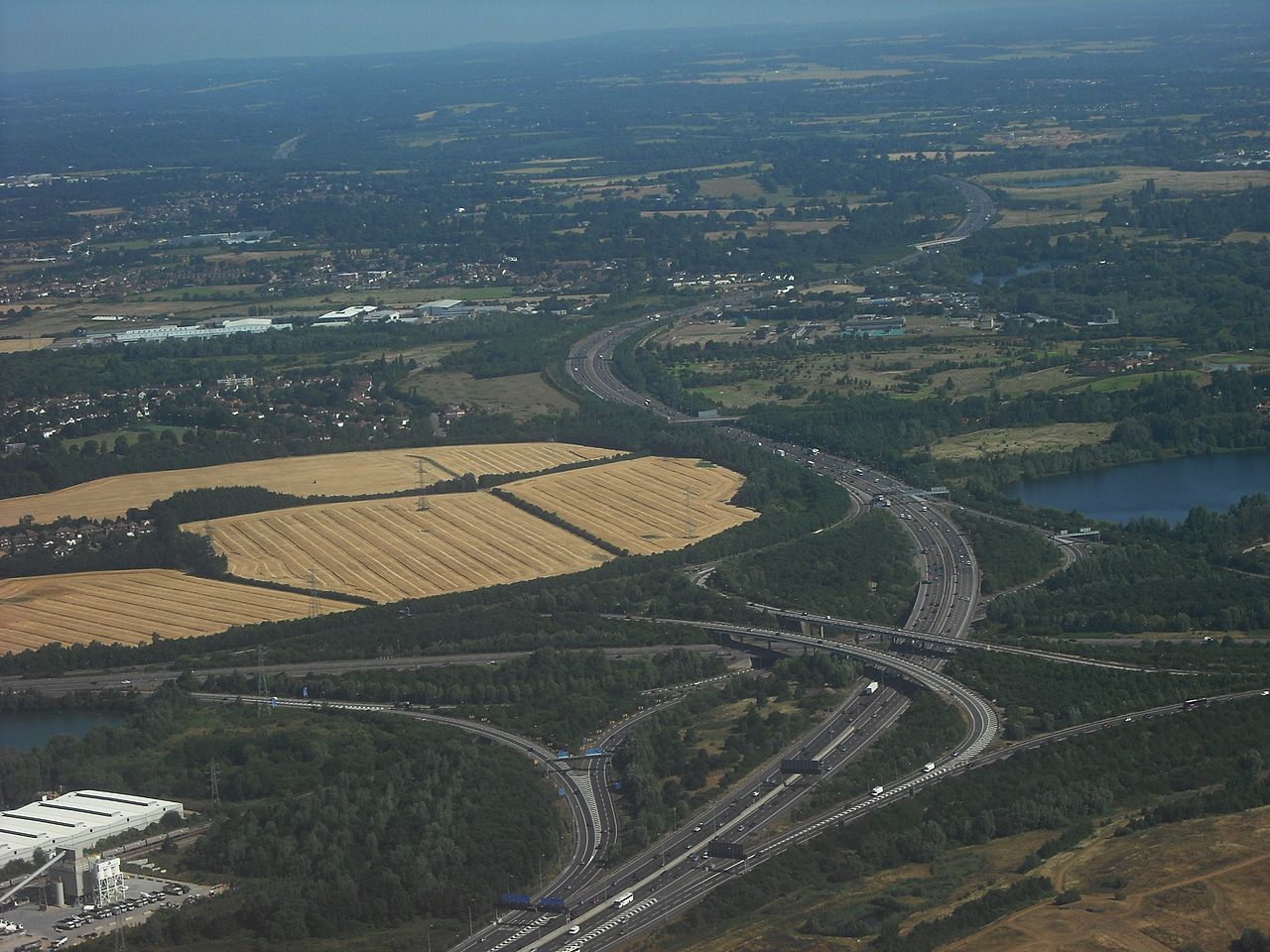
The M25 links many of England's major radial motorways — including the M1, M3, M4 and M11 — and provides access to London's main airports and freight terminals. The motorway is formed of dual carriageway sections with most stretches carrying four lanes in each direction or managed lanes that vary by location. Many parts feature hard shoulders, emergency refuges and gantries for signs and speed cameras. Variable speed limits and lane management are used on busy sections to control flow and reduce the severity of congestion.
History and development
Concepts for an orbital route around London date back to early 20th-century plans for coordinated road networks. Construction began on several disconnected sections in the 1970s, with the continuous circuit completed in 1986. The decision to complete the orbital reflected a postwar emphasis on motorway connectivity for both commuter and long-distance traffic. Since opening, the M25 has been subject to successive upgrade programmes to increase capacity, improve junctions and introduce active traffic management technologies.
Traffic, congestion and management
The M25 is a heavily trafficked corridor and is frequently listed among the busiest parts of the UK motorway system. Certain stretches close to major interchanges and airports can experience severe congestion during peak periods; on one recorded day, traffic volumes near Heathrow reached approximately 196,000 vehicles. To mitigate delays, authorities have implemented widening projects, managed motorway schemes with variable speed limits, and improved incident response to clear breakdowns and crashes more quickly.
Role and importance
The motorway plays several roles in Britain's transport network: it acts as a distributor for long-distance traffic avoiding central London, a connector between regional motorways, and a local commuter route for suburbs and satellite towns. The M25 also provides critical links to the four principal airports that serve London — Heathrow, Gatwick, Stansted and Luton — and to major freight routes, making it important for both passenger travel and logistics. For information about the motorway's relationship with airports, see the airports and air transport network.
Notable facts and distinctions
- The M25's completion in the mid-1980s created a continuous high-speed orbital road around one of Europe's largest metropolitan areas.
- It has been a focal point for debates about road capacity, environmental impact and the balance between car use and public transport in and around London.
- Over time the motorway has been the subject of phased improvements rather than wholesale reconstruction; this has included targeted widening, junction redesigns and technology-led traffic management.
As a major piece of transport infrastructure, the M25 continues to evolve. Planning, construction and management decisions balance capacity needs against environmental and community concerns, while engineering and traffic-control measures aim to keep one of Britain's busiest orbital roads moving as efficiently as possible.
Questions and answers
Q: What is the M25 motorway?
A: The M25 motorway, or London Orbital, is a 117-mile (188 km) orbital motorway around Greater London.
Q: When was the M25 first suggested?
A: The M25 motorway was first suggested early in the 20th century.
Q: How many sections of the M25 were built in the early 1970s?
A: A few sections of the M25 were built in the early 1970s.
Q: How many vehicles are recorded on a single day near London Heathrow Airport?
A: 196,000 vehicles are recorded on a single day near London Heathrow Airport.
Q: What are the four main airports connected by the M25?
A: The four main airports connected by the M25 are Heathrow, Gatwick, Stansted and Luton.
Q: Why is there no motorways going through central London?
A: There are no motorways going through central London because it is too densely populated and would cause disruption to local communities.
Q: How many lanes did originally exist on the M25 when it was completed in 1986? A:The M25 originally had six lanes (three each way) when it was completed in 1986.
Related articles
Author
AlegsaOnline.com M25 motorway — the London Orbital Leandro Alegsa
URL: https://en.alegsaonline.com/art/60217
Sources
- iht.org : "M25 London Orbital Motorway (Junctions 13 to 30)"
- business.timesonline.co.uk : "Rising costs put the brakes on dozens of roadbuilding projects"
- ciht.org.uk : The Motorway Archive : The M25 London Orbital Motorway
- hansard.millbanksystems.com : "HANSARD 3 December 1990 Written Answers (Commons) TRANSPORT"
- independent.co.uk : "The bluffer's briefing on: The M25"
- hansard.millbanksystems.com : "M25 (Widening)"
- cnplus.co.uk : "M25 scoop for Balfour in Surrey"
- dft.gov.uk : "Case Study - M25 Controlled Motorway"
- independent.co.uk : "The roadblock that became a bandwagon"
- independent.co.uk : "Pointless lies that reveal so much"
- independent.co.uk : "Minister gives green light to widen M25"
- getsurrey.co.uk : "Plans to widen M25 to 12 lanes under attack"
- nce.co.uk : "BAA makes plans for Terminal 5 despite inquiry"
- bbcel.co.uk : "M25 Junctions 12 to 15 widening"
- highways.gov.uk : "M25 Jct 12 to 15 Widening"