
Lydia (ancient Anatolian kingdom)
Ancient kingdom in western Anatolia centered on Sardis, known for early coinage, the legendary wealth of Croesus, and its cultural role before Persian conquest.
Overview
Lydia was an Iron Age kingdom in western Anatolia occupying the valleys of the Hermus and Cayster rivers and the surrounding interior. Its core territory included the regional capital Sardis and neighbouring towns and agricultural land. Located at the crossroads between inland Anatolia and the Aegean coast, Lydia played an important political and commercial role in the first millennium BCE. For sources and maps of the region see Anatolia.
Image gallery
10 Images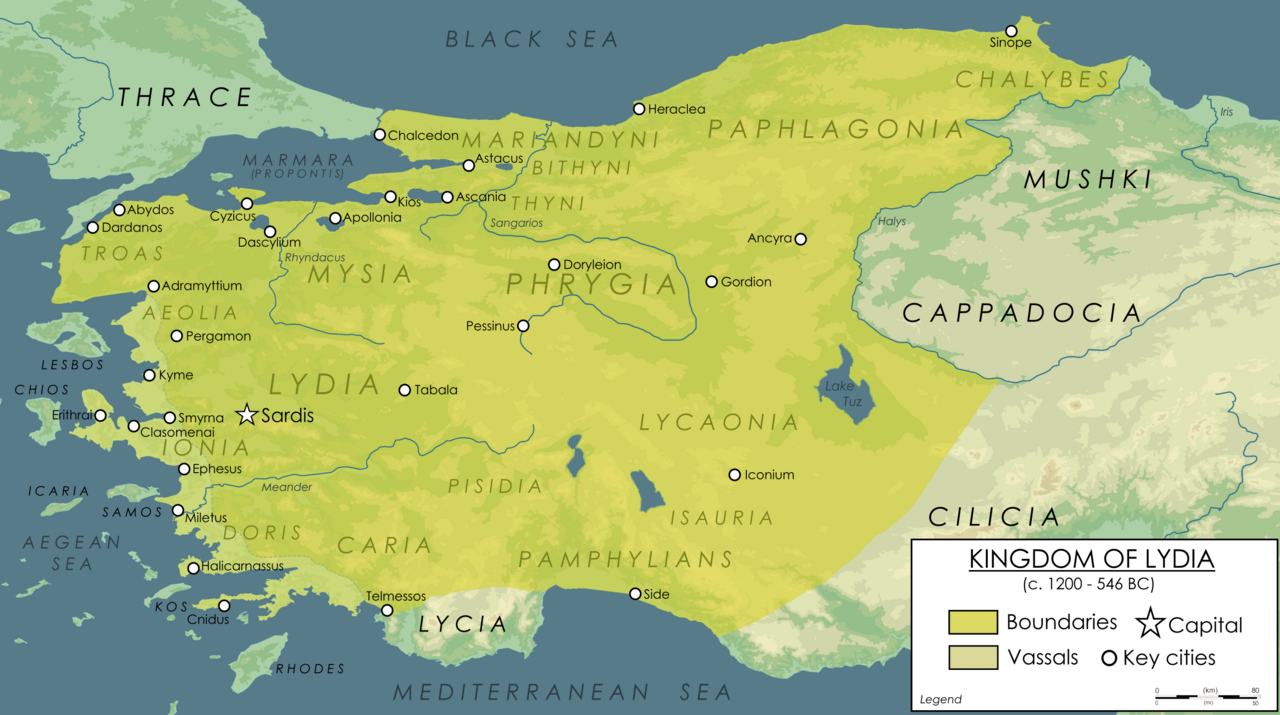


Characteristics and institutions
Lydia combined urban centres, fertile river valleys and mineral-rich uplands. Its economy relied on agriculture, trade, and access to gold-bearing sands in local rivers that contributed to Lydian wealth in antiquity. The kingdom is widely credited with producing some of the earliest stamped metal coinage, using electrum (a natural alloy of gold and silver) to strike small discs for use in commerce. Lydian society included royal administration, artisan workshops, and urban markets that linked inland resources with Aegean trade networks.
History and notable rulers
The dynasty most commonly associated with classical Lydian power is the Mermnad house, whose members ruled during the 7th and 6th centuries BCE. Prominent rulers often mentioned in ancient accounts include Gyges, who established the dynasty, and Croesus, famed in Greek sources for his great wealth. Croesus reigned in the mid-6th century BCE and was defeated when the expanding Persian empire under Cyrus the Great annexed Lydia, ending the kingdom's independence.
Culture, language and relationships
The Lydians spoke an Anatolian language closely related to other languages of the region and left inscriptions that help scholars understand local administration and religion. Their culture was shaped by contacts with neighbouring Greek cities on the Aegean coast—trade and exchange brought artistic and religious influences in both directions. Greek historians, especially Herodotus, preserved stories about Lydia and its kings, contributing to the later reputation of Croesus as a symbol of wealth.
Legacy and significance
- Economic innovation: Lydia is often credited with early minted coinage that influenced monetary practices across the Mediterranean.
- Historical crossroads: the kingdom bridged inland Anatolia and the Aegean, acting as an intermediary in trade and cultural exchange.
- Literary legacy: stories of Croesus and Lydian wealth entered Greek and later European traditions as emblematic tales about fortune and power.
After incorporation into the Persian Achaemenid Empire, Sardis remained an important administrative centre, and Lydian material culture continued to influence the region under subsequent empires. For further archaeological and historical overviews see relevant specialist work and maps at regional resources and studies addressing the Persian expansion under Cyrus.
Questions and answers
Q: Where was Lydia located?
A: Lydia was an ancient kingdom in Anatolia which occupied the valleys of the Hermus and Cayster rivers.
Q: When were the Lydians the most powerful people in Anatolia?
A: From the middle of the 7th century to the middle of the 6th century, the Lydians were the most powerful people in Anatolia.
Q: What is said to be the Lydians' contribution to the world of finance?
A: The Lydians were said to have been the first makers of gold and silver coins.
Q: Who was Croesus?
A: Croesus was a king of Lydia who is said to have reigned for 14 years.
Q: When did Croesus reign as king of Lydia?
A: Croesus is said to have reigned as king of Lydia from 560 BC until he was defeated by the Persian king Cyrus the Great in 546 BC.
Q: What was Croesus famous for?
A: Croesus was famous for his great wealth.
Q: Who defeated Croesus?
A: Croesus was defeated by the Persian king Cyrus the Great.
Related articles
Author
AlegsaOnline.com Lydia (ancient Anatolian kingdom) Leandro Alegsa
URL: https://en.alegsaonline.com/art/60088