
Lugworm (Arenicola marina): biology, habitat and human uses
Overview of the lugworm (Arenicola marina): appearance, burrow behaviour, feeding, ecological role, life cycle, and use as bait and study organism.
The lugworm, commonly called the sandworm, is a large intertidal polychaete best known for the neat coiled casts of sand it leaves on sheltered beaches. The name most often refers to Arenicola marina, a segmented worm in the phylum Annelida. Lugworms live buried in permanent U- or J-shaped tubes in the sediment and are usually encountered indirectly by the characteristic piles of processed sand they eject at low tide. Their activity is an obvious sign of active sediment turnover on many temperate coasts.

Image gallery
3 Images

Distribution and habitat
Lugworms occur mainly on temperate sandy and muddy-sand shores of the North Atlantic and adjacent seas, where they inhabit upper and mid-intertidal flats. They prefer sheltered sites with fine to medium sand that can retain the structure of their burrows. Within their range they may be patchily distributed according to sediment type, tidal exposure and local salinity.

Burrow structure and how to find them
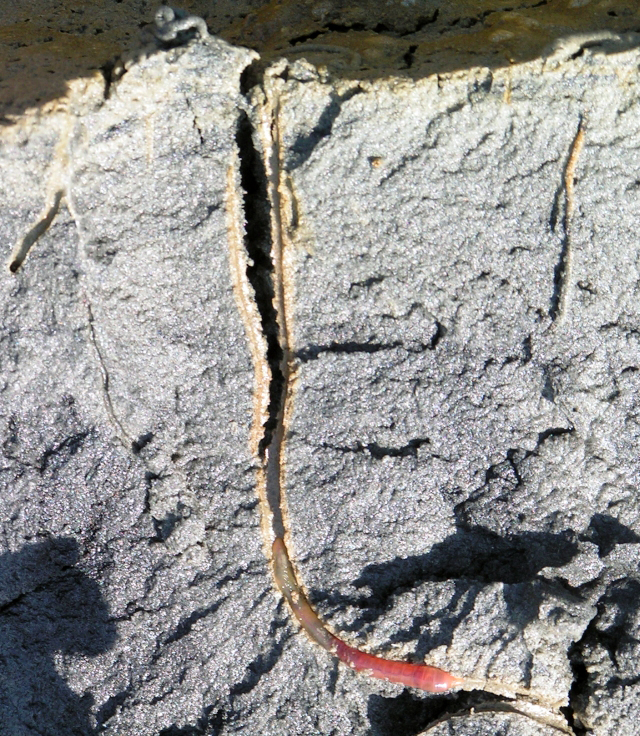
Each lugworm lives in a U- or J-shaped burrow with two openings: one through which seawater is drawn to ventilate the tube and another where processed sediment and fecal casts are expelled on the surface as a coiled mound. These surface castings are often the most obvious sign of lugworm presence and are visible at low tide. Because the animal itself remains in the tube it is rarely seen unless dug up by hand.
Form and anatomy
Lugworms are relatively large polychaetes with elongated, segmented bodies that may reach several centimetres to a few decimetres when extended. Their segmented body bears chaetae (bristles) that help anchor the animal in its tube and aid movement within the sediment. Internally they have a well-developed circulatory system with blood vessels that transport respiratory pigments, and many species show external filamentous structures (branchiae) on anterior segments that assist gas exchange. Superficially they resemble terrestrial earthworms, but they are distinct in anatomy and life history.
Feeding and digestion
Lugworms are mainly deposit feeders: they ingest sediment and extract organic detritus, microalgae and microorganisms as they pass material through their gut. They do not feed by filtering suspended plankton in the same way as some tube-dwelling worms; instead they process sediment, extracting organic particles and microbes as part of their digestive processes. The ejected casts are depleted in organic matter and display the animal's role in sediment sorting.
Ecological role
The sediment turnover caused by lugworm feeding — bioturbation — affects sediment texture, oxygen penetration and nutrient recycling. By ingesting, mixing and aerating sediment, lugworms influence the distribution of bacteria and small invertebrates and improve conditions for other benthic organisms. They are also an important prey item for shorebirds, fish and crabs, linking benthic production to higher trophic levels.

Life cycle and reproduction
Arenicola species generally have separate sexes and reproduce by releasing eggs and sperm into the water where fertilisation occurs. Larvae commonly pass through a planktonic stage before settling to the bottom and constructing a burrow. Specific timing and larval duration vary by species and locality, as with many marine annelids.
Species notes and identification
The textbook species is Arenicola marina, but a closely related form, Arenicola defodiens, occurs in similar habitats and can grow larger. Identifying species reliably for scientific work may require examination of size, segment features and sometimes internal anatomy or molecular markers; superficially similar lugworms should not be assumed to be the same species without care.
Human uses, research and conservation
Lugworms are widely collected as bait by anglers and are familiar to beachcombers who dig in the sand. They are also used as model organisms in studies of benthic ecology, sediment toxicology and environmental monitoring because their activity strongly influences sediment chemistry and they respond to pollution and habitat change. Over-collection, habitat alteration and contamination can reduce local populations; conservation of intertidal habitats and careful management of bait collection help maintain healthy lugworm beds.
Further information
- Common name: lugworm or sandworm; scientific name frequently cited as Arenicola marina.
- Feeding: deposit feeding and sediment processing (digestion and sorting).
- Anatomy: segmented body with bristles, circulatory system and branchiae (blood vessels, gill-like structures).
- Human interest: bait, ecological indicator and subject of coastal research.
Questions and answers
Q: What is a lugworm?
A: A lugworm (Arenicola marina) is a large marine worm of the phylum Annelida. It is also known as the sandworm and can be found making coiled tubes of sand on beaches at low tide.
Q: How big can a lugworm grow?
A: Lugworms can grow to about 5 inches long (13 cm).
Q: What does the body of a lugworm look like?
A: The body of a lugworm is segmented, like that of an earthworm, and has bristles in the middle. It also has well-developed blood-vessels, and gills to breathe in the water.
Q: Where does a lugworm live?
A: Lugworms live in U-shaped tubes in the sand, and filter out their food from the water.
Q: Is there more than one species of lugworms?
A: Yes, there is another species called Arenicola defodiens which lives a similar life but grows to about 9 inches long (23 cm).
Q: What does a young lugworm look like?
A: A young lugworm looks like it would when it's living in its burrow - segmented with bristles down its middle.
Q: What does a simplified cross section of a lug worm burrow look like?
A: A simplified cross section of a lug worm burrow looks like an U-shaped tube with small ridges along its walls where food particles are filtered out from passing water.
Related articles
Author
AlegsaOnline.com Lugworm (Arenicola marina): biology, habitat and human uses Leandro Alegsa
URL: https://en.alegsaonline.com/art/59819
Sources
- marinespecies.org : World Register of Marine Species