
Loricifera — tiny loricate animals of marine sediments
Loricifera are microscopic marine animals living between sediment grains. Described in 1983, they form a distinct ecdysozoan phylum notable for their protective lorica and for species found in oxygen‑free deep basins.
Overview
Loricifera are a small phylum of microscopic, exclusively marine animals first described by Reinhardt Kristensen in 1983. Members of this group live as interstitial organisms in seabed particles and are part of the broader Ecdysozoa, a clade characterized by molting. Loricifera are formally recognized as a phylum, distinct from but related to other tiny sediment dwellers such as kinorhynchs and priapulids.
Image gallery
2 Images
Characteristics and anatomy
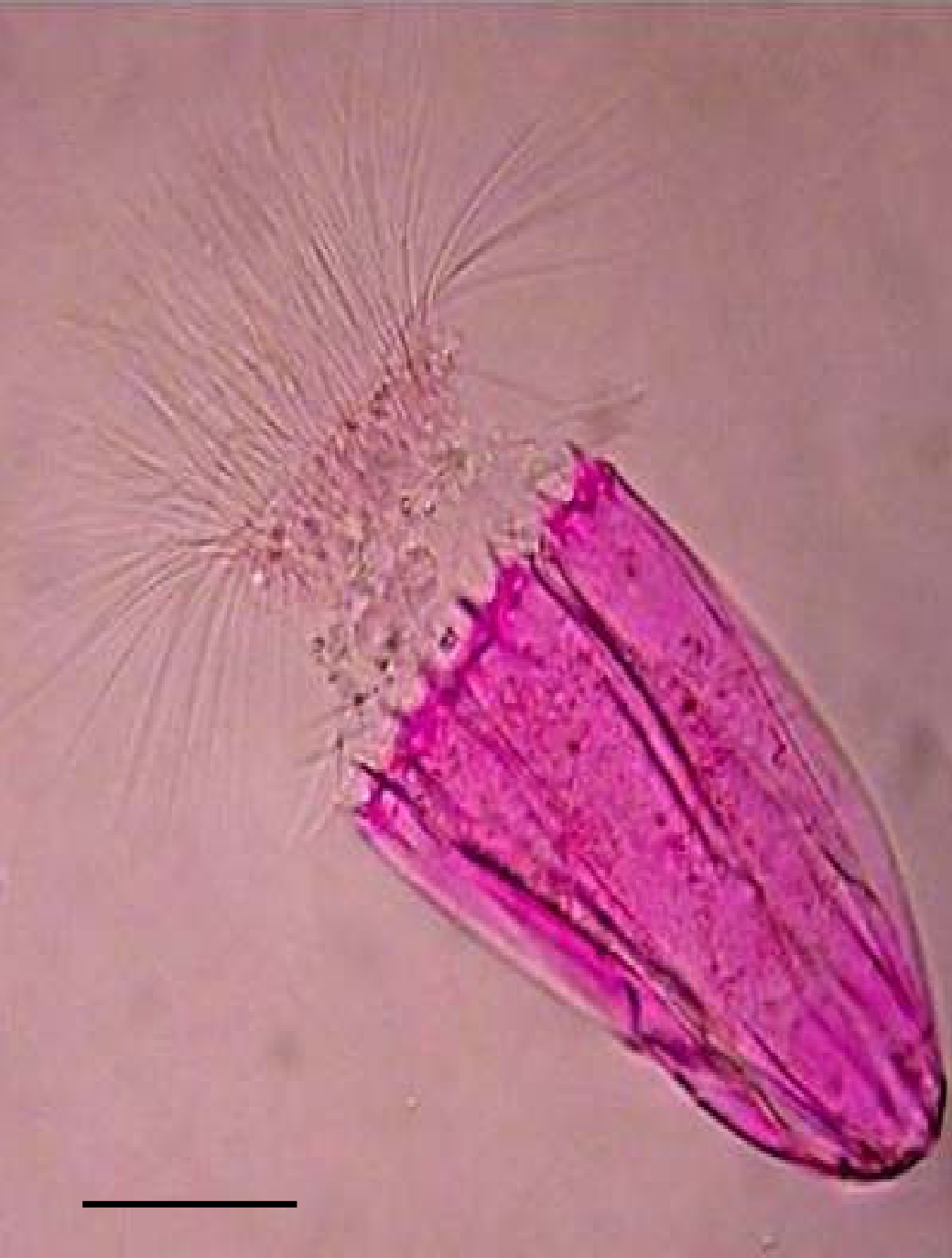
Typical loriciferans measure roughly 100 µm to about 1 mm and are protected by a multilayered cuticular case called a lorica. Their body plan is compact and divided into an introvert (a retractable head‑like region), a thorax, and an abdomen encased by the lorica. The introvert bears scalids — spines or plates used for locomotion and sensing the environment. They undergo ecdysis (molting) like other ecdysozoans, and their soft parts are often withdrawn into the lorica for protection.
Life cycle and behavior
Loricifera show complex development that includes larval stages and successive molts. Reproduction is generally sexual, and species display various reproductive strategies, though detailed life histories remain incompletely described for many taxa. Feeding is presumed to involve scraping or ingesting bacteria and organic detritus from the surfaces of sediment grains; the precise diets vary and are an active area of study.
Habitat and ecology
These animals live between grains of sand and gravel within marine habitats, especially in soft sediment from shallow coastlines to deep basins. Their tiny size makes them part of the meiofauna — organisms that influence nutrient cycling and microbial communities in sediments. Notably, some loriciferans discovered in anoxic deep‑sea basins have been reported to complete their life cycles in environments lacking free oxygen, a rare adaptation among animals that has drawn considerable scientific interest.
Discovery, diversity and research
Since the first descriptions in the late twentieth century, taxonomists have documented a limited number of species: the source material lists about twenty‑two described species across several genera, with many more collected but awaiting formal description. Their small size, firm attachment to sediment particles and cryptic habits contributed to their late recognition. Loricifera are still under active investigation for their evolutionary relationships, physiology (including adaptations to low or absent oxygen), and ecological roles.
Distinctive facts and significance
- The lorica — a defining external case — gives the group its name and provides protection during withdrawal and molting.
- Loricifera are important for understanding animal diversity at microscopic scales and the limits of animal life in extreme environments.
- Ongoing sampling and molecular work continue to reveal additional species and clarify their place within the Ecdysozoa and the subgroup Scalidophora.
Questions and answers
Q: What is Loricifera?
A: Loricifera is a recently discovered phylum of marine animals.
Q: Who described the phylum of Loricifera?
A: Loricifera was described by Reinhardt Kristensen.
Q: What makes Loricifera unique?
A: Loricifera is unique because it includes the first animals known to exist in a completely anoxic environment.
Q: Where do Loricifera live?
A: Loricifera live in sediment in the spaces between marine gravel to which they attach themselves.
Q: How small are Loricifera?
A: Loricifera's size ranges from 100 µm to about 1 mm.
Q: Why have Loricifera remained undiscovered for so long?
A: Loricifera attach themselves quite firmly to the gravel, which explains why they remained undiscovered for so long.
Q: Have Loricifera been found in the fossil record?
A: No, Loricifera have not yet been found in the fossil record.
Related articles
Author
AlegsaOnline.com Loricifera — tiny loricate animals of marine sediments Leandro Alegsa
URL: https://en.alegsaonline.com/art/59254
Sources
- nature.com : "Animals thrive without oxygen at sea bottom"
- doi.org : 10.1038/464825b
- sciencenews.org : "Multicelled animals may live oxygen-free"
- doi.org : doi:10.1186/1741-7007-8-32
- nature.com : doi=10.1038/ismej.2007.83
- www3.interscience.wiley.com : doi=10.1111/j.1462-2920.2008.01777.x
- doi.org : doi:10.1186/1741-7007-8-30