
Long-nosed bandicoot (Perameles nasuta)
Small marsupial of eastern Australia and Tasmania, the long-nosed bandicoot is known for its pointed snout, burrowing foraging, very short gestation and vulnerability to habitat loss and introduced predators.
Overview
The long-nosed bandicoot (Perameles nasuta) is a small terrestrial marsupial native to the temperate and coastal woodlands of eastern Australia and parts of Tasmania. It belongs to the broader bandicoot family and is one of several closely related species commonly referred to as long-nosed bandicoots. The species is recognizable by its elongated, pointed snout, compact body and habit of digging for invertebrates and tubers after dusk.
Image gallery
5 Images



Physical characteristics
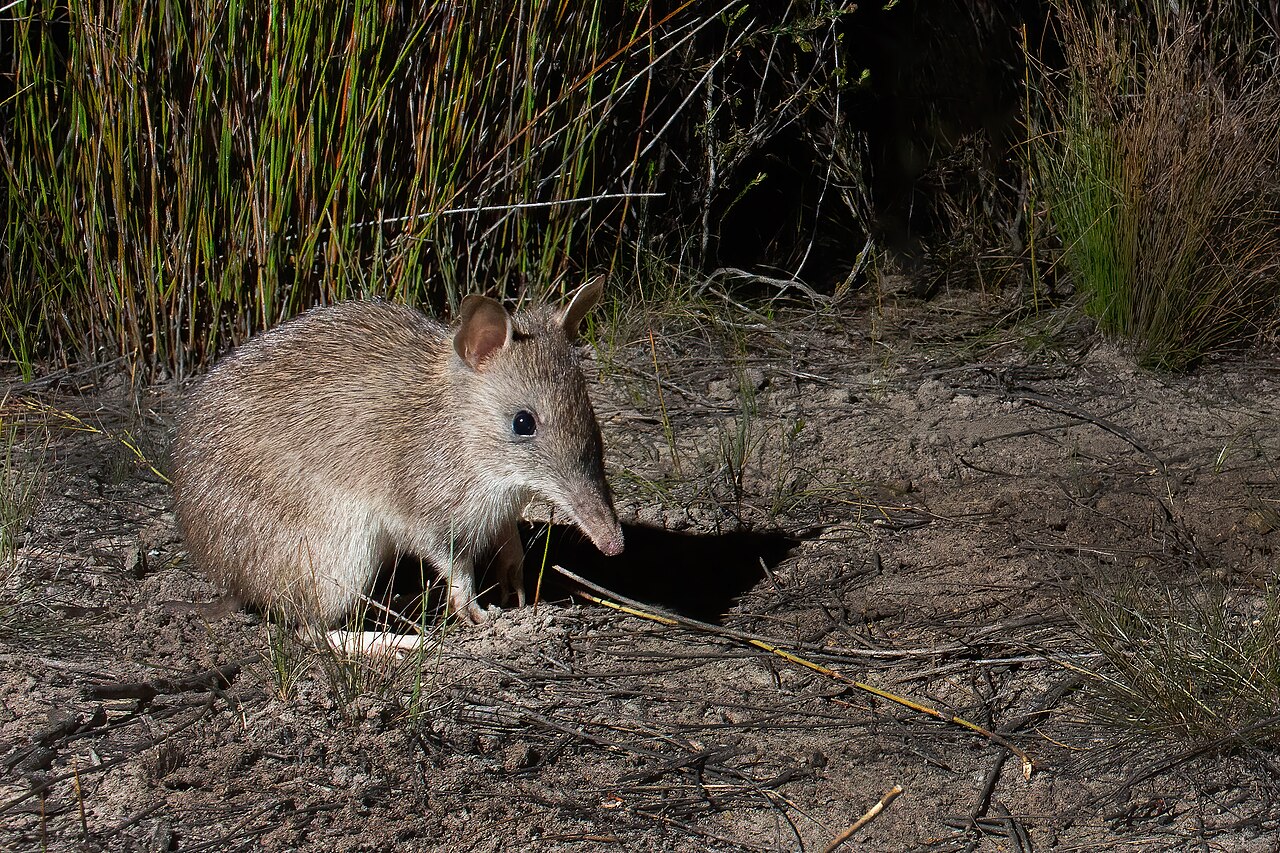
Adults are relatively small, with coarse fur that ranges from sandy to grey-brown. The most distinctive feature is the narrow, mobile snout used to pry and root in soil and leaf litter. Strong foreclaws and a compact, rounded body support a fossorial lifestyle, while a short tail and hind limbs adapted for quick movement make them effective at escaping predators over short distances. Bandicoots are primarily nocturnal and solitary foragers.
Distribution and habitat
Perameles nasuta is most common along the east coast of Australia, with populations recorded from Victoria north through Queensland. It also occurs on parts of Tasmania. Preferred habitats include open forest, heathland, coastal scrub and edges of rainforests where dense ground cover and leaf litter provide nesting sites and feeding opportunities. Individuals shelter in shallow nests of vegetation, hollow logs or abandoned burrows.
Behavior and diet
Long-nosed bandicoots are omnivorous foragers that use scent and touch to locate prey. Their diet typically includes insects, earthworms, small vertebrates, seeds and fungal material. Foraging activity turns over soil and leaf litter, making bandicoots important ecological engineers in their habitats. They are mainly nocturnal and rest by day in concealed nests.
Reproduction
As a marsupial, the long-nosed bandicoot has a brief gestation followed by a longer period of development in the pouch. It is noted for having one of the shortest gestation periods among mammals—often cited as about twelve days—and a relatively high capacity for reproduction compared with many other mammal groups. Litters may be small, but females can breed multiple times when conditions permit, a strategy that helps sustain populations in variable environments. For more on breeding biology see short gestation and high reproductive rate discussions in marsupials and mammals.
Threats and conservation
Long-nosed bandicoots face multiple threats from habitat clearance, fragmentation and modification for agriculture and urban development. Introduced predators such as foxes and feral cats prey on adults and juveniles, and competition and vegetation changes caused by introduced herbivores (for example, rabbits) can reduce cover and food resources. Road mortality is a further local problem where urban expansion has occurred. In some regions their status is of conservation concern; populations around Sydney have been listed as endangered under local conservation measures. Protective actions include habitat restoration, predator control and legal protection of remaining bushland corridors.
Human interactions and notable facts
- Long-nosed bandicoots are protected by wildlife legislation in many Australian states and territories and are the subject of local conservation programs.
- They play a useful ecological role by aerating soil and dispersing seeds while feeding on invertebrates, which helps control some pest species.
- Because several similar species are called long-nosed bandicoots, careful taxonomic identification is important for monitoring and management.
For field identification, local distribution and up-to-date conservation listings consult regional wildlife authorities and species recovery plans maintained by conservation agencies and research institutions (bandicoot family, east coast, Victoria, Queensland, Tasmania). Additional reading on reproductive biology and comparative mammalian gestation is available through resources discussing short gestation, high reproductive rate and general mammal life histories. Local conservation status and recovery information can be sought for regions such as Sydney where populations are formally listed.
Questions and answers
Q: What is a long-nosed bandicoot?
A: A long-nosed bandicoot is a small marsupial mammal that lives along the east coast of Australia from Victoria to Queensland and is found in forests and rainforests.
Q: How many species of long-nosed bandicoots are there?
A: There are four species of long-nosed bandicoots.
Q: Where do long-nosed bandicoots live?
A: Long-nosed bandicoots live in small hidden nests, in among shrubs, hollow logs, or old rabbit burrows.
Q: What is the gestation period of the long-nosed bandicoot?
A: The long-nosed bandicoot has the shortest gestation period of all mammals.
Q: How is the long-nosed bandicoot endangered?
A: Long-nosed bandicoots are endangered because the areas they like to live in have been cleared for farming or housing, and they are also hunted by dogs, cats, and foxes.
Q: Which animal has caused damage to the bandicoots' habitat?
A: Rabbits have eaten many of the plants and made it unsuitable for bandicoots.
Q: Are long-nosed bandicoots protected by law?
A: Yes, bandicoots are protected by law.
Related articles
Author
AlegsaOnline.com Long-nosed bandicoot (Perameles nasuta) Leandro Alegsa
URL: https://en.alegsaonline.com/art/59102
Sources
- species.wikimedia.org : Perameles nasuta
- faunanet.gov.au : "Long-nosed bandicoot"
- lamington.nrsm.uq.edu.au : "Long-nosed bandicoot"