
Long March (1934–1935)
Strategic retreat of Chinese Communist forces during 1934–1935 that preserved their leadership and became a founding episode of the People's Republic of China.
Overview
The Long March refers to the strategic, year-long withdrawal of Chinese Communist forces from their bases in the southeast toward a new stronghold in northwestern China between 1934 and 1935. This enforced relocation allowed the movement to escape encirclement by the Kuomintang (Nationalist) armies and to regroup. Traditional accounts describe a route of roughly 6,000 miles (about 9,600 km) traveled over roughly a year; modern scholarship notes that routes and distances varied and estimates differ. The episode has been central to the Communist Party’s self-image and narrative of survival.
Image gallery
5 Images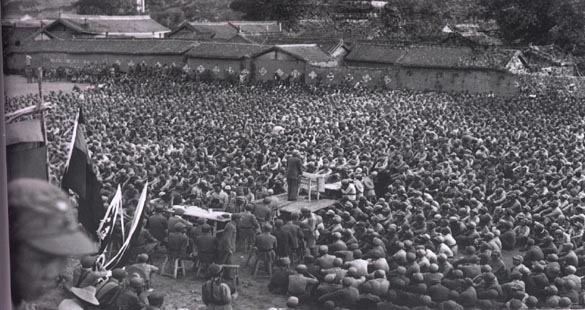


Background
Facing a series of military campaigns by the Nationalist government, Communist units abandoned their localized soviet areas to avoid annihilation. The withdrawal has been characterized as a retreat and strategic redeployment: the Communist leadership and units undertook a long, mobile campaign to preserve core personnel, weaponry and political organization. Key personalities associated with the march include Mao Zedong and other leaders who later assumed prominent roles. The operation unfolded against the larger context of the Chinese Civil War and rising Japanese aggression in East Asia.
Route, conditions and engagements
The journey was not a single continuous column but a series of intersecting marches by different Red Army units that later converged. Forces crossed rivers, high mountain ranges and marshlands, encountering hostile troops and difficult weather. Participants faced shortages of food, disease, and combat losses. Several dramatic episodes—such as contested river crossings and mountain passes—entered Communist lore. Historians note that while specific incidents are celebrated in party histories, some details remain debated.
- Terrain: mountains, swamps, and long stretches of undeveloped countryside.
- Climate: exposed to freezing altitudes and hot lowland marches, depending on route.
- Combat: frequent skirmishes with pursuing Nationalist forces and local militias.
Participants, numbers and leadership
Estimates of how many people began the march and how many completed it vary. Contemporary and later accounts give starting figures ranging from tens of thousands up to a few hundred thousand, and surviving contingents numbered in the low thousands. The attrition rate was severe. The movement of cadres and soldiers, however, preserved an organizational nucleus that later expanded. During and after the march, leadership struggles continued; the experience elevated certain figures within the party’s internal hierarchy.
Outcome and significance
The Long March is widely seen as a turning point because it allowed Communist forces to avoid complete destruction, to relocate to a remote base area in northwestern China, and to consolidate leadership and ideology. In subsequent decades it was commemorated as proof of revolutionary endurance and sacrifice. Militarily, it did not by itself defeat the Nationalists, but politically it helped unify and legitimize the Communist leadership, and it formed a powerful founding myth in later Communist propaganda and historical memory.
Contested aspects and legacy
Scholars debate precise figures, the scale of particular engagements, and the role of myth-making in shaping the Long March’s popular image. Some episodes are treated as heroic legend within official narratives, while historians continue to reassess logistics, casualty figures and strategic choices. The Long March remains a frequently cited reference in analyses of revolutionary movements, endurance under hardship, and the process by which military setbacks can be converted into political capital.
For contemporary summaries and further reading, see resources on the Long March, biographies of Mao Zedong and other commanders, studies of the Chinese Communist movement, and accounts of the opposing forces under Chiang Kai-shek and the Nationalist government.
Questions and answers
Q: What is the Long March?
A: The Long March is the retreat of Mao Zedong and the Communists in 1934-35.
Q: What was the goal of the Long March?
A: The goal of the Long March was for the Communists to retreat to their stronghold away from Chiang Kai-shek and the Nationalists, regroup, and start fighting again to beat the Nationalists.
Q: How long was the Long March?
A: The Long March was over 12,400 km in one year.
Q: How many people started the Long March and how many finished?
A: About 300,000 people started the Long March, and fewer than 10% finished.
Q: What was the survival rate of the Long March?
A: Only 8,000 out of 100,000 people survived the 6,000-mile trek over 370 days.
Q: Why did the survivors of the Long March become more dedicated?
A: The survivors became more dedicated because they had survived such a difficult trial together, which created a more cohesive group.
Q: Who emerged as a leader during the Long March?
A: Mao Zedong emerged as a leader during the Long March.
Related articles
Author
AlegsaOnline.com Long March (1934–1935) Leandro Alegsa
URL: https://en.alegsaonline.com/art/59099
Sources
- britannica.com : "Long March"